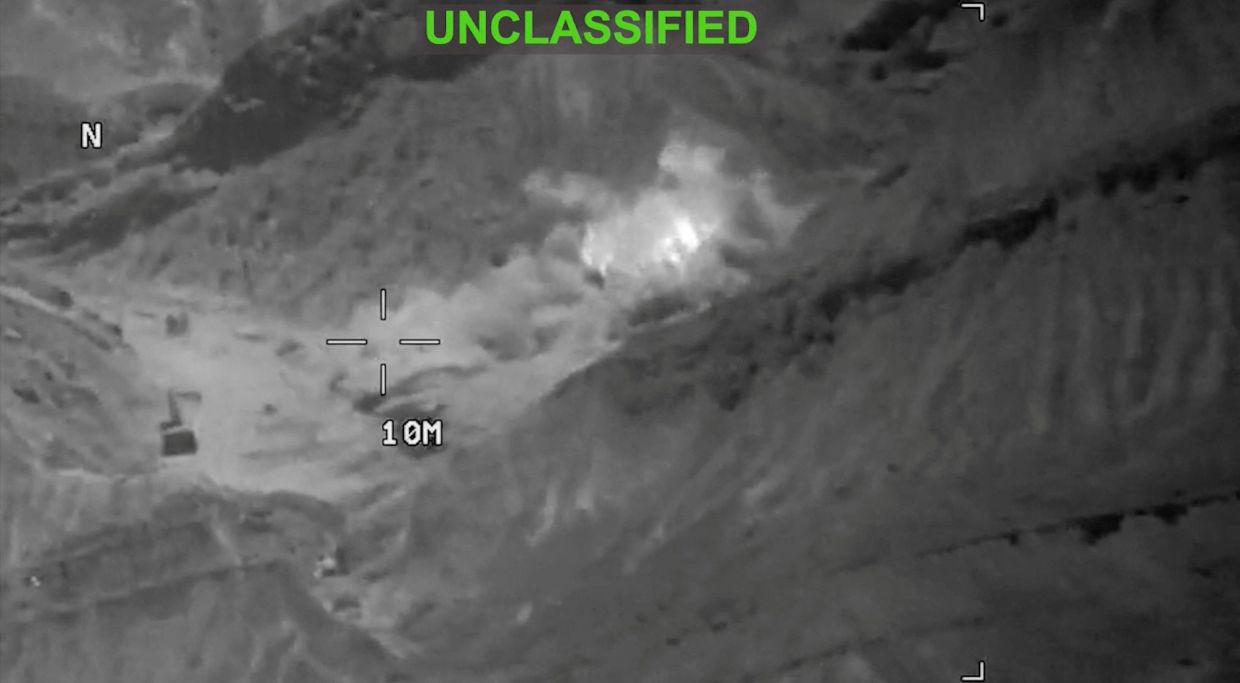
The United States has pressed ahead with sustained military operations against Iran, completing its eighth consecutive evening of coordinated airstrikes directed by President Donald Trump. The latest campaign was triggered by an Iranian attack on US military personnel stationed in Jordan that resulted in the deaths of two servicemen and left a third missing in action, according to US Central Command. This represents a significant acceleration in the tit-for-tat military exchanges between Washington and Tehran, shattering hopes for a brief respite following a ceasefire arrangement that had been in place for approximately one month before collapsing last week.
US Central Command announced that the eighth wave of strikes commenced at 6 p.m. Eastern Time on Saturday, with operations focused on degrading Iran's coastal surveillance infrastructure and air defense capabilities that threaten regional maritime commerce. The military statement emphasised that the strikes were specifically designed to target the Islamic Revolutionary Guard Corps units responsible for the preceding night's assault on American military installations. Beyond the immediate objective of retaliation, the broader campaign aims to restrict Iranian operational capacity in the strategically vital Strait of Hormuz, through which approximately one-fifth of the world's global oil trade transits annually.
The geographic scope of the American bombardment has been substantial, with confirmed strikes near Sirik in southern Iran and additional targets identified in the Shadegan area bordering Iraq. Perhaps most controversially, Iranian officials reported that American forces struck a site associated with a nuclear power plant under construction at Darkhovin, prompting a formal condemnation from Iran's Atomic Energy Organization. While Iranian state media outlets Mehr and Tasnim initially reported no casualties or infrastructure damage from these strikes, the targeting of nuclear-related facilities raises significant international legal and diplomatic questions about the scope of the current conflict.
In immediate response to the American airstrikes, Iran's military apparatus has launched coordinated drone and missile attacks against US military assets distributed across the Gulf region. Iranian state television reported early Sunday that unmanned aerial vehicles had targeted equipment and personnel at Kuwait's Al-Adiri camp and Ali Al Salem Air Base, locations that had already absorbed Iranian attacks throughout the preceding week. These retaliatory strikes underscored Tehran's determination to maintain escalatory pressure despite the American campaign's stated objective of disabling Iranian strike capabilities. Kuwait's military authorities confirmed they had again intercepted incoming Iranian missiles and drones on Sunday, while Bahrain's air defense systems similarly intercepted Iranian attacks, though neither nation reported casualties or material damage from these encounters.
The maritime dimension of this conflict has emerged as a critical flashpoint with direct implications for global energy security and shipping industries. The United States has characterised its recent military actions as enforcement of a naval blockade against Iran, effectively restricting Tehran's ability to project power through maritime commerce disruption. In response, Iran's Islamic Revolutionary Guard Corps has claimed to be implementing its own restrictions on shipping movements through the Strait of Hormuz, insisting that vessels must follow prescribed routes. The IRGC reported on Sunday that four commercial vessels attempted transit using what it deemed an unsafe corridor with American backing, resulting in two abandoning the effort and another two suffering unspecified accidents, though the military authority provided no elaboration on the nature of these incidents.
The human toll of this escalating conflict has become increasingly apparent. The US military has confirmed that two servicemen were killed on Friday in the Jordanian attack, bringing the total number of American military deaths since hostilities commenced to sixteen, with more than four hundred and twenty others wounded. These figures represent a substantial cost in human terms, particularly given the conflict's relatively recent inception. Iran's Health Ministry has provided competing casualty assessments, claiming that American strikes conducted over the preceding three weeks alone had killed fifty Iranians and wounded more than five hundred, though these figures remain difficult to independently verify given the fog of conflict and competing propagandistic claims from both sides.
The immediate political consequences have manifested in various regional locations. The US embassy in Jordan issued an evacuation order for Aqaba's international airport and seaport on Sunday, citing specific and credible threat assessments. However, Jordanian authorities subsequently disputed this characterisation, asserting they had detected no concrete threats in recent hours and had not themselves issued evacuation directives, suggesting potential friction between American and regional security evaluations. This discrepancy highlights the challenging coordination requirements when multiple nations face shared security concerns but possess different threat assessment methodologies and confidence levels.
Iranian Supreme Leader Ayatollah Mojtaba Khamenei issued a written statement late Saturday delivered through state media, declaring that American actions had demonstrated the fundamental unreliability of commitments made by President Trump, characterising his signature and pledges as lacking any meaningful credibility. The statement went further, warning of escalating consequences for the United States, promising what Khamenei described as "even heavier costs and further humiliation." This rhetoric reflects Tehran's determination to project strength despite absorbing sustained American military strikes, though notably Khamenei himself has remained absent from public view since before his predecessor and father, Ali Khamenei, was killed in the initial American-Israeli airstrike campaign launched on February 28. The supreme leader's disappearance from the public sphere has fueled speculation about his whereabouts and, implicitly, questions about the stability of Iran's political leadership structure during this critical period.
The original ceasefire agreement, which had briefly halted this conflict approximately one month prior, appears to have dissolved completely, creating a concerning vacuum where diplomatic off-ramps might previously have existed. The current phase of escalation raises genuine questions about whether either side retains sufficient incentive to pursue negotiated settlement, given the demonstrated capacity of both parties to absorb punishment while maintaining operational capability. For Southeast Asian observers and policymakers, particularly those concerned with energy security and maritime commerce, the ongoing turbulence in the Persian Gulf represents a persistent source of economic vulnerability, with crude oil price volatility directly influencing regional economies dependent on stable energy supplies.

