The USS Abraham Lincoln, returning from an extended deployment across the Middle East, is set to dock this week at Thailand's Laem Chabang port near the coastal resort city of Pattaya, carrying approximately 5,000 sailors and Marines who have spent over 200 days deployed. The arrival represents a significant moment for Thailand's tourism sector, which has struggled to recover its footing in recent years, though it simultaneously raises uncomfortable questions about the social costs of military shore leave in a destination historically dependent on sex tourism.
The aircraft carrier embarked from its home port in San Diego in November before being redirected to support military operations linked to the United States-Israeli conflict with Iran, establishing what Democratic lawmakers have characterized as a modern record for consecutive days at sea. The extended deployment has not been without consequence for personnel aboard, with recent reporting from military-focused outlets documenting troubling accounts of suicide attempts, declining morale, and broader mental health challenges among crew members. These conditions provide a complex backdrop to the anticipated shore leave, as sailors and Marines seek respite after months of confinement in a high-stress operational environment.
Local economic stakeholders in Pattaya have seized upon the visit as a potential catalyst for financial recovery. Mayor Poramase Ngampiches has estimated that individual service members could spend between 1,000 and 3,000 baht daily, equivalent to roughly $30 to $91, depending on the length of their shore time and whether they choose overnight stays. Importantly, shore leave typically operates on a rotation basis, preventing the simultaneous arrival of all personnel at once, which would distribute spending across several days. This staggered approach has prompted tourism officials to project meaningful near-term stimulus for Pattaya's substantial hospitality infrastructure, which comprises over 300,000 rooms.
The economic logic driving local enthusiasm is straightforward: Pattaya's tourism sector has languished, with Lisa Hamilton, president of the Pattaya Nightlife Business Association, remarking that she had not witnessed business activity as depressed in her two decades of residence in the city. The prospect of thousands of uniformed visitors with disposable income spending money on accommodation, food, beverages, and entertainment represents the kind of demand injection that struggling hospitality operators desperately need. Thanet Supornsahasrungsi, president of the Association of Chonburi Tourism Federation, has noted that the economic benefit will partly depend on how personnel distribute their spending, with some possibly travelling north to Bangkok rather than remaining in Pattaya.
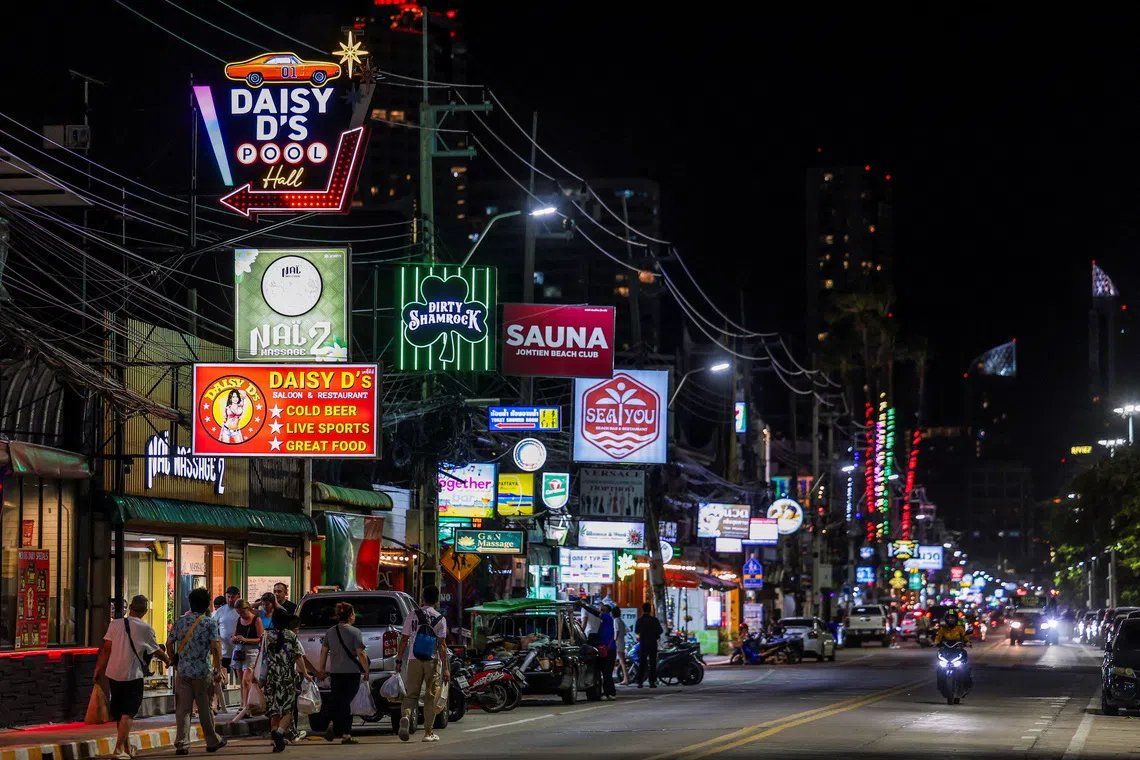
Yet beneath this economic calculus lies a more troubling reality that local and national authorities cannot ignore. Pattaya's transformation from a modest fishing village during the Vietnam War into a major international destination was substantially accelerated by American servicemen seeking recreation and, more notably, sexual services. Prostitution remains technically illegal throughout Thailand, yet the sex industry operates with remarkable visibility across major tourism zones, including swaths of Bangkok and, especially, the Pattaya waterfront and nightlife districts. The Federal Bureau of Investigation, in an assessment a decade ago, designated Pattaya as among the world's preeminent sex tourism destinations, a designation that reflects decades of entrenched networks and structures in the local economy.
In anticipation of the carrier's arrival, Thai police have mobilized additional patrols throughout Pattaya's beach and entertainment precincts, and coordinated weekend raids that resulted in the detention of between 40 and 50 individuals suspected of involvement in prostitution. Pattaya police chief Anek Srathongyoo acknowledged on Monday the fundamental challenge confronting law enforcement: sex workers operate with sufficient sophistication to solicit customers in public spaces while remaining largely invisible to authorities and operating without formal detection. The officer's candid admission that local law enforcement is doing its best but faces structural difficulties underscores the limits of enforcement-driven approaches to addressing demand-side sex tourism.
Academic researchers studying the intersection of tourism and sexual exploitation have articulated concerns specific to the current circumstances. Pipatpong Fakfare, an associate professor at Bangkok University's School of Humanities and Tourism Management, has emphasized that the sudden surge in visitors correlates measurably with increased likelihood of sexual exploitation and heightened prevalence of sexually transmitted disease transmission. Fakfare has also flagged the documented mental health crises aboard the aircraft carrier, noting that crew members experiencing stress, depression, or suicidal ideation may engage in riskier behaviour ashore, potentially compounding vulnerability among exploited populations.
The visit thus encapsulates a fundamental tension within Southeast Asian development and regional geopolitical engagement. Military alliances and the operational requirements of naval forces generate economic activity and currency inflow that local communities depend upon, yet these same dynamics historically correlate with the expansion of sex industries and human trafficking networks. The United States maintains substantial strategic interests in Thailand as a key Southeast Asian partner, and port visits serve to reinforce bilateral ties while providing operational rest for deployed personnel. Simultaneously, these visits perpetuate demand patterns that sustain exploitation networks serving women and children across the region.
Thailand's position as a critical hub within American security architecture in Asia means that curtailing military visits is neither politically viable nor strategically desirable from Bangkok's perspective. Yet the concentration of temporary demand for sexual services within compressed timeframes risks overwhelming local law enforcement capacity and emboldening trafficking networks to expand supply. The challenge for Thai policymakers involves managing an inherent contradiction: welcoming the economic and geopolitical benefits of military cooperation while genuinely constraining the harms associated with sex tourism demand.
The Lincoln's docking represents, in microcosm, the regulatory and moral complexities confronting modern Thailand. Economic desperation, particularly acute in hospitality sectors struggling with reduced international arrivals, creates powerful incentives to accommodate military tourism. Simultaneously, Thailand's stated commitments to combating human trafficking and sexual exploitation—commitments enshrined in international agreements and domestic law—require consistent enforcement and prevention strategies. The upcoming days will demonstrate whether Pattaya and Thai national authorities can navigate this tension constructively, providing respite for service members while meaningfully limiting the expansion of exploitation networks that have defined the city's economy for generations.

