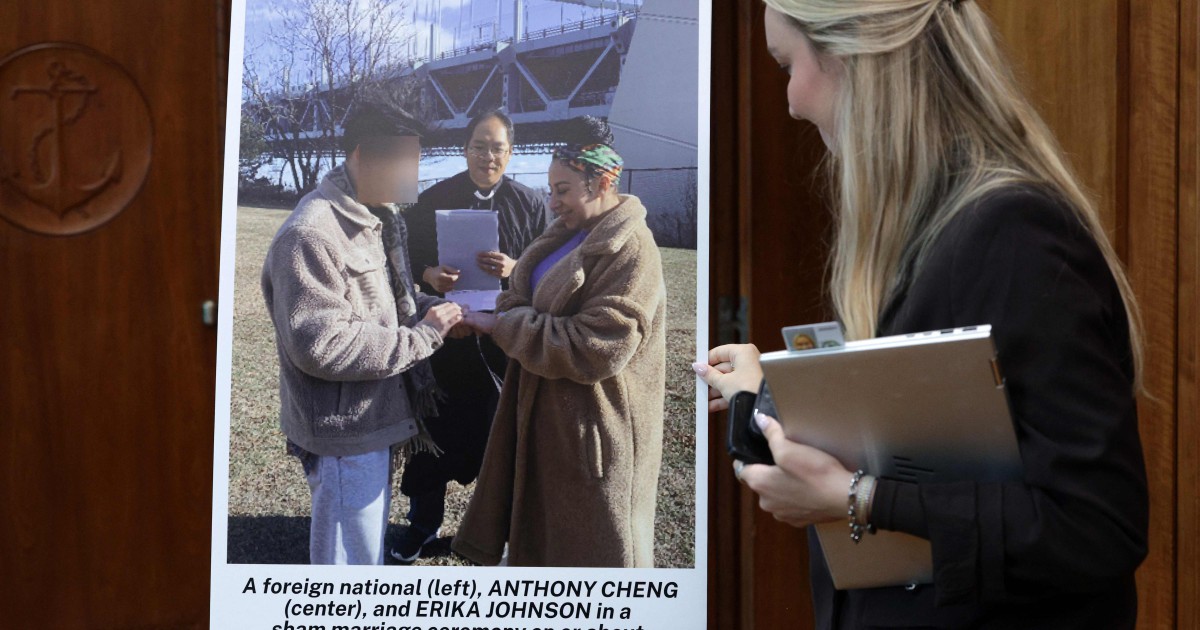
The United States Justice Department on Wednesday unsealed charges against 11 defendants accused of operating one of the country's most extensive sham marriage operations, with court filings detailing a sophisticated scheme spanning an entire decade that facilitated approximately 1,000 fraudulent unions. The network primarily targeted Chinese nationals seeking to circumvent standard immigration procedures and obtain legal residency status in the United States, according to documents made public through federal courts.
The scale of this operation underscores a persistent vulnerability within American immigration enforcement, where marriage—traditionally one of the quickest pathways to permanent residence—remains susceptible to exploitation by organized networks. The fact that prosecutors could identify and prosecute such a sprawling conspiracy suggests law enforcement agencies have intensified scrutiny of marriage-based immigration applications, a category that accounts for a substantial portion of US permanent resident visas annually. The charges arrive amid mounting political pressure on immigration enforcement following executive action from the Trump administration targeting what officials have termed "birth tourism" and other forms of immigration deemed circumventive.
Sham marriage schemes represent a distinct category of immigration fraud that differs fundamentally from human smuggling or document forgery. These arrangements typically involve creating genuine legal marriages between a foreign national and a US citizen or permanent resident for the explicit purpose of enabling immigration benefits, with participants either paid substantial fees or coerced through debt arrangements. The parties involved rarely establish genuine marital relationships and frequently divorce once immigration status has been secured and processed through the appropriate government agencies.
For Malaysian readers particularly, this case carries relevance beyond academic interest in American law enforcement. Southeast Asia, with its substantial populations of citizens seeking employment and education opportunities abroad, regularly witnesses targeting by international immigration fraud networks. The mechanisms described in this prosecution—coordination between domestic and overseas recruiters, maintenance of client databases, systematic documentation falsification, and fee collection—mirror patterns observed across the region affecting Malaysian, Thai, Indonesian, and Filipino nationals attempting migration to wealthy nations.
The operation's longevity—persisting across an entire decade—suggests that detection mechanisms at US immigration authorities were either inadequately developed or insufficiently resourced until relatively recently. Immigration marriage fraud investigations require substantial investigative capabilities, including cross-referencing marriage records, analysing relationship timelines, and conducting interviews with suspicious couples. The capacity to sustain 1,000 fraudulent marriages without immediate detection points to either systemic gaps in vetting procedures or the sophistication of those managing the scheme in creating superficially credible documentation and maintaining operational security.
Chinese nationals have historically represented a significant portion of marriage fraud schemes targeting the United States, partly reflecting the sheer volume of Chinese immigration applications and partly owing to established networks and intermediaries operating between major Chinese cities and American destinations. These networks often recruit willing US citizens to enter marriages, frequently offering compensation ranging from several thousand to tens of thousands of dollars per transaction. Some recruits participate willingly in exchange for payment, while others may be manipulated through debt bondage or coercion by criminal organisations.
The timing of these charges, coinciding with executive attention to immigration enforcement and the Trump administration's stated focus on closing what it characterises as loopholes in the system, reflects broader political momentum around stricter immigration policies. "Birth tourism," the targeted phenomenon referenced in the charging announcement, refers to instances where foreign nationals travel to the United States while pregnant to give birth, thereby conferring citizenship on the child through birthright provisions in the Constitution. While technically distinct from marriage fraud, both fall within the category of immigration-related activities that current policymakers view as exploitative and requiring legislative or enforcement correction.
The prosecution may catalyse broader systemic changes to marriage-based immigration applications, including enhanced biographical verification, increased interview requirements, and greater information-sharing between domestic law enforcement and immigration authorities. Such reforms could substantially lengthen processing times for legitimate marriage-based immigration cases, potentially affecting numerous couples with genuine relationships seeking to establish permanent residence through lawful channels. This collateral consequence—making legitimate immigration more cumbersome—represents an unintended but foreseeable outcome of cracking down on fraud.
The scheme's existence also highlights the continuing demand for alternative immigration pathways among individuals who either lack qualifying credentials for employment-based visas or cannot meet financial requirements for investor immigration categories. This demand-supply dynamic, where restrictive official immigration policies meet individuals motivated to immigrate through any available means, creates recurring opportunities for smugglers and fraudsters. Without expanding legitimate immigration channels or addressing root causes of outmigration, prosecution efforts alone cannot eliminate fraud entirely.
For immigration practitioners across Southeast Asia, this case serves as cautionary evidence that American authorities possess increasingly sophisticated investigative tools and demonstrated willingness to pursue complex, multinational immigration fraud schemes. Anyone considering irregular migration pathways or engaging with intermediaries offering swift immigration solutions should recognise that such schemes carry substantial legal consequences, including criminal prosecution, deportation, and permanent immigration bars even to family members.
The 11 individuals charged face potential prison sentences and substantial fines if convicted, setting a precedent for future prosecutions. Law enforcement agencies have indicated that the investigation remains ongoing, suggesting additional charges may follow. For genuine immigrants navigating legitimate channels and contributing positively to American society, the strengthened enforcement may paradoxically complicate their pathways through increased scrutiny and extended processing delays, illustrating the broader tensions within immigration policy between security, enforcement, and facilitating legitimate migration.

