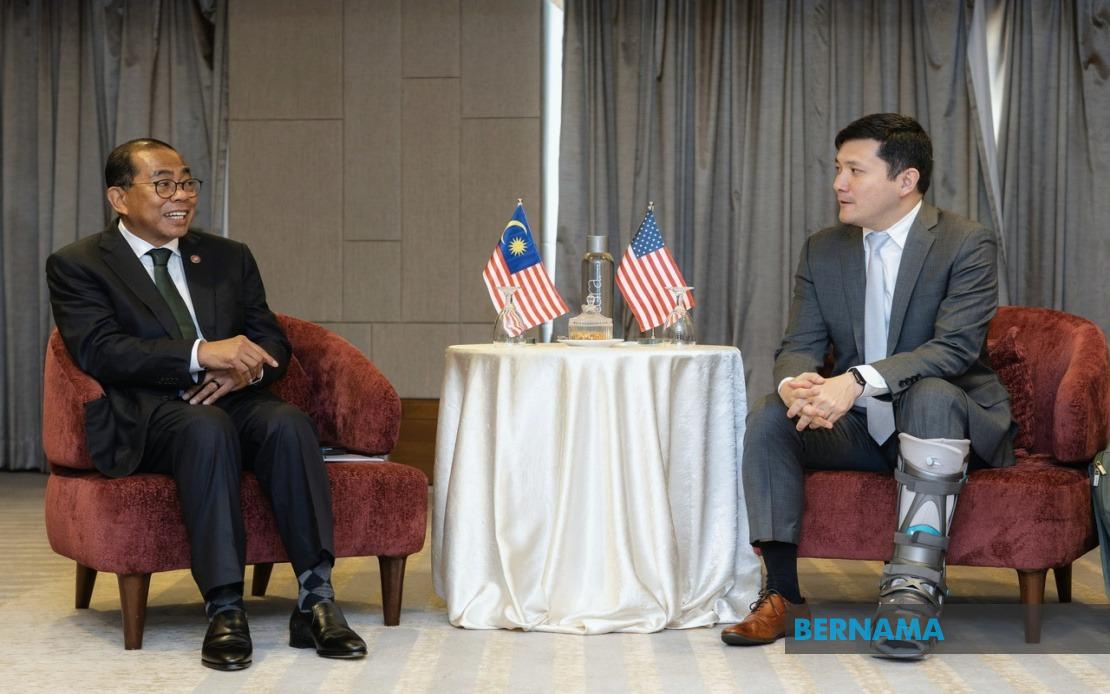
Malaysia's Defence Minister Datuk Seri Mohamed Khaled Nordin has confirmed that the United States intends to deepen its defence partnership with the country, following a courtesy meeting with US Ambassador to ASEAN Kevin Kim during the 37th Annual Military Law and Operations Conference currently underway in Kuala Lumpur. The exchange underscores Washington's continued strategic interest in maintaining robust security ties across Southeast Asia, a region increasingly vital to broader Indo-Pacific security architectures.
During their discussion, the two officials explored avenues for expanding existing defence cooperation frameworks without delving into specific policy deliberations. Mohamed Khaled indicated that the meeting centred on reinforcing the foundation of the bilateral relationship, with both parties recognising the mutual benefits of closer military and strategic alignment. The timing of the engagement, coinciding with a major regional military law and operations conference, reflects the structured and institutionalised nature of Malaysia-US defence interactions.
Beyond his engagement with the American envoy, Mohamed Khaled also received separate courtesy visits from two other distinguished figures actively shaping regional security architecture. ASEAN Secretary-General Dr Kao Kim Hourn used the occasion to exchange perspectives on challenges confronting the 10-member bloc, while Singapore's newly appointed Permanent Secretary for Defence Joseph Leong signalled Singapore's intention to intensify cooperation with Malaysia at multiple levels.
The discussions with the ASEAN Secretary-General proved particularly substantive, focusing on how defence establishments across the region can better support ASEAN Centrality—a foundational principle emphasising the bloc's central role in regional affairs. Both officials acknowledged that defence ministries possess considerable leverage in advancing collective security objectives while promoting stability and prosperity across Southeast Asia. This conversation assumes heightened importance amid rising geopolitical tensions in the South China Sea and broader concerns about regional power competition.
Singapore's commitment to closer defence cooperation, articulated through Joseph Leong's visit, encompasses both bilateral Malaysia-Singapore relations and the broader multilateral frameworks that bind the two nations together. Particularly significant is Singapore's emphasis on strengthening ties through the Five Power Defence Arrangements, a long-standing security mechanism involving Malaysia, Singapore, Australia, the United Kingdom, and New Zealand. This arrangement has proven crucial for maritime security and coordinating responses to transnational threats across Southeast Asia.
The 37th MILOPS conference itself represents a significant gathering of military and governmental representatives from over 30 nations converging in Kuala Lumpur through August 6. The conference's focus on regional security challenges and the legal dimensions of military operations provides crucial platforms for fostering understanding among diverse participants. For Malaysia, hosting such a prestigious gathering enhances its regional diplomatic standing while allowing senior defence officials direct access to counterparts from major powers and neighbouring nations.
Malaysia's strategic position has acquired heightened importance to major powers seeking to maintain influence in Southeast Asia. The country's location along critical maritime trade routes, its growing defence capabilities, and its balanced approach to great power relations make it an attractive partner for both Western powers like the United States and rising Asian powers. The US commitment to defence ties reflects broader Washington strategy to sustain engagement in a region where Chinese influence has expanded considerably in recent years.
The emphasis on strengthening defence sector contributions to ASEAN stability marks a shift in how regional security is conceptualised. Rather than viewing military cooperation purely through bilateral lenses, Malaysian and regional officials increasingly situate defence partnerships within frameworks promoting collective security and rules-based regional orders. This approach proves especially relevant given the prevalence of maritime disputes and the need for coordinated responses to transnational challenges including piracy, human trafficking, and terrorism.
For Malaysian readers, these developments carry practical implications for national security strategy and defence modernisation. Enhanced US defence ties could facilitate technology transfer, joint training opportunities, and improved intelligence sharing on regional threats. Simultaneously, deepening ASEAN-level defence cooperation ensures Malaysia maintains influence over collective regional responses rather than finding itself sidelined in security matters affecting its immediate neighbourhood.
The convergence of high-level bilateral defence discussions with broader ASEAN-level strategic dialogue suggests a recognition among regional and international actors that sustainable peace requires institutionalised cooperation mechanisms and regular engagement at multiple levels. As regional tensions persist and new challenges emerge, Malaysia's capacity to cultivate strong defence relationships while promoting stability through multilateral frameworks becomes increasingly consequential for both national and regional security.

