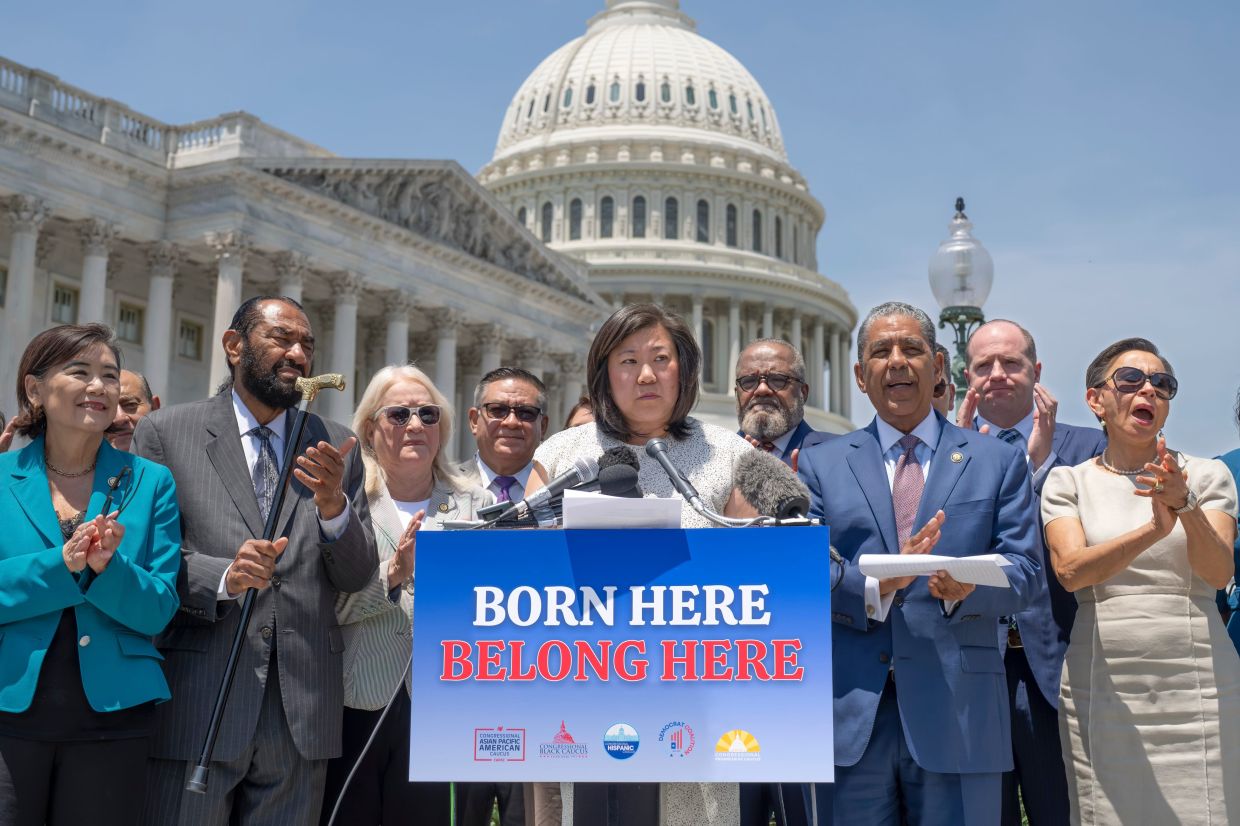
The US Supreme Court has delivered a significant blow to one of Donald Trump's flagship immigration policies, ruling 6-3 that children born on American soil to undocumented parents or those holding temporary visas retain full citizenship rights. The decision in Trump vs Barbara overturns an executive order Trump signed in early 2025, which would have fundamentally altered more than a century of established American citizenship law. The ruling represents a major setback for the Trump administration's hardline immigration agenda and has implications far beyond US borders, particularly for immigrant communities across Southeast Asia and the broader Asian diaspora.
Trump responded to the Supreme Court's decision with characteristic defiance, congratulating China on what he characterised as their "massive Birthright Citizenship WIN" while simultaneously pledging to pursue legislative alternatives. The President took to social media to declare the ruling "too bad" for America, insisting that Congress could reverse it through legislation rather than the lengthy constitutional amendment process. His rhetoric appeared designed to frame the decision as a victory for foreign interests, particularly China, as he shifted focus toward potential congressional action to restrict birthright citizenship through statutory means rather than constitutional interpretation.
The scope of Trump's blocked executive order was notably broader than the standard immigration debate might suggest. Rather than targeting only children born to undocumented immigrants—the population typically referenced in birthright citizenship discussions—the order would have stripped citizenship from children of lawfully present temporary residents. This encompassed highly skilled workers on H-1B and L-1 visas, international students, individuals on dependent visas, temporary labour permits, and achievement visa holders. Only children with at least one American citizen parent would have retained birthright citizenship under the proposed framework. The distinction between unlawful presence and lawful temporary status became central to understanding how radical the executive order actually was, targeting populations often invisible in mainstream immigration debates.
Chief Justice John Roberts articulated the Court's constitutional reasoning in unequivocal terms, grounding the majority opinion in both historical principle and modern constitutional understanding. He wrote that citizenship represents "the right to have rights—to freely participate in our political community," and that the Framers of the 14th Amendment extended that promise to "every free-born person in this land." This framing reconnected contemporary birthright citizenship law to its origins in the aftermath of the Civil War, when Congress enacted the 14th Amendment's Citizenship Clause in 1866 and the states ratified it in 1868 specifically to protect the rights of formerly enslaved persons and other marginalised communities. The Court's reasoning emphasised continuity with founding principles rather than innovation.
The legal precedent underpinning modern birthright citizenship dates to 1898, when the Supreme Court decided Wong Kim Ark's case—a landmark ruling that resonated powerfully through Tuesday's decision. Wong, the American-born son of Chinese immigrants, had been denied re-entry to the United States following a visit to China, with immigration officials arguing he lacked citizenship because of his parents' status under the Chinese Exclusion Act. The Supreme Court's determination that Wong held automatic birthright citizenship established a principle that survived not only the Chinese Exclusion Act but also the era of Jim Crow segregation. More than a century later, Wong Kim Ark's descendants praised the Court's reaffirmation of his legacy, with his great-grandson Norman Wong observing that his ancestor, "one man, only a cook," had stood up for fundamental rights that benefited all Americans.
The historical resonance of the decision particularly registered with Asian-American advocacy groups, who recognised in the 14th Amendment's protection the legal foundation enabling their communities' growth and political integration. Stop AAPI Hate emphasised that birthright citizenship had directly shaped America's demographic and political evolution, allowing Asian-American and other communities of colour to expand their numbers and increase political representation. The organisation explicitly connected Wednesday's ruling to the Trump administration's evident targeting of Asian-American communities through birth tourism allegations and the broader immigration restriction agenda. For Malaysian and Southeast Asian readers, the case illustrated how citizenship laws in Western democracies carry profound implications for diaspora communities and immigration patterns across the region.
Birth tourism—the practice of pregnant women travelling to the US specifically to deliver children and secure automatic citizenship—emerged as a central rhetorical focus for Trump administration officials, with Chinese nationals repeatedly cited as primary participants in such schemes. The US Department of Justice responded to the Court's decision by directing federal prosecutors to prioritise birth tourism investigations, with Justice Department officials pledging to "zealously protect the sanctity of United States citizenship." Officials referenced a 2024 case involving Michael Wei Yueh Liu and Jing Dong, who had operated a birth tourism scheme charging Chinese clients tens of thousands of dollars to facilitate American births. This enforcement emphasis suggested the Trump administration intended to pursue birth tourism prosecutions as a workaround to the Supreme Court's constitutional ruling.
Trump's Solicitor General, D. John Sauer, had argued during April's oral proceedings that birthright citizenship had spawned "a sprawling industry of birth tourism," with "uncounted thousands of foreigners from potentially hostile nations" travelling to the US for deliveries. This framing—linking citizenship access to national security concerns and portraying birth tourism as a systemic threat—resonated with broader Trump administration rhetoric connecting immigration restriction to American safety and sovereignty. However, the Supreme Court majority rejected this security-based argument as insufficient grounds for overriding a constitutional guarantee rooted in the 14th Amendment's text and purpose.
The Court's decision occurred amid rising political polarisation over immigration in the United States, with birthright citizenship representing a wedge issue Trump's campaign had weaponised. Restricting citizenship eligibility became a cornerstone of Trump's second-term agenda, reflecting his administration's broader strategy of using executive orders to reshape immigration policy prior to seeking legislative support. The executive order was scheduled to take effect in 2025 but faced immediate legal challenges that ultimately reached the Supreme Court within months. The rapid judicial progression underscored the constitutional stakes involved and the urgency with which civil rights organisations and immigrant advocacy groups mobilised against the policy.
For Malaysia and Southeast Asia, the Supreme Court's decision carried particular significance given substantial populations of Southeast Asian temporary workers, students, and professionals in the United States. Many Southeast Asians working in American companies on H-1B visas or pursuing advanced education would have fallen within the scope of Trump's blocked citizenship restriction had the executive order survived judicial review. The ruling affirmed that children born to these workers would retain automatic citizenship despite their parents' temporary visa status, providing legal certainty to families navigating US immigration law.
Crish O'Mara Vignarajah of Global Refuge, a nonprofit organisation serving refugee populations, framed the Supreme Court's decision as birthright citizenship's survival of successive historical threats. The principle had endured the Chinese Exclusion Act and Jim Crow segregation, and now survived what Vignarajah characterised as an executive order that would have "essentially turned the maternity ward into a customs checkpoint." This vivid formulation captured the everyday implications of citizenship restrictions, moving beyond abstract constitutional debate to the practical reality of how such policies would operate within American hospitals and medical facilities.
Trump's response indicated his determination to pursue citizenship restrictions through alternative constitutional channels, specifically congressional legislation. He claimed that no lengthy constitutional amendment process would be necessary and that Congress could easily accomplish through statute what the courts had forbidden through executive action. This suggested that the political battle over birthright citizenship would continue in the legislative arena, even as the Supreme Court had definitively settled the constitutional question for the present moment. The ongoing political contestation underscored how closely immigration policy remained intertwined with American partisan division.

