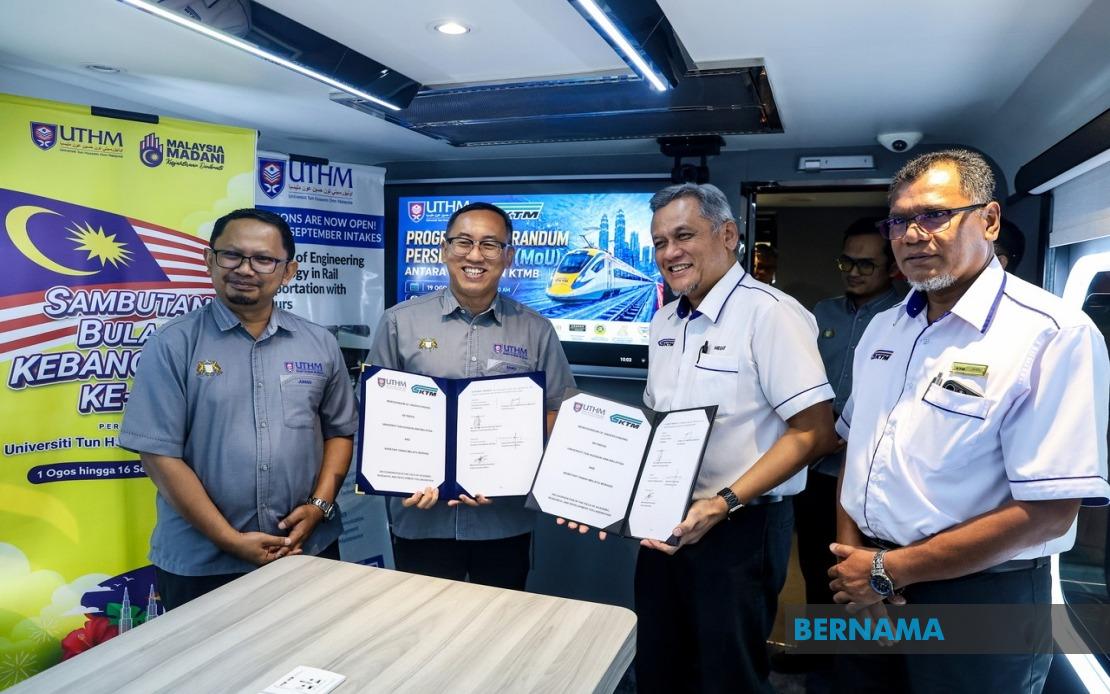
Universiti Tun Hussein Onn Malaysia (UTHM) and Keretapi Tanah Melayu Bhd (KTMB) have formalised an expanded three-year collaboration spanning October 2026 to July 2029, marking a significant deepening of their longstanding commitment to advance rail technology and engineering excellence. The partnership, which builds upon an original agreement established in 2019, encompasses work-based learning initiatives, joint research endeavours, professional competency development and systematic knowledge exchange between the academic institution and Malaysia's national railway operator. This extended engagement reflects growing recognition within both organisations that addressing the nation's infrastructure and transportation challenges requires sustained dialogue between universities and industry practitioners.
The collaboration represents a deliberate strategy to cultivate a skilled workforce capable of meeting contemporary demands within Malaysia's expanding rail sector. Prof Dr Mas Fawzi Mohd Ali, UTHM's vice-chancellor, explained that the renewed partnership directly supports the university's Global Technopreneur University 2030 (GTU2030) vision, which seeks to embed innovation, entrepreneurial thinking and technological advancement throughout its educational programmes. By positioning students within actual railway operations through structured work-based learning, the institution aims to bridge the persistent gap between theoretical instruction and practical industrial application. This pedagogical approach proves increasingly essential as Malaysia invests substantially in rail infrastructure modernisation and expansion projects that demand engineers with both academic grounding and operational familiarity.
Work-based learning constitutes the partnership's cornerstone, providing UTHM students with direct engagement in rail operations, technological systems and real-world industry challenges. Rather than limiting exposure to classroom environments and laboratory settings, students now gain extended immersion within KTMB's operational ecosystem, observing how engineering principles translate into daily railway management. This experiential dimension allows students to comprehend not merely technical specifications but the organisational contexts within which engineering decisions operate. The scheme particularly benefits students enrolled in UTHM's Bachelor of Rail Transportation Engineering Technology with Honours programme, which has already produced nearly 200 graduates who have secured positions throughout Malaysia's rail industry and internationally, including postings in Singapore and Saudi Arabia.
The measurable track record from the original 2019 agreement underscores the partnership's effectiveness. These graduates now occupy roles across KTMB operations and affiliated railway enterprises, suggesting that the programme successfully prepares engineers for industry transition. Students who previously participated reported enhanced capacity to apply theoretical knowledge to practical problems, accelerated development of technical and professional competencies, and superior preparation for workforce entry. This progression from classroom to employment represents precisely the outcome that Malaysian educational institutions increasingly target, particularly as graduate employability concerns persist across multiple sectors.
Research collaboration forms a second critical dimension of the partnership. UTHM will leverage its academic research capabilities, laboratory facilities and faculty expertise in partnership with KTMB's accumulated operational data, field experience and technical knowledge. This combination positions both organisations to address persistent technical challenges affecting train systems and rail infrastructure with solutions grounded in both theoretical rigour and practical feasibility. Malaysian rail operations face ongoing pressures regarding maintenance efficiency, modernisation timing, safety protocols and technological integration—challenges that academic inquiry combined with operational insight can address more effectively than either institution pursuing solutions independently. The resulting research outputs may extend beyond immediate KTMB requirements to inform broader Southeast Asian rail development discourse.
Megat Khairulazhar Khairodin, KTMB's chief corporate officer, articulated the railway operator's perspective, emphasising that the collaboration grants KTMB access to academic expertise, sophisticated research infrastructure and specialised knowledge repositories that would prove costly and time-consuming to develop internally. This mutual benefit arrangement ensures that resource investment serves both parties' strategic interests. KTMB simultaneously gains consultation support for curriculum development across its own MyRA academy programmes, which offer diploma, bachelor's and postgraduate qualifications in rail transportation engineering technology. This alignment between UTHM's academic pathways and MyRA's professional offerings creates integrated talent pipelines that strengthen sector-wide capability.
Competency development activities extending beyond traditional classroom instruction represent an additional partnership component. The arrangement encompasses academic site visits that expose students to infrastructure, operational procedures and technological systems; industry forums that bring practitioners into dialogue with students and faculty; and targeted skill-building workshops addressing identified sectoral needs. These structured engagements create multiple exposure points where academic and professional communities interact and learn from one another. Furthermore, KTMB has already committed five staff members to pursue master's-level qualifications in rail-related fields through UTHM, demonstrating the railway operator's recognition that continuing professional development within academic environments generates valuable returns for organisational capacity.
The document exchange ceremony, conducted aboard a KTMB chartered train travelling between Kluang Station and KL Sentral, itself symbolised the partnership's significance. The event coincided with celebrations marking Rel Merdeka 69 and Malaysia's 69th National Month, contextualising the collaboration within broader national development aspirations. Such ceremonial framing, while sometimes dismissed as mere symbolism, nonetheless signals governmental and institutional commitment to infrastructure sectors and human capital development—commitments that shape organisational priorities and resource allocation decisions.
For Malaysia's broader economic positioning, this partnership carries implications extending beyond the rail sector alone. As Southeast Asian economies compete increasingly on technological sophistication and infrastructure capability, the quality of engineering talent becomes decisive. Partnerships linking universities with infrastructure operators create domestic capacity to absorb, adapt and innovate upon global technologies rather than remaining perpetually dependent upon imported expertise. The UTHM-KTMB model offers a replicable template for other sectors—ports, airports, utilities, telecommunications—where similar academic-industrial collaboration could strengthen competitive advantage and reduce long-term operational costs.
The extended timeline through July 2029 provides sustained commitment that permits development of mature collaborative structures. Unlike short-term arrangements that often falter as initial enthusiasm wanes, this three-year extension allows both organisations to invest in institutional relationships, data-sharing protocols, research infrastructure modifications and curricular refinements that genuinely embed collaboration into regular operations. Such deep integration increases likelihood of sustained benefits persisting beyond formal agreement expiry. As Malaysia continues investing in rail network expansion, modernisation and technological integration, the availability of engineering talent trained through authentic industry partnership will prove increasingly valuable in translating infrastructure ambitions into operational reality.

