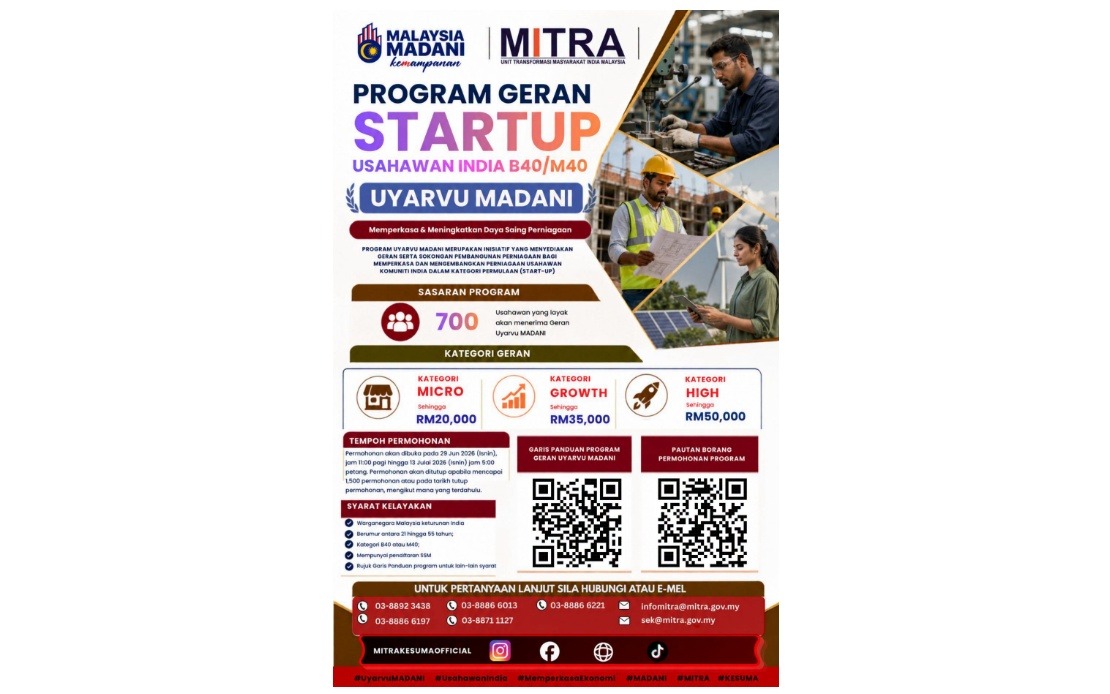
The Malaysian Indian Transformation Unit has launched applications for its Startup Accelerator Grant Assistance Programme, known as Uyarvu MADANI, beginning today and running through 5 pm on July 13. The initiative represents a significant opportunity for entrepreneurs from the Indian community seeking financial support and business development resources to establish or expand their ventures.
Eligibility for the programme is restricted to entrepreneurs from the Indian community whose household income falls within the B40 and M40 income categories, reflecting the government's commitment to economic inclusion among lower and middle-income groups. Successful applicants will receive grants ranging from RM20,000 to RM50,000, providing meaningful capital for business launch or scaling operations. The financial assistance is designed to address barriers that entrepreneurs from less privileged backgrounds typically encounter when seeking startup funding through conventional channels.
The programme aims to support approximately 700 entrepreneurs across Malaysia through a combination of direct grant assistance and tailored business development support. This two-pronged approach acknowledges that financial capital alone is insufficient for sustainable entrepreneurial success. Selected recipients will gain access to mentorship, training, and operational guidance to enhance their business competitiveness and improve their prospects for long-term profitability and market sustainability.
Uyarvu MADANI represents one of six new initiatives introduced by MITRA specifically for 2026, indicating a broadening of support mechanisms for the Indian community. The total allocation across these six programmes reaches RM65.5 million, demonstrating substantial government investment in community economic development. This integrated approach suggests recognition that entrepreneurship serves as a pathway for community members to build wealth, create employment opportunities, and contribute to broader economic growth.
The application window operates on a first-come, first-served basis with an important caveat: the deadline will close earlier if the programme receives 1,500 applications before the July 13 cutoff date. This mechanism ensures manageable programme administration while creating urgency for prospective applicants. Entrepreneurs interested in participating must therefore prepare their applications promptly to secure their place, as popular programmes often reach capacity well before official closing dates.
For Malaysian readers unfamiliar with MITRA's operations, the unit functions as a dedicated agency focused on advancing the social, economic, and educational interests of the Indian community. MITRA's expansion of grant programmes reflects shifting policy approaches toward targeted economic intervention for specific demographic groups. This represents a departure from more general small business support schemes, acknowledging that particular communities face distinct barriers requiring customized solutions.
The timing of this programme launch during mid-year allows entrepreneurs to establish businesses before the year-end holiday period, potentially maximizing their operational runway and cash flow projections during the critical first year. Startups launched in June or July can navigate through the monsoon season and reach commercial traction by the following quarter, positioning them favourably for sustainable growth.
For Malaysian entrepreneurs more broadly, the Uyarvu MADANI programme illustrates how targeted grants can supplement traditional financing options like bank loans and investor capital. The emphasis on business development support alongside grants reflects international best practices in startup acceleration, where coaching and mentorship significantly improve venture survival rates. Similar programmes operated by other community-focused organizations and government agencies may soon follow this model.
Prospective applicants should note that while the grant amounts are modest compared to venture capital, they serve as sufficient seed capital for service-based businesses, small manufacturing operations, or retail ventures. The grant ceiling of RM50,000 aligns with typical startup costs for these business categories in Malaysia, particularly when combined with personal contributions and in-kind resources from founders.
The Uyarvu MADANI scheme also signals government recognition of entrepreneurship's role in poverty alleviation and community economic mobility. By providing access to capital that lower and middle-income entrepreneurs struggle to secure through conventional means, the programme removes a critical barrier that prevents capable individuals from establishing income-generating ventures. This approach complements broader social safety net initiatives by enabling rather than merely sustaining communities.
Entrepreneurs considering application should gather financial documentation, business plans, and personal identification in advance, as the compressed application timeline through July 13 requires swift submission once applications commence. Given the 1,500-application cap before closure, prospective participants should prioritize completing their applications early to avoid disappointment if the programme reaches capacity. Detailed application guidelines and support information should be available through MITRA's official channels and participating government offices throughout Malaysia.

