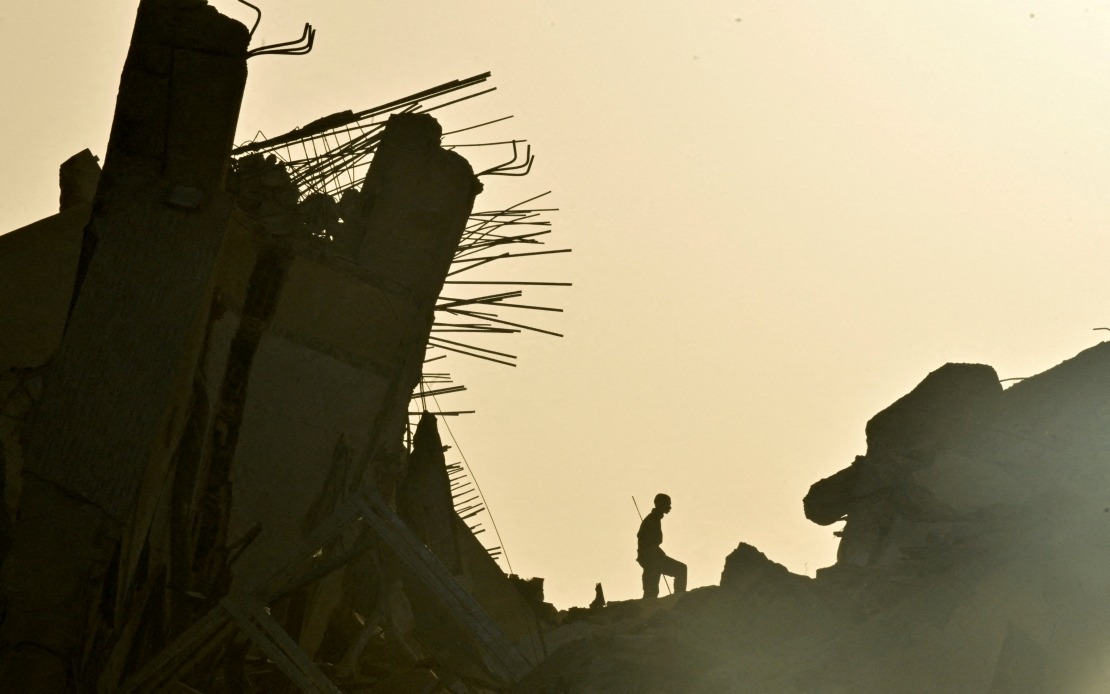
Venezuela is grappling with a catastrophic humanitarian crisis following back-to-back earthquakes that struck the nation on Wednesday, leaving at least 1,450 people dead and more than 3,200 injured, according to statements from the country's National Assembly President Jorge Rodríguez. The twin tremors, measuring magnitudes 7.2 and 7.5 respectively, have unleashed one of the region's worst natural disasters in recent years, with rescue operations now extending into a fourth day as the critical window for finding survivors rapidly closes.
The seismic activity has continued unabated, with authorities confirming that 430 aftershocks have rattled the affected regions since the initial quakes struck. This persistent seismic instability poses considerable challenges to rescue operations, forcing teams to work with heightened caution whilst searching through unstable rubble. The coastal state of La Guaira and the capital, Caracas, have borne the brunt of destruction, with entire blocks of residential and commercial high-rise buildings reduced to rubble, transforming once-vibrant urban neighbourhoods into landscapes of devastation.
The scale of structural damage has proven immense and sobering. Officials report that more than 2,500 residential buildings and other facilities have either completely collapsed or sustained severe damage requiring demolition. Among these are approximately 780 homes and 38 hospitals, a fact that compounds the humanitarian challenge by reducing medical capacity precisely when it is needed most. The loss of hospital infrastructure means that the injured are being treated in makeshift facilities, field hospitals, and neighbouring regions, straining already-stretched medical resources across the country.
Thousands of people remain unaccounted for, with National Assembly President Rodríguez indicating that rescue teams continue discovering victims trapped beneath concrete slabs and twisted steel. Each passing hour diminishes the probability of pulling survivors from the rubble alive. Rescue workers understand that the 72-hour window—considered the critical threshold beyond which survival rates plummet dramatically—is rapidly approaching. The grim reality of earthquake rescue science means that many who might have been saved yesterday slip beyond recovery with each dawn.
The international response has been substantial, demonstrating regional and global solidarity with Venezuela during its darkest hour. Approximately 30,000 Venezuelan emergency workers have been mobilized from across the country, whilst 2,700 specialized rescue experts from 24 other nations have arrived to assist in the search and recovery operations. This represents one of the largest international rescue deployments in recent South American history, reflecting the unprecedented nature of the disaster. Teams from neighbouring countries, developed nations, and specialist organizations have contributed sniffer dogs, heavy machinery, medical personnel, and structural engineers to support Venezuelan efforts.
The deployment of such extensive rescue resources underscores the complexity of extracting victims from collapsed buildings in urban environments. Modern earthquake rescue involves carefully dismantling rubble layer by layer to avoid triggering secondary collapses that could kill both survivors and rescuers. Specialized teams work in rotating shifts to maintain focus and prevent fatigue-related errors that could prove fatal. The presence of international teams brings additional expertise and fresh equipment, though communication and coordination across so many organizations require sophisticated logistics and planning.
For Malaysian readers and Southeast Asian observers, this catastrophe offers sobering reminders about the region's seismic vulnerability. Much of Southeast Asia sits along the Pacific Ring of Fire and experiences frequent tectonic activity. Nations including the Philippines, Indonesia, and Malaysia have experienced significant earthquakes, and this Venezuelan crisis highlights the importance of preparedness, building codes, and international cooperation mechanisms. The speed with which Venezuela mobilized international assistance—and the rapid response from 24 nations—demonstrates how regional disaster protocols can accelerate aid delivery during emergencies.
The economic and social consequences of this disaster will reverberate through Venezuela for years. Beyond the immediate loss of life and injury to thousands, the country faces massive reconstruction challenges, displacement of hundreds of thousands of people, and the psychological trauma that follows such catastrophic natural events. For a nation already experiencing significant economic and political challenges, this earthquake adds another layer of complexity to an already fraught situation, potentially triggering secondary crises in food supply, water provision, and disease control.
Rescue operations continue around the clock, though seasoned disaster responders acknowledge that the probability of extracting living survivors diminishes sharply as days pass. The focus gradually shifts from rescue to recovery—from searching for those who might live to locating and identifying those who have perished. Families continue to arrive at command centers, providing information about missing relatives and hoping for miraculous discoveries. Medical teams prepare for potential disease outbreaks resulting from decomposing remains, whilst engineers assess which buildings can be stabilized and which must be demolished.
As Venezuela processes this unprecedented tragedy, the international community remains engaged, though long-term reconstruction support will become the pressing need once the acute emergency phase concludes. The disaster serves as a stark reminder of nature's power and humanity's vulnerability to geological forces beyond our control, regardless of economic status or geopolitical circumstances.

