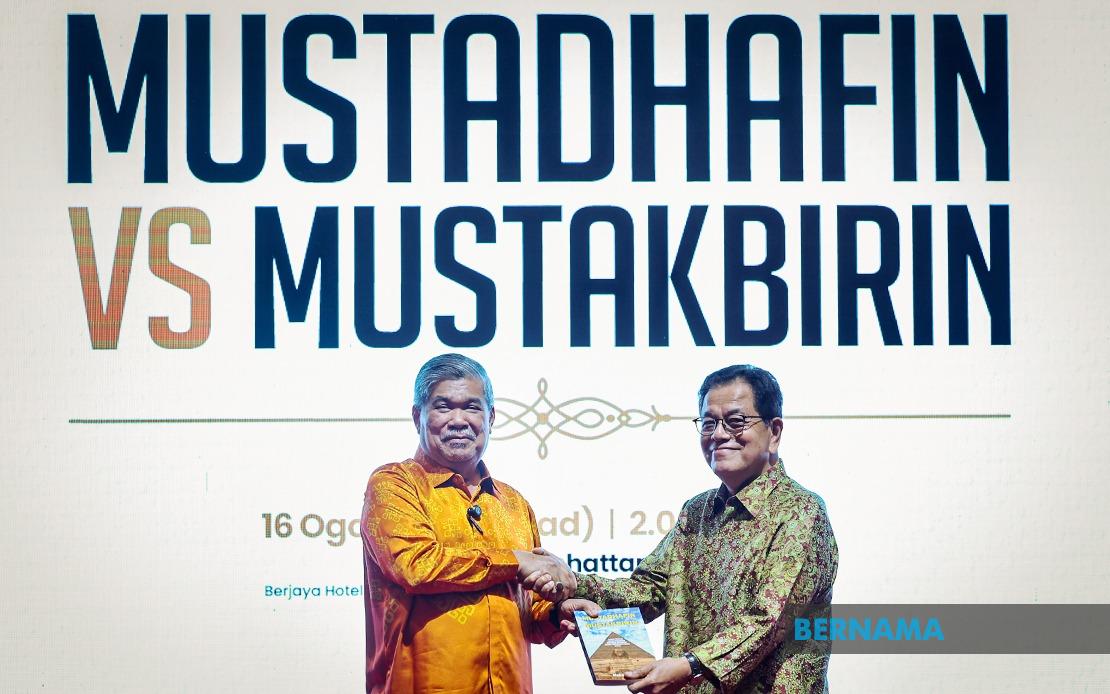
Datuk Seri Mohamad Sabu has issued a timely warning to Malaysians about the dangers of uncritically accepting unverified claims, particularly in the politically charged environment where allegations circulate with little regard for accuracy. Speaking after launching his book in Kuala Lumpur, the Amanah president and Agriculture and Food Security Minister cautioned that blindly embracing allegations without proper verification can reinforce a harmful tribal mentality known as 'asabiyyah'—the tendency to defend one's own group regardless of wrongdoing while simultaneously dismissing or denigrating the positive actions of rival groups.
The minister's intervention arrives at a moment when Malaysian political discourse has become increasingly polarised, with various groups advancing competing narratives about fundamental issues. Mohamad Sabu specifically referenced the perennial assertion that the Democratic Action Party is a communist organisation, and that any political cooperation with it therefore constitutes implicit support for communism. Rather than accept this premise, he posed a direct challenge to those making such claims, asking whether the DAP genuinely represents communist ideology in the contemporary context. His question represents an attempt to inject rationality into a debate that has long been dominated by historical rhetoric and unexamined assumptions.
Mohamad Sabu emphasised that the public bears a responsibility to actively verify information before forming political opinions or taking positions. This approach demands intellectual rigour—a willingness to investigate sources, examine evidence, and understand the actual situation rather than merely accepting whatever claims align with existing biases or group identity. In an era where social media algorithms amplify sensational content and conspiracy theories spread at unprecedented velocity, this message carries particular relevance for Malaysian society, where misinformation campaigns have repeatedly influenced public opinion during election cycles and policy debates.
The minister drew a stark contrast between how misinformation travels through the information ecosystem compared to factual, nuanced information. Accusations and suspicions, he noted, spread with remarkable ease and speed, particularly through social media platforms where emotional triggers and tribal signalling often outweigh accuracy. Conversely, facts and genuine knowledge require effort to understand and absorb—they demand time, concentration, and intellectual humility. This asymmetry between the velocity of falsehood and the laborious pace of truth propagation represents a fundamental challenge to democratic discourse in the digital age, and Southeast Asian nations like Malaysia are not immune to these dynamics.
During his remarks, Mohamad Sabu drew on his personal trajectory to illustrate the importance of independent verification. From his youth, he cultivated a habit of investigating matters firsthand rather than passively accepting propaganda circulating within his social circles or community. This deliberate scepticism toward received wisdom, combined with a commitment to understanding actual ground realities, has apparently shaped his approach to both personal decision-making and public leadership. His book documents this philosophy through accounts of encounters with various political and social actors, illustrating how direct engagement and observation can challenge or complicate conventional narratives.
The book's launch, presided over by National Journalism Laureate Tan Sri Johan Jaaffar, signals an attempt to position critical thinking as a value worthy of public consideration during a period when Malaysia faces complex political choices. Mohamad Sabu's broader intellectual project, as reflected in his new publication, extends beyond domestic Malaysian politics. The volume addresses global geopolitical dimensions, examining historical phenomena such as colonialism and contemporary issues including Palestinian affairs while analysing shifts in international power dynamics. This global perspective provides context for understanding how misinformation and tribal thinking operate not merely as domestic Malaysian phenomena but as worldwide patterns that influence how nations and populations understand each other.
The Amanah president's intervention also carries implications for coalition politics in Malaysia, where various parties must cooperate across ideological and historical divides. Political alliances that cross traditional lines—such as between Islamist and secular-nationalist parties—often become targets for accusation campaigns designed to drive wedges between coalition partners. By encouraging citizens to verify rather than blindly accept such allegations, Mohamad Sabu implicitly advocates for a political culture where substantive disagreements are debated on their merits rather than through character assassination or ideological guilt-by-association.
For Malaysia's broader democratic project, this message about epistemic responsibility represents both a necessary intervention and a reflection of genuine challenges. The country has witnessed numerous episodes where unverified claims regarding political figures, religious matters, or communal relationships have mobilised significant portions of the electorate. Social media has dramatically amplified this tendency, as algorithmic systems reward engagement over accuracy and individual users often lack the time or tools to conduct proper fact-checking. Mohamad Sabu's call for greater scrutiny addresses a real problem that transcends party lines and affects the quality of political decision-making across the spectrum.
The emphasis on personal investigation and critical engagement also resonates with broader Southeast Asian concerns about information sovereignty and resistance to manipulation. In a region where multiple external actors attempt to shape political outcomes through sophisticated information campaigns, the cultivation of critically thinking citizens becomes a form of democratic defence. Malaysia, as one of Southeast Asia's most economically developed and digitalised nations, faces particular vulnerability to information warfare while simultaneously possessing the educational infrastructure to build widespread media literacy and critical thinking capacity.
Moreover, Mohamad Sabu's argument extends to how minorities and marginalised groups experience political discourse. When allegations are accepted without verification, vulnerable communities often become convenient scapegoats, with entire religious, ethnic, or political groups tarred by association with extreme or radical individuals. The application of 'asabiyyah' dynamics to such vulnerable populations can have serious consequences for social cohesion and individual safety. By advocating for verification practices, Mohamad Sabu implicitly protects democratic space for diverse viewpoints and genuine minority participation in political life.
The challenge ahead for Malaysian society involves translating this philosophical position into actual practice and institutional structures. While individual citizens may embrace critical thinking, the incentive structures of social media and traditional media often reward sensationalism over accuracy. Building a political culture more resistant to misinformation will require not merely individual virtue but also systemic changes—better digital literacy education, media organisations committed to fact-checking, and platforms designed to reduce the spread of unverified claims. Mohamad Sabu's warning represents a necessary first step in recognising the problem and articulating the importance of solutions.

