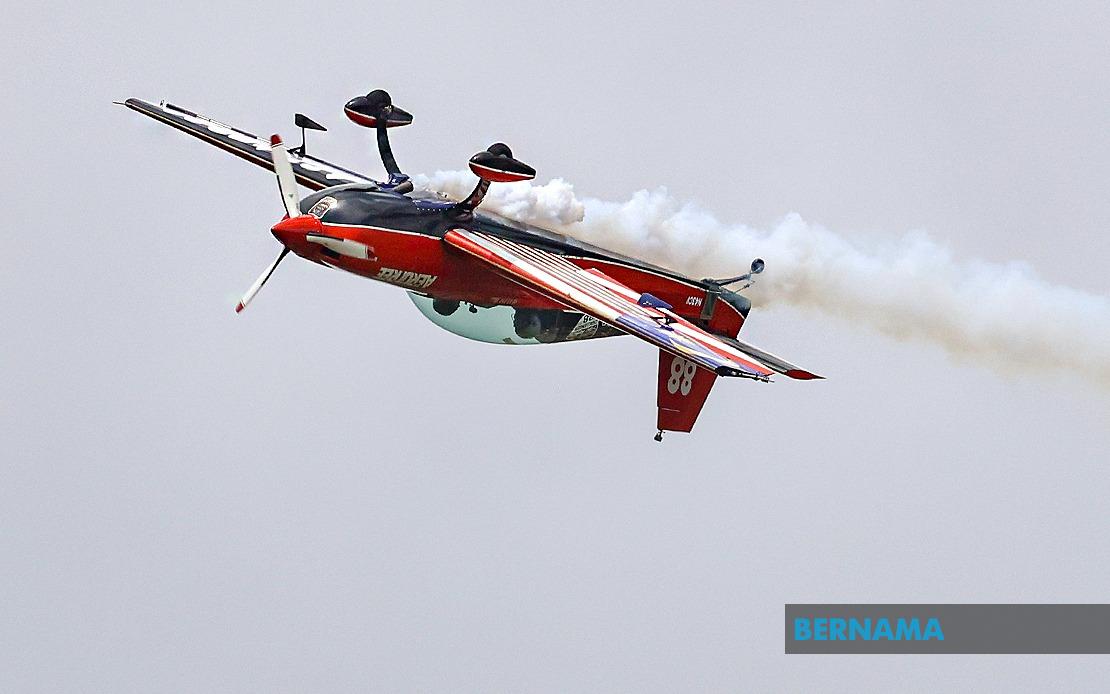
Major (Retired) Datuk Halim Othman, a 60-year-old former Royal Malaysian Air Force fighter pilot, commanded centre stage at Putrajaya on August 30 for the premiere of the Merdeka Sunset Show: Melukis Senja, bringing unparalleled expertise accumulated over four decades in military and civilian aviation to choreograph a twilight aerial spectacle during Malaysia's 69th National Day celebrations. The solo aerobatic performance, executed at 7 pm with synchronized smoke and pyrotechnic effects against the setting sun, represented the culmination of Halim's groundbreaking career navigating high-performance aircraft and international competition circuits where precision, courage and intimate mastery of aviation machinery remain non-negotiable demands.
The path to this high-profile national showcase originated from Halim's singular achievement as Malaysia's first and, to date, only pilot to qualify for the prestigious Red Bull Air Race World Championship. This distinction carried profound significance beyond personal accomplishment: competing at that elite international level required Halim to navigate an arena historically dominated by non-Malaysian and non-Asian pilots, a competitive landscape where preconceptions about Asian aviation capabilities ran deep. The Red Bull circuit represents aeronautical competition at its most unforgiving—pilots manoeuvre specially modified aircraft through three-dimensional courses at speeds exceeding 200 kilometres per hour, executing G-forces that demand extraordinary physical conditioning, mental acuity and aircraft handling finesse honed through relentless practice.
Halim's professional trajectory commenced in 1985 when he joined the RMAF, subsequently earning the coveted "Top Gun" designation that signified exceptional performance among fighter pilot cohorts. His military service exposed him to operational complexities spanning combat readiness, tactical flying and multi-platform aircraft mastery. The roster of military and civilian aircraft he has commanded reads as a technical curriculum vitae: the Soviet-supplied MiG-29N, the twin-engine F/A-18D Hornet, the venerable A-4 Skyhawk, the nimble F-5E Tiger, and the aerobatic specialist Extra 300L. Beyond military platforms, his experience extends to sophisticated corporate transports including the Learjet 35A and turboprop King Air 350i, reflecting the diversified demands placed upon professional aviators operating across institutional hierarchies.
The transition from military operations to international air racing represented a significant career evolution, one that culminated in measurable success during 2014 when Halim captured the Challenger Cup in both Ascot, United Kingdom and Las Vegas, United States, subsequently finishing second in the Challenger Cup Final at the Red Bull Ring in Austria. These results, achieved in direct competition with international pilots, validated his contention that Malaysian aviators possessed competitive parity with their global counterparts when afforded equivalent platforms and opportunities. The significance extends beyond personal medals: Halim's participation in international racing circuits functioned as a quiet diplomatic statement about Malaysian technological capability and human potential within a traditionally Western-dominated aviation sphere.
Halim's entrepreneurial initiatives further demonstrated his commitment to systematic development of Malaysia's aeronautical infrastructure. As founder and president of Aerotree Defence and Services Sdn Bhd, he spearheaded establishment of Krisakti, Malaysia's inaugural officially sanctioned aerobatic display team, which premiered at LIMA 2011. This institutional innovation proved consequential because structured aerobatic teams represent specialised capabilities requiring integrated training, standardized procedures, and sustained investment—elements absent from Malaysia's aviation ecosystem prior to Krisakti's inception. The formation of such teams signals governmental and private sector commitment to cultivating indigenous excellence in precision flying disciplines that demand extraordinary coordination and technical sophistication.
The Merdeka Sunset Show itself emerged from conceptual foundations laid at the previous year's Langkawi International Maritime and Aerospace Exhibition, where Halim introduced the original "Melukis Senja" (Painting the Dusk) aerobatic performance. That earlier iteration established the artistic framework now adapted for national celebration: combining aeronautical precision with aesthetic elements including smoke tracers and synchronized pyrotechnics to create visual narratives against natural atmospheric backdrops. This fusion of technical mastery with performative artistry distinguishes contemporary aerobatic display from purely functional aviation demonstrations, elevating the discipline into experiential entertainment that engages public audiences while simultaneously showcasing advanced aviation capabilities.
Halim's philosophical perspective on aerobatic flying emphasizes disciplinary rigor and technical comprehension rather than reckless exhibition. In conversations regarding his approach, he consistently stressed that aerobatic performance demands comprehensive understanding of aircraft limitations, tolerance thresholds, and the margins separating controlled manoeuvres from structural catastrophe. This perspective reflects professional maturity accumulated through decades of operating high-performance machinery where incremental errors compound into potentially catastrophic consequences. The discipline requires continuous education, relentless physical conditioning, and psychological resilience capable of managing the cognitive load presented by three-dimensional spatial orientation at elevated velocities and sustained G-forces.
Reflecting on his Red Bull Air Race participation, Halim articulated a conscious commitment to representing Malaysian capabilities on international stages historically characterized by limited Asian representation. His remarks regarding motivation reveal personal conviction that performance excellence by Malaysian aviators functioned as implicit national testimony—demonstrating that Malaysian institutions could develop world-class practitioners capable of competing authentically against established international benchmarks rather than accepting peripheral status. This consciousness regarding representational significance reflects broader Southeast Asian dynamics where participation in elite international competitions carries implications transcending individual achievement, touching upon national competence and regional technological development narratives.
Looking forward, Halim articulated intentions to establish an expanded aerobatic team featuring six aircraft equipped with coloured smoke systems designated for future National Day observances and forthcoming LIMA exhibitions. This expansion programme represents deliberate institutional development aimed at sustaining aerobatic capabilities while creating training opportunities for emerging Malaysian pilots. The investment in multi-aircraft teams requiring synchronized performance capabilities constitutes substantial commitment to developing specialized aviation expertise that will position Malaysia within elite international aerobatic display circles, potentially attracting regional and international events that showcase local talent.
Beyond performance metrics and international competition standings, Halim consistently framed his aviation pursuits within corporate social responsibility frameworks explicitly targeting youth engagement with aerospace disciplines. His articulation of motivation for the Merdeka Sunset Show and related initiatives emphasized inspiration of younger generations, fostering aspirational interest in aviation careers, and demonstrating tangible pathways through which Malaysian youth might pursue excellence in technically demanding fields historically dominated by Western practitioners. This mentoring orientation suggests recognition that individual achievement means little absent institutional pipelines capable of channeling emerging talent toward sustained excellence.
The broader significance of the Merdeka Sunset Show extends beyond ceremonial observance of national independence. The event functions as public demonstration of Malaysian aeronautical capability, a visual testament to four decades of accumulated expertise concentrated in one pilot and the institutional frameworks supporting his achievements. For Malaysian audiences, the performance communicates that national talent can compete authentically in globally competitive domains; for regional observers, it signals Southeast Asian capacity for technological sophistication and specialized expertise. Halim's career trajectory and his determination to mentor subsequent generations suggest that Malaysian aviation excellence need not remain exceptional but could become systematized through institutional commitment and talented practitioners devoted to cultivating indigenous capability in demanding technical disciplines.

