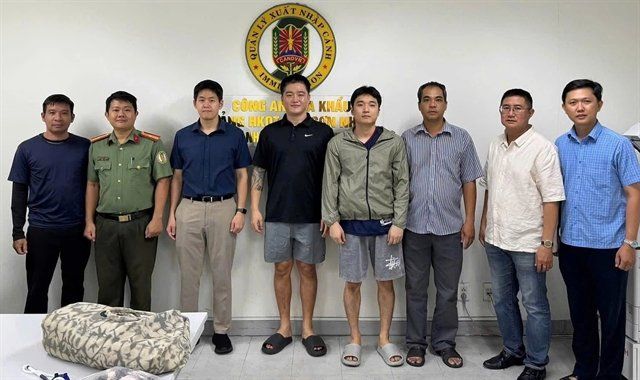
Ho Chi Minh City authorities have successfully apprehended three South Korean nationals who were the subjects of Interpol red notices, subsequently transferring them to South Korean law enforcement at Tan Son Nhat International Airport. The operation, coordinated between the HCM City Police Investigation Agency and the Ministry of Public Security's Police Investigation Agency, represents a significant breakthrough in combating transnational cybercrime that has increasingly plagued the region. The three individuals—Wang Taesan (born 1990), Han Joonhee (born 1992), and Bang Giseong (born 1997)—stand accused of orchestrating sophisticated high-technology fraud operations that deliberately targeted South Korean victims across multiple continents.
The criminal network employed what Vietnamese investigators characterize as layered deception tactics designed to maximize psychological pressure on victims and exploit their vulnerability. In their primary scheme, the suspects claimed possession of compromising video material of targets and threatened public dissemination unless ransoms were paid immediately. This extortion methodology, known as sextortion in cybersecurity circles, relies on victims' fear and shame to compel rapid payments without verification. Crucially, Vietnamese police confirmed that the suspects never actually possessed any such materials, rendering the entire threat fabrication—yet the psychological manipulation proved devastatingly effective in extracting money from panicked victims who believed their reputations faced imminent destruction.
The second operational methodology employed by the ring involved impersonation of legitimate authority figures, a tactic that exploits ingrained social deference toward law enforcement institutions. Members of the criminal network would contact victims while falsely representing themselves as South Korean prosecutors, police officers, or other government officials. To lend credibility to these elaborate deceptions, the perpetrators would dispatch forged documentation through digital channels, including fabricated arrest warrants bearing the victims' names and ostensibly linking their bank accounts to criminal enterprises. This multi-layered social engineering approach—combining authentic-looking bureaucratic documentation with official-sounding communications—proved highly effective at overwhelming victims' critical judgment during moments of acute stress and fear.
Once victims were sufficiently frightened by the false accusations and official-seeming threats, the suspects would demand immediate fund transfers to purportedly neutral accounts for financial "verification" procedures. Victims, terrified of arrest or prosecution, complied with these demands without considering that legitimate law enforcement agencies never request payment to clear criminal suspicions. This variation of advance-fee fraud has become increasingly prevalent throughout Southeast Asia, exploiting both cultural respect for authority and the speed and anonymity inherent in digital financial systems. The scheme operates with particular effectiveness across borders, where victims possess limited ability to verify the authenticity of purported officials or navigate foreign legal systems.
The arrest operation in Ho Chi Minh City represents merely one component of Vietnam's broader enforcement initiative targeting Korean cybercriminals operating from Vietnamese territory. In a concurrent operation conducted at Noi Bai International Airport in Hanoi, immigration authorities coordinated with local police to apprehend Lee Sammin, a South Korean national born in 1996, who was similarly wanted on an Interpol Red Notice. Lee Sammin's criminal enterprise focused on investment fraud, with the ring impersonating financial experts and stock market specialists through social media platforms and internet-based communication channels. The network circulated deliberately false information about ostensibly imminent initial public offerings, convincing victims that immediate investment would generate substantial returns.
The investment fraud operation attributed to Lee Sammin and associates ultimately defrauded victims of approximately US$10,693,343, representing a substantially larger monetary loss than typical individual cybercrime cases. The geographic distribution of this victim base and the sophistication required to maintain credibility across multiple platforms and sustained communications suggest organizational structure and specialization within the criminal network. Such investment schemes targeting the aspirational middle-class desire for wealth generation represent particularly insidious forms of cybercrime, as they exploit legitimate human financial ambitions rather than purely emotional fears. Victims often remain reluctant to report their losses to authorities, viewing themselves as financially naive rather than criminal victims, thereby allowing perpetrators extended operational periods before detection.
The successful apprehension and extradition of these individuals reflects strengthened Vietnamese-South Korean law enforcement cooperation and demonstrates Vietnam's commitment to combating cybercriminal networks that utilize Vietnamese territory as operational bases. Southeast Asia has increasingly become a staging ground for transnational cybercrime operations, as certain jurisdictions offer weak regulatory frameworks, abundant internet infrastructure, and distance from both victims and pursuing authorities. Vietnamese criminal networks operating from Viet Kieu communities or foreign criminals exploiting Vietnamese vulnerabilities represent ongoing challenges for regional security. These arrests signal that authorities are developing capacity to identify, locate, and apprehend perpetrators despite the inherent difficulties of tracking digital-first crimes across borders.
For Malaysian readers and regional stakeholders, these cases underscore the pervasive nature of cross-border cybercrime affecting Southeast Asian populations and the necessity of individual vigilance regarding unsolicited communications claiming official authority. The methodologies employed—sextortion, false legal threats, fraudulent investment opportunities—target vulnerable demographic groups including the elderly, newly prosperous professionals, and individuals with limited cybersecurity literacy. Financial institutions throughout the region should implement enhanced verification procedures for large international transfers, particularly those initiated through rushed circumstances or claims of legal emergency. Public awareness campaigns emphasizing that legitimate authorities never demand immediate payment to resolve criminal accusations or legal matters could substantially reduce victim susceptibility to these repeatedly successful schemes.

