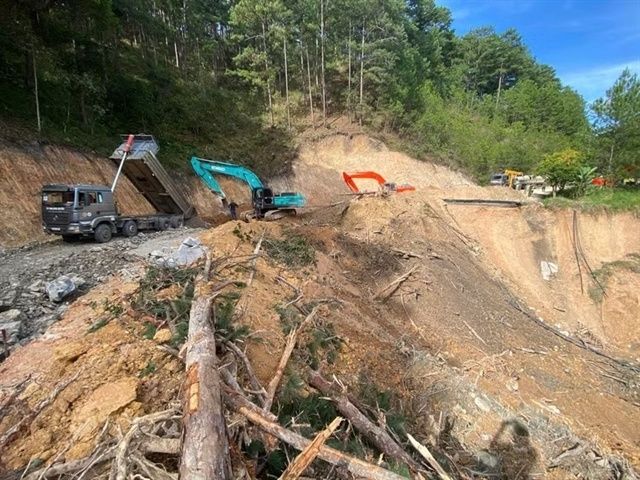
Vietnam's Ministry of Construction has activated emergency protocols following significant damage to Ho Chi Minh Road infrastructure in Tuyen Quang Province, triggered by successive periods of intense rainfall throughout June. The declaration targets a critical section at kilometre marker 115+000, where the main north-south artery intersects with National Highway 2C, an important traffic corridor managed by Road Management Zone I. The decision reflects official concern about both immediate safety risks and the broader impact on transportation networks serving this region.
The underlying cause of the infrastructure failure stems from an extraordinary pattern of rainfall events that pounded the area between June 1 and 30. Data from the Tuyen Quang Provincial Hydrometeorological Station and the National Centre for Hydrometeorological Forecasting documented multiple heavy downpours during this month-long period. Such concentrated precipitation volumes overwhelmed drainage systems and destabilised the roadbed, resulting in visible structural deformation that transport authorities deemed too hazardous for continued unrestricted use by heavy vehicles and long-distance traffic.
The scope of the emergency declaration extends beyond the primary damage site. A secondary affected zone stretches between kilometre markers 124+600 and 128, where Ho Chi Minh Road overlaps with National Highway 2. This section has experienced localised flooding complications that threaten traffic management and flow stability. The twin problems—direct infrastructure damage and waterlogging—create compounding challenges for authorities attempting to maintain transportation functionality across the province.
To address these cascading issues, the Ministry of Construction has assigned clear responsibilities across the road management hierarchy. The Department for Roads of Vietnam and Road Management Zone I have taken the lead role in conducting comprehensive damage assessments and developing engineering solutions. These organisations must produce an Emergency Construction Order that outlines repair methodology, resource allocation, and implementation timelines. This formal authorisation document becomes the legal instrument enabling rapid mobilisation of repair crews and procurement of materials without standard bureaucratic delays.
The hierarchical accountability structure underscores the seriousness with which Vietnamese authorities regard this infrastructure failure. The Director General of the Department for Roads of Vietnam and the Director of Road Management Zone I bear personal responsibility to the Minister of Construction for both the damage assessment findings and the execution of remedial works. This accountability framework incentivises rapid, effective response while ensuring that senior officials maintain direct oversight of operations rather than delegating critical decisions to lower administrative levels.
For Malaysia and other Southeast Asian nations with similar tropical climate patterns and road infrastructure networks, Vietnam's emergency declaration carries instructive implications. The Ho Chi Minh Road represents a vital economic artery connecting northern industrial zones with Ho Chi Minh City's commercial hub. Damage to such strategic corridors directly impacts supply chains, logistics costs, and regional trade flow. Malaysian authorities managing equally important routes like the North-South Expressway or Federal Route 2 can draw lessons from how Vietnam's institutional response prioritises rapid damage assessment and authorisation structures that bypass normal regulatory constraints during crises.
The Transport and Road Safety Division of the Ministry of Construction has been tasked with coordinating implementation across all participating agencies. This centralised coordination function prevents the fragmentation and delays that often occur when multiple organisations operate without clear hierarchical direction during emergencies. By establishing a single focal point for directing remedial efforts, Vietnam's ministry model emphasises the importance of institutional clarity when managing time-sensitive infrastructure crises that affect thousands of daily commuters and commercial vehicles.
The June rainfall patterns that damaged Ho Chi Minh Road at Tuyen Quang reflect broader climate patterns affecting mainland Southeast Asia during monsoon seasons. The region's infrastructure increasingly faces stress from extreme weather events that exceed design specifications developed under historical climatic parameters. Climate models suggest such events may intensify, prompting road authorities across Vietnam, Thailand, Laos, and Cambodia to reconsider infrastructure resilience standards and maintenance protocols for critical transport corridors.
The emergency construction process outlined by Vietnam's Ministry represents a pragmatic approach balancing speed with due process. Rather than proceeding with ad-hoc repairs lacking formal authorisation, emergency construction orders provide legal framework enabling rapid deployment of resources while maintaining accountability mechanisms. This methodology proves particularly valuable for Southeast Asian nations where rapid urbanisation and monsoon-driven rainfall patterns create frequent infrastructure challenges requiring swift, coordinated responses.
Once emergency repairs are completed, the Department for Roads of Vietnam must provide completion reports to the ministry, which will then formally terminate the emergency declaration. This closure mechanism ensures that temporary emergency powers do not become entrenched, maintaining the principle that extraordinary measures remain truly temporary. For other regional governments managing similar infrastructure systems, Vietnam's approach demonstrates how institutional frameworks can balance rapid crisis response with mechanisms ensuring return to normal administrative procedures once immediate dangers subside.

