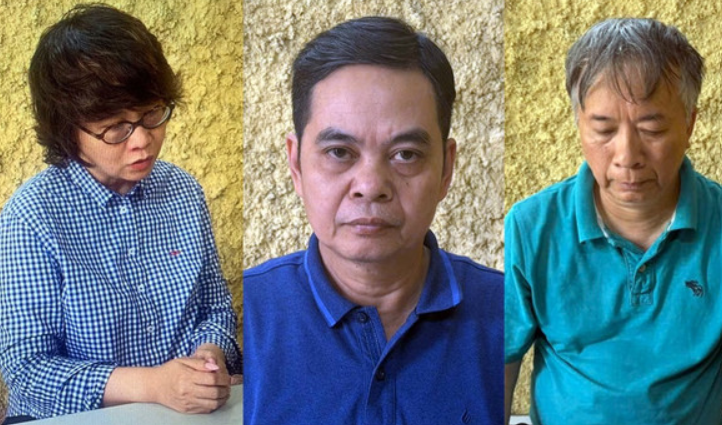
Vietnam has intensified its enforcement against perceived challenges to state authority by arresting three senior executives of a major publishing house that released a controversial biography of Ho Chi Minh, the founding father of Vietnam's Communist Party. The arrests, confirmed by Hanoi police on Wednesday, represent part of a coordinated campaign that has ensnared the book's author, a well-known influencer who promoted it, and dozens of media outlets that carried favourable coverage. The operations underscore the Vietnamese government's determination to control narratives around national history and political ideology at a moment when the party faces mounting pressures from economic challenges and generational shifts in public opinion.
The book in question, titled "Stories with Thanh -- A New Account of Light", was authored by Nguyen Thanh Nam, a former telecommunications executive whose literary venture inadvertently triggered one of the year's most visible state interventions in publishing. Published in May by the Vietnam Writers' Association Publishing House, the work examined Ho Chi Minh's formative years overseas and his early efforts to mobilise anti-colonial sentiment. Although the subject matter might seem historically routine in most democracies, Vietnamese authorities interpreted the narrative as containing distortions that undermined both the revolutionary record and the contemporary policies derived from party doctrine. Nguyen Thanh Nam was detained in early July on charges related to producing and disseminating information contrary to the interests of the Socialist Republic of Vietnam.
The three publishing executives arrested this week—identified as the director, editor-in-chief, and head of the editorial board—now face identical accusations alongside the author. According to official police statements, all parties involved bore responsibility for editing, revising, and promoting material that allegedly "distorts the history of the revolutions, the policies and guidelines of the party and state." This formulation of culpability extends well beyond the author to encompass the entire editorial chain, a legal strategy that effectively criminalises the basic functions of publishing. The message to the Vietnamese media and publishing industries is unmistakable: institutional collaboration with controversial content carries severe organisational and personal consequences.
The suppression campaign extended beyond the publisher to media outlets that had championed the book. Vietnam's culture ministry announced sanctions against 23 news agencies for publishing articles that praised the biography, characterising their coverage as lacking adequate source verification. The ministry's statement claimed these outlets had subsequently acknowledged their editorial lapses and gained what officials described as "a profound understanding of the lessons of source verification"—language suggesting coercive acceptance rather than genuine institutional reform. Fines totalling nearly US$2,500 were imposed across the sanctioned outlets, while more than twelve journalists and editors associated with the coverage faced reassignment, suspension, or termination from their positions.
The author himself appeared on state television to offer a carefully worded apology that illuminates the pressures exerted throughout the prosecution. Nguyen Thanh Nam publicly conceded that his book contained "factual errors and false assertions that run counter to the guidelines and policies of the party and state" and acknowledged that the work had damaged "the image of President Ho Chi Minh." Such confessions, broadcast nationally, serve multiple purposes within Vietnam's political system: they reinforce state narratives, deter others from similar ventures, and create public records of capitulation that legitimise the underlying charges. The forced retraction underscores how thoroughly the state can marshal institutional and reputational mechanisms to enforce ideological conformity.
For Malaysian observers, this episode illuminates the divergent trajectories of Southeast Asian nations regarding press freedom and political discourse. Vietnam's approach contrasts sharply with Malaysia's own contested media landscape, where competition between regulatory frameworks, commercial interests, and political actors creates ongoing tensions but generally permits greater scope for historical revisionism and biographical scrutiny. The Vietnamese case demonstrates how authoritarian systems weaponise publishing law and criminal statutes against intellectual output, transforming questions of historical interpretation into state security matters. The breadth of the crackdown—encompassing author, publisher, influencer, and sympathetic journalists—reveals how comprehensively state authority can penetrate information ecosystems when political leadership perceives threat.
The enforcement action also reflects deeper anxieties within Vietnam's Communist Party about generational legitimacy and historical narrative control. Ho Chi Minh remains a foundational figure in national mythology, and any suggestion that his biographical record requires reinterpretation threatens carefully constructed party narratives. By treating a historical biography as seditious material, authorities signal that existing official accounts are beyond scholarly challenge. This rigidity potentially alienates younger Vietnamese citizens, particularly urban professionals and digital natives accustomed to accessing diverse information sources, who may view such prosecutions as indicative of institutional brittleness rather than strength.
Human Rights Watch has documented that Vietnam currently imprisons more than 160 political prisoners, reflecting patterns of detention that predate this particular crackdown. However, the publishing house arrests represent a notable expansion of enforcement into cultural production domains, suggesting that state security concerns have broadened beyond traditional political activism into historical scholarship and literary expression. The simultaneous sanctioning of news media indicates coordination across multiple state agencies—police, culture ministry, and party authorities—to construct what amounts to a unified response against perceived ideological transgression. Such coordination suggests high-level political attention and sustained commitment to controlling this narrative domain.
The implications for Southeast Asian publishers, academics, and journalists extend beyond Vietnam's borders. Regional publishing networks operate across borders; authors, editors, and investors maintain transnational connections. The Vietnamese case establishes a demonstrable risk profile for projects involving sensitive historical interpretation or party criticism, potentially chilling creative and scholarly work throughout the region. Malaysian and other Southeast Asian publishers may exercise self-censorship regarding Vietnamese-related content or Vietnamese-language publishing, effectively extending Hanoi's regulatory reach through market mechanisms rather than legal enforcement alone.

