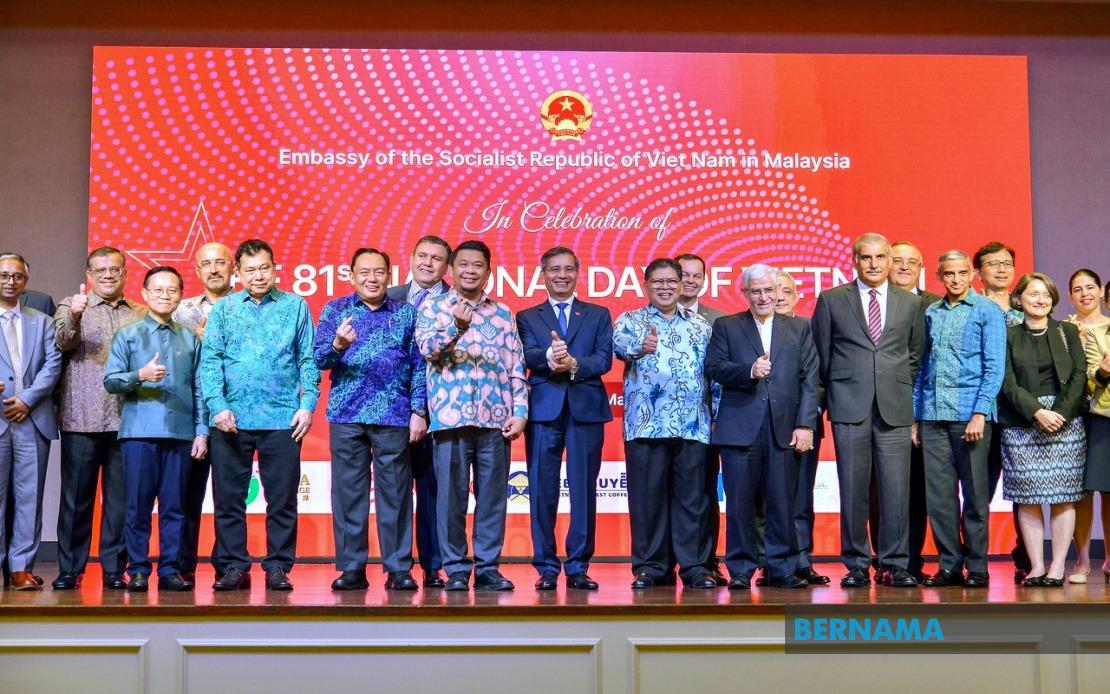
Vietnam and Malaysia are embarking on an expanded partnership framework that promises to reshape the trajectory of their bilateral relationship across multiple dimensions. At a ceremony marking Vietnam's 81st National Day in Kuala Lumpur on Thursday, Vietnam's Ambassador to Malaysia Dinh Ngoc Linh articulated a vision of strengthened ties rooted in political confidence and aligned strategic interests, positioning Malaysia as a crucial partner for Hanoi as regional dynamics continue to shift in complex directions.
The elevation of Vietnam-Malaysia relations to Comprehensive Strategic Partnership status, formalized in November 2024, represents a culmination of diplomatic efforts stretching back to the establishment of formal ties in 1973. This framework transcends traditional bilateral concerns, embedding cooperation within a broader architecture designed to address the multifaceted challenges confronting Southeast Asia. Ambassador Dinh underscored that this partnership reflects not merely political convenience but authentic mutual understanding and convergence of national interests in an increasingly uncertain global environment.
Trade and economic integration constitute the bedrock upon which this partnership rests. Over the past year, bilateral commerce has expanded substantially, with Malaysian investors showing growing confidence in Vietnam's manufacturing and technology sectors, while Vietnamese enterprises have found opportunities in Malaysian agricultural development and regional distribution networks. Beyond conventional trade metrics, the two countries have deepened collaboration in investment frameworks, with Malaysian companies establishing manufacturing bases in Vietnamese industrial zones and Vietnamese entities participating in Malaysian infrastructure projects. This economic interdependence creates structural incentives for maintaining strong diplomatic relations irrespective of domestic political transitions.
Educational and cultural exchanges have emerged as particularly vital channels for building enduring people-to-people connections that underpin state-level cooperation. Malaysian universities now host thousands of Vietnamese students, while Vietnamese cultural programs regularly reach Malaysian audiences, fostering generational familiarity that transcends official statements. These grassroots connections create constituencies within both societies invested in the success of the partnership, generating resilience against temporary diplomatic friction or misunderstandings that might otherwise derail cooperation.
Defence and security cooperation represents perhaps the most strategically significant dimension of the partnership, particularly given maritime security concerns affecting both nations. Vietnam and Malaysia share interests in maintaining freedom of navigation through contested waters and preventing the militarization of regional disputes. Enhanced defence exchanges, joint training exercises, and intelligence sharing arrangements strengthen mutual confidence while contributing to regional stability. Ambassador Dinh's emphasis on this domain reflects recognition that security partnerships often prove more durable than economic ties, as they rest on shared threat perceptions rather than price competition.
The partnership also carries implications for broader ASEAN cohesion at a moment when regional unity faces pressures from great power competition and divergent national interests. Vietnam and Malaysia, representing different positions within ASEAN—Vietnam as a frontline state confronting major power assertiveness and Malaysia as a traditionally balanced non-aligned actor—carry particular responsibility for modelling inclusive cooperation. Their strengthened partnership sends signals that ASEAN members can deepen bilateral relations while maintaining commitment to collective centrality and consensus-based decision-making that defines the organization's character.
Ambassador Dinh's impending conclusion of his three-year posting provides context for his unusually expansive remarks about the partnership's significance. Outgoing ambassadors frequently use farewell opportunities to consolidate achievements and establish narratives that frame their tenure's contribution to bilateral relations. His emphasis on generational continuity and his pledge to maintain personal commitment to the friendship beyond his official role reflect diplomatic practice of ensuring that personal relationships between officials extend institutional memory and provide informal channels for problem-solving during future disagreements.
The presence of Deputy Foreign Minister Datuk Lukanisman Awang Sauni as guest of honour at the celebration underscores Malaysian official commitment to the partnership framework. Malaysia's diplomatic positioning, historically emphasizing non-alignment and regional consensus-building, means that its embrace of strategic partnerships carries particular weight. When Malaysia designates another nation as a strategic partner, it signals readiness for substantive cooperation on issues beyond routine bilateral management, potentially including coordination on regional initiatives and convergent foreign policy positions on contested regional questions.
However, the strength of any strategic partnership depends on mechanisms for managing inevitable friction points and differing strategic assessments. Vietnam and Malaysia maintain different threat perceptions regarding major power engagement, divergent economic models despite complementarity in specific sectors, and occasional tensions over maritime jurisdiction in the Gulf of Thailand. A truly comprehensive partnership must incorporate institutional frameworks for diplomatic problem-solving that prevent temporary disagreements from cascading into relationship-threatening crises. The specific mechanisms for managing such disputes remain largely unstated in public discourse, suggesting either sophisticated informal arrangements or potential vulnerabilities in the partnership architecture.
The regional implications of Vietnam-Malaysia strategic partnership extend beyond bilateral concerns into the broader architecture of Southeast Asian international relations. Malaysia's capacity to maintain strong partnerships with multiple actors—including traditionally complicated relationships with Thailand and Singapore—while deepening ties with Vietnam demonstrates sophisticated diplomatic choreography. This approach serves Malaysian interests by preserving flexibility and avoiding bloc formation, while simultaneously enhancing Vietnam's ability to pursue cooperative strategies that don't depend entirely on alignment with any single external power or regional bloc.
Looking forward, the sustainability of this partnership will likely depend on sustained political will from both governments and embedding cooperative mechanisms deeply enough that transitions in leadership create continuity rather than discontinuity. The ceremonial nature of partnership declarations, while important for establishing political commitment, must translate into functional cooperation structures where multiple ministries and agencies coordinate across borders with sufficient regularity that relationships attain organizational reality beyond ambassadorial rhetoric.

