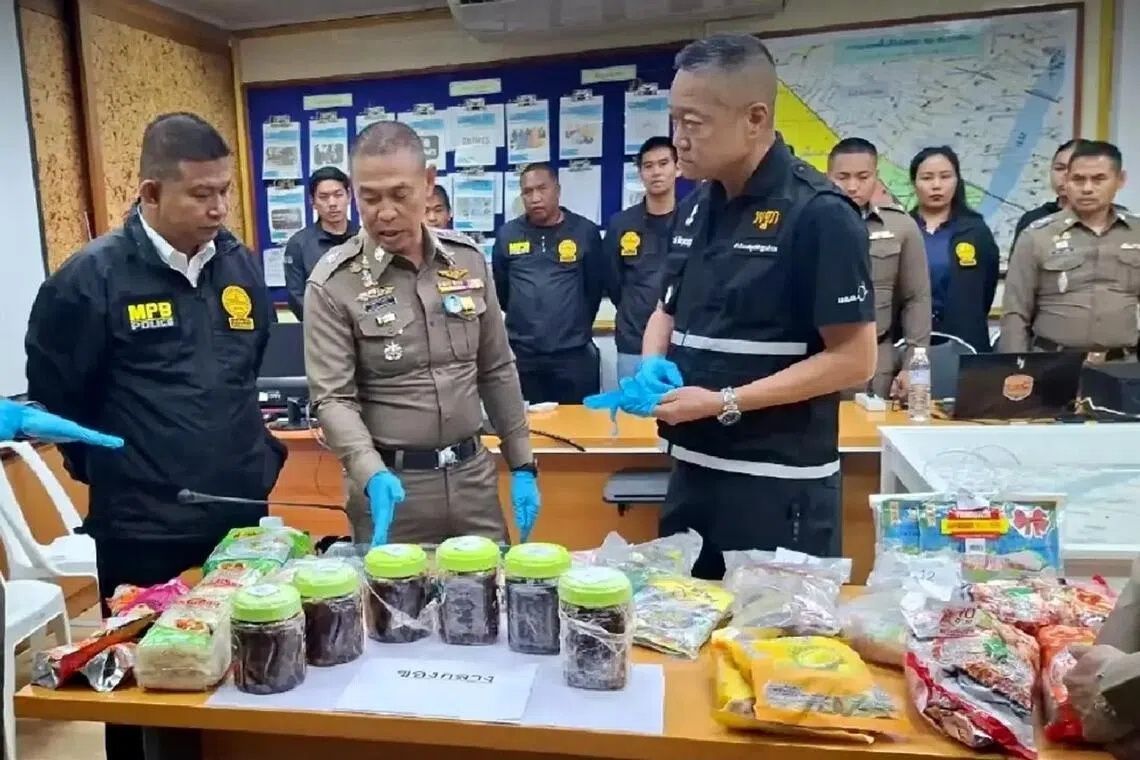
Thai police have uncovered an international drug trafficking network orchestrated by Vietnamese nationals that leveraged Thailand as a key transit hub to ship crystal methamphetamine concealed within everyday food products to customers in Japan. Metropolitan Police Bureau commissioner police lieutenant-general Siam Boonsom revealed the operation's details on July 17, working alongside police major general Chaiya Phetpanya and investigators from Bang Yi Khan Police Station. The discovery emerged following the interrogation of Sompong, a Thai national arrested as a key player in the scheme, and demonstrates how criminal organisations continue to exploit Southeast Asia's porous borders and complex supply chains to move illicit substances across the region.
The breakthrough came when a courier hired to transport goods internationally grew suspicious about parcels ostensibly containing tamarind paste intended for delivery to Tokyo. These distinctive jars, filled with a common Southeast Asian ingredient, represented the perfect disguise for contraband—innocuous enough to avoid scrutiny yet heavy enough to raise concerns for someone accustomed to handling legitimate shipments. Upon examination, authorities discovered six foil-wrapped packages secreted within the containers, with laboratory analysis confirming the presence of more than two kilograms of crystal methamphetamine, street-named ice. The discovery highlights a recurring vulnerability in cross-border commerce: unaware couriers are frequently recruited to transport illegal goods without their knowledge, transforming ordinary people into unwitting accomplices in major trafficking operations.
The investigation's scope expanded rapidly as Thai police traced the network's architecture, revealing a sophisticated operational structure designed to maximise anonymity and frustrate law enforcement efforts. Vietnamese nationals allegedly directing the enterprise from Hanoi coordinated the entire scheme through intermediaries, relying on anonymous Facebook accounts to hire motorcycle couriers who would collect packages from residential addresses occupied by Vietnamese nationals throughout Thailand. These riders would then pass the contraband to separate Thai couriers who bore the actual risk of international transportation. This deliberate compartmentalisation created multiple insulating layers between the network's leadership and the final shipment, ensuring that even if authorities intercepted goods or arrested couriers, investigators would struggle to connect individual nodes back to the operation's architects in Vietnam.
Financial analysis provided the crucial thread connecting seemingly disparate actors within the network. Police discovered that funds associated with the operation flowed through a bank account registered to Sompong, suggesting his role extended beyond simple courier duties into the realm of money management and logistics coordination. Vietnamese nationals allegedly took turns withdrawing substantial sums—between 20,000 and 50,000 baht per transaction—before departing Thailand for their home country. This rotating withdrawal pattern served a dual purpose: it reduced the visibility of any single individual's involvement and minimised the risk that any one person would accumulate sufficient evidence to warrant extended investigation or surveillance. The methodology reveals how international criminal syndicates have adapted to modern banking oversight and financial monitoring systems, fragmenting transactions and personnel movements to evade detection.
The operation's mechanics reflect broader trends in how transnational drug trafficking has evolved across Southeast Asia. Rather than employing a single fixed route or permanent infrastructure, the network utilised Thailand's geography and existing commercial pathways to facilitate movement of contraband. The choice of tamarind paste as a concealment medium demonstrates operational sophistication—the product is sufficiently common in regional trade to avoid raising red flags at border checkpoints, yet provides adequate space and opacity to conceal significant quantities of drugs. This approach contrasts with more crude smuggling methods and suggests the network possessed experience, resources, and intelligence about how customs authorities screen incoming goods at ports like Tokyo.
Thailand's role as a transit country remains strategically crucial for smuggling operations targeting Japan and other wealthy East Asian markets. The kingdom's extensive land borders with Laos and Myanmar, combined with its established ports and developed transportation infrastructure, create natural corridors for illicit goods movement. Criminal organisations exploit these geographical advantages while cultivating networks of local facilitators—couriers, money handlers, and logisticians—who provide the operational capacity to sustain large-scale trafficking. For Malaysian readers, this case illustrates how neighbouring Thailand's challenges with drug transit operations have implications across the entire region, as the same routes and methodologies can be adapted for trafficking within or through Malaysia.
Police believe the investigation has so far identified only a portion of the network's total personnel, with preliminary evidence suggesting more than four individuals were directly involved in the Bangkok-based operations. Arrest warrants have been issued for Sompong and three Vietnamese nationals believed responsible for managing financial flows, operating the communication infrastructure through social media, and directing aspects of the logistics operation. Sompong has publicly denied the allegations against him, though investigators have secured sufficient evidence to move forward with prosecutions. Additionally, authorities are examining the potential involvement of Sompong's girlfriend, believing she possessed knowledge of the operation though she was not included in the initial warrant applications.
The network's apparent focus on Japan as a destination market reflects the high commercial value of methamphetamine in that country, where demand remains robust despite decades of law enforcement efforts. Japan's strict drug laws and substantial user market create attractive profit margins for international trafficking organisations, justifying the investment in elaborate smuggling infrastructure. The decision to route shipments through Thailand rather than employing direct air cargo or maritime routes suggests the network valued the security advantages provided by Thailand's less stringent inspection protocols compared to direct Japan-Vietnam shipments. This calculus changes periodically as enforcement efforts intensify, compelling smuggling networks to continuously modify routes, concealment methods, and personnel arrangements.
The case underscores persistent challenges facing Thai and regional law enforcement authorities in combating international drug trafficking. Despite significant resources dedicated to border security and drug interdiction, sophisticated syndicates continue to exploit systemic vulnerabilities and leverage the region's complex geography. The financial sophistication demonstrated by this network—utilising multiple intermediaries, rotating personnel, fragmenting transactions, and leveraging digital communications—presents considerable obstacles to investigation and prosecution. For Malaysian authorities, observing how neighbouring Thailand confronts these challenges provides valuable lessons regarding the adaptability and resourcefulness of criminal organisations operating across Southeast Asia, emphasising the necessity for enhanced regional coordination and intelligence sharing.

