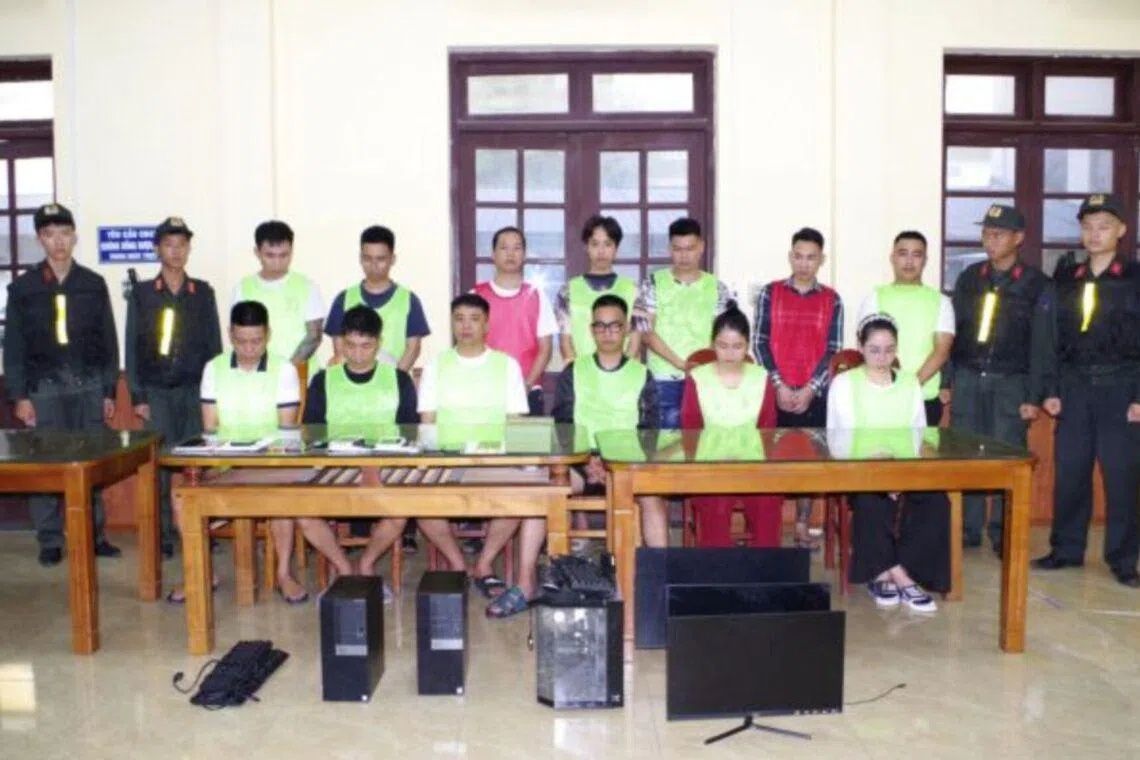
Police in Vietnam's northern Ninh Binh province have successfully broken up a major transnational cybercrime syndicate that defrauded over 500 victims of approximately 250 billion dong, equivalent to RM39.2 million. The operation, which came to light following intensive investigations, resulted in the arrest of twelve suspects and the seizure of substantial evidence including cash, vehicles, mobile devices, computers, forged identity documents, jewellery and detailed financial records. The bust represents a significant blow against organised online fraud networks that have become increasingly prevalent across Southeast Asia, targeting vulnerable citizens through increasingly sophisticated digital deception tactics.
Investigators identified Nguyen Van Cuong, aged 28, and Nguyen Van Phuong, aged 34, as the primary architects and leaders orchestrating the criminal enterprise. The network operated with military-style hierarchy and specialisation, with members assigned distinct roles and responsibilities within the fraudulent operation. A disturbing aspect of the ring's operations involved the deliberate recruitment and transportation of Vietnamese citizens to Cambodia, where the fraudsters operated with greater operational freedom and reduced risk of detection. This cross-border dimension underscores how criminal syndicates exploit jurisdictional complexities and regulatory gaps between nations to shield their activities from law enforcement.
The fraudsters employed a remarkably diverse arsenal of deception methods to exploit their victims. Perpetrators routinely impersonated legitimate authority figures including police officers, prosecutors, judges, bank employees and tax officials, leveraging the inherent trust citizens place in government institutions to lower victims' defences. This psychological manipulation technique exploits deeply ingrained cultural respect for authority figures, making targets more susceptible to subsequent financial demands. Beyond simple impersonation, the network invested considerable resources in creating counterfeit digital platforms designed to convincingly mirror the authentic websites and mobile applications of government agencies and established commercial enterprises. These fraudulent digital replicas served as gateways through which victims were gradually guided toward transferring funds or divulging sensitive financial information.
The scam scenarios deployed by the network demonstrated considerable creativity and targeting precision. Fraudsters advertised fictitious part-time employment opportunities to ensnare job-seeking citizens, while simultaneously promoting fake investment vehicles ostensibly focused on financial markets, securities trading and cryptocurrency ventures. A particularly insidious approach involved romance scams, where perpetrators established fabricated romantic relationships over extended periods to build emotional investment before requesting financial assistance. The gang also compromised legitimate social media accounts belonging to unwitting users, subsequently leveraging these hijacked platforms to solicit money from the account holders' genuine contacts, exploiting existing relationships and trust networks to increase the likelihood of success.
One particularly elaborate deception scheme involved fraudsters masquerading as military officers who contacted retail shops and commercial enterprises with purported intentions to place substantial bulk orders. After establishing apparent legitimacy, these perpetrators convinced business owners to purchase additional merchandise on their behalf and remit deposits or advance payments to designated bank accounts. This variant cleverly combined elements of phishing, social engineering and business impersonation to extract funds before victims realised the fundamental illegitimacy of the transaction. The sophistication of this specific scheme suggests the network included individuals with genuine business acumen and deep understanding of commercial practices, enabling them to exploit the procedural gaps and trust mechanisms inherent in legitimate trade.
According to the suspects' admissions during police interrogation, the network's criminal activity intensified from October 2024 onwards, representing an acceleration in their operational tempo. Over the relatively compressed timeframe of just several months, the organisation successfully targeted approximately 500 distinct victims and extracted over 250 billion dong through their various fraudulent schemes. This concentration of victimisation during a short period indicates that the network operated with significant resources, technical capability and organisational efficiency. The rapid expansion suggests the perpetrators possessed confidence in their methods' effectiveness and perceived limited risk of swift law enforcement intervention, potentially emboldened by Cambodia's distance from Vietnamese jurisdiction and regulatory oversight.
Police have initiated formal criminal proceedings against the detainees, with six suspects formally charged with the specific crime of fraudulent appropriation of property and remanded into custody pending trial. The remaining six individuals remain subject to ongoing investigative procedures as authorities gather additional evidence and establish their precise roles within the hierarchy. This graduated approach to prosecution reflects police determination to systematically build comprehensive cases demonstrating individual culpability while simultaneously pressuring lower-ranking operatives to cooperate in exchange for more lenient treatment. Such strategic prosecutorial choices frequently prove effective in unravelling larger criminal organisations by incentivising mid-level members to testify against superiors.
The investigation remains actively expanding as authorities pursue leads indicating additional suspects who have not yet been apprehended. Police are systematically working through financial records, communication logs and witness testimony to identify other network members potentially operating either within Vietnam or in Cambodia. Simultaneously, authorities are implementing asset seizure and freeze orders targeting bank accounts, real estate, vehicles and other valuables believed to represent proceeds derived from the fraudulent operations. These financial countermeasures serve the dual purpose of disrupting the network's remaining operational capacity while simultaneously enabling authorities to recover stolen funds that might be returned to defrauded victims.
For Malaysian readers, this case carries particular relevance given the region's vulnerability to sophisticated cyberfraud operations that frequently target victims across multiple Southeast Asian nations without regard for national borders. The tactics described—government impersonation, counterfeit digital platforms and social engineering—are increasingly weaponised against Malaysian citizens through similar transnational networks. The successful Vietnamese law enforcement response demonstrates both the organisational sophistication required to detect and dismantle such operations and the critical importance of cross-border police cooperation in combating cybercrime. Malaysian authorities continue to investigate similar networks, with the Ninh Binh case providing valuable operational intelligence regarding criminal methodologies and recruitment patterns that may assist in identifying comparable threats domestically.

