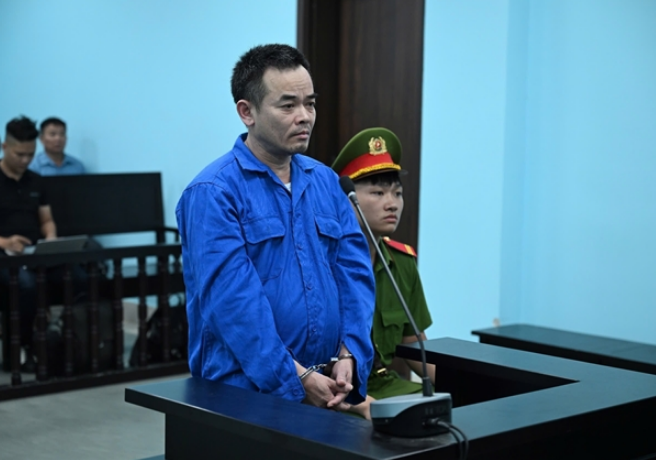
A Vietnamese court has delivered a harsh 20-year prison sentence to a concrete mixer truck driver who deliberately continued driving over a teenage girl following an initial collision, seeking to evade financial responsibility for the accident. The Hanoi People's Court on Tuesday handed down the conviction against 52-year-old Dinh Van Long from Phu Tho province in a ruling that exposed the deliberate and calculated nature of the tragedy that unfolded on a busy Hanoi highway last September.
The victim, Nguyen Dao Ha A., was just fourteen years old, a resident of Phu Xuyen Commune in the capital. Court documents detail how the incident occurred when Long, working as a driver for a construction materials company since January 2024, was operating a concrete mixer truck carrying approximately fourteen tonnes of ready-mix concrete towards National Highway 1A on the morning of September 13, 2025. The circumstances leading to the collision emerged from a complex road situation: as Long's truck approached the Van Diem underpass in Phu Xuyen Commune, another truck was travelling alongside in the same direction while the teenage girl, riding an electric motorbike, attempted to pass from the right side.
Prosecutors established that the girl lost control of her vehicle and fell directly into the path of Long's truck. The front right wheel ran over her abdomen with considerable force. According to Long's own account to investigators, he felt a significant impact and noticed the steering wheel shake beneath his hands. He applied the brakes, and the massive truck gradually came to a halt several metres down the road. The critical moment came when Long checked his mirrors and saw no evidence of the victim in his field of vision. Rather than exit the vehicle to investigate, he made a calculated decision that would transform a tragic accident into a premeditated crime.
The prosecution's case rested on a chilling reconstruction of Long's thought process at that pivotal moment. Long himself confessed that he reasoned the situation through a grim cost-benefit analysis: if the girl survived the initial impact, he would face substantial compensation claims and financial ruin; if she died, he would face criminal responsibility but potentially avoid the financial burden. Operating under this fatally flawed logic, Long engaged the truck's engine and deliberately drove forward, directly over the spot where the teenager lay beneath his vehicle.
The evidence presented to the court revealed the horror of Long's deliberate actions. Despite feeling unusual resistance from the road beneath the truck and hearing the distinct grinding sound of the tyres against an object, Long continued driving forward for another ten metres, knowingly dragging the girl's body along the asphalt. Only when bystanders rushed towards his vehicle, shouting warnings and pointing to what lay trapped beneath the truck, did Long finally stop the engine. The girl, critically injured with catastrophic abdominal trauma from being dragged under the massive vehicle, was extracted from her position and rushed to Bach Mai Hospital, one of Vietnam's premier medical institutions. Her injuries, however, proved unsurvivable, and she died during transport.
Long's response to his actions was to flee the scene immediately. He did not contact emergency services, did not report the accident, and did not attempt to provide any assistance. Instead, he disappeared into the Hanoi traffic, only turning himself in to police later that evening after the initial shock had worn off. This decision to abandon the victim compounded the moral culpability of his actions in the eyes of the court and the public.
During the investigation phase, some restitution was made to the victim's family, though money could never adequately address the loss. Long's own daughter voluntarily contributed eighty million Vietnamese Dong, approximately three thousand US dollars, towards compensation, while Long's employer, the construction materials company, paid an additional one hundred million Dong, roughly thirty-eight hundred US dollars. However, the victim's family pursued justice rather than mere financial settlement, formally requesting that the court impose the most severe punishment and seeking additional compensation that would encompass emergency medical treatment costs, funeral expenses, and damages for emotional suffering.
The trial panel's judgment characterised Long's behaviour as possessing a particularly dangerous character that transcended a simple traffic accident. The judges determined that Long had acted with direct intent and demonstrated a violent nature in his calculated decision to continue driving despite knowing a person lay beneath his vehicle. The court noted that the case had provoked widespread public outrage throughout Vietnam, reflecting the shocking nature of Long's deliberate choices and the vulnerability of road users in the face of such reckless disregard for human life.
Beyond the twenty-year prison term, the court imposed substantial additional financial penalties to attempt restitution. Long was ordered to pay a further one hundred eighty-two million Vietnamese Dong to the victim's family, underscoring the court's intention to hold him accountable on multiple levels. The sentence reflects a troubling reality in Southeast Asian traffic safety: the intersection of poor road discipline, inadequate enforcement mechanisms, and in this case, an individual's calculated decision to prioritise self-preservation over another person's life.
The case carries implications beyond Vietnam's borders for regional observers monitoring traffic safety and judicial responses to vehicular crimes. It demonstrates how quickly a moment of reduced attention on congested highways can escalate into tragedy, and how individual decision-making under pressure—no matter how misguided—can transform accident into murder. For Malaysian readers accustomed to their own challenges with road safety and hit-and-run incidents, the case illustrates both the severity of consequences in Vietnam's legal system and the ongoing struggle across Southeast Asia to create roads where all users, particularly vulnerable motorcyclists and young riders, can travel with reasonable confidence in their safety and in the responsibility of drivers sharing those roads.

