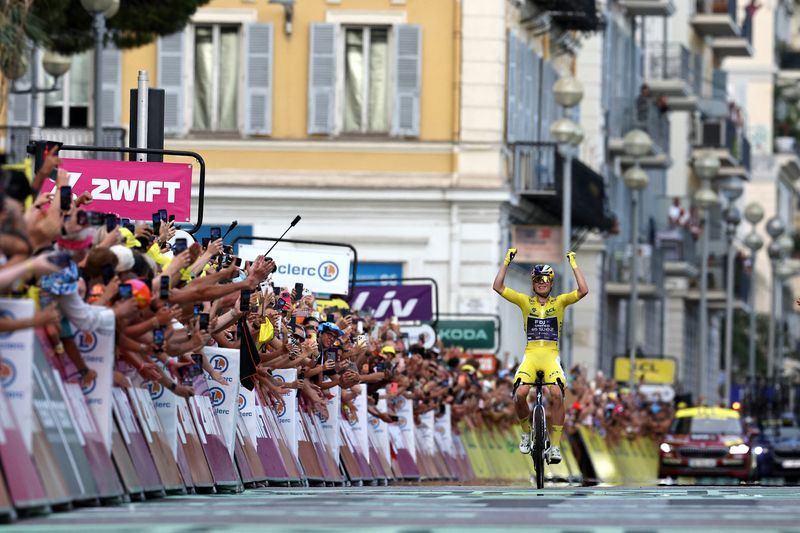
Demi Vollering stamped her authority on professional cycling this weekend by claiming her second Tour de France Femmes crown, the Dutch rider from FDJ-Suez proving her credentials as one of the sport's elite competitors with a commanding display on the concluding stage near Nice on Sunday. The 29-year-old crossed the finish line in emphatic fashion on the final 99.2-kilometre stage, consolidating her position as one of cycling's most accomplished female athletes and reinforcing her dominance in grand tour racing.
Vollering arrived at Sunday's concluding effort with an eight-second advantage over Polish rival Katarzyna Niewiadoma-Phinney, a margin that provided scope for tactical manoeuvre but hardly guaranteed success in one of professional cycling's most demanding formats. The general classification standings remained competitive enough to keep spectators and analysts watching closely as the peloton tackled the lumpy terrain around the Côte d'Azur, with several climbs serving as potential flashpoints for decisive action. The ultimate contest would hinge on how various riders managed their legs across the demanding course profile and their willingness to commit to aggressive racing when opportunities arose.
The decisive moment arrived as the leading contenders tackled the Col d'Eze for the fourth and final time during the stage. Vollering seized the initiative precisely when it mattered most, launching a penetrating attack on Niewiadoma-Phinney that immediately stretched the elastic between them. The Dutch champion rode with controlled aggression thereafter, managing her effort while extending her advantage with each pedal stroke, ultimately rolling into Nice alone and untroubled. Her capacity to time such moves with clinical precision underscored why she remains among the sport's most respected performers and most feared competitors in mountainous terrain.
The magnitude of Vollering's achievement extends beyond merely winning a stage and retaining the yellow jersey. Throughout the race, she had to manage the psychological pressures inherent in defending a narrow lead against capable opposition while simultaneously dealing with the physical demands of three weeks of racing at the sport's highest intensity. Her previous Grand Tour victories and consistency at this level meant she possessed the tactical experience and mental fortitude to navigate such situations, yet experience alone does not guarantee success when faced with hungry competitors determined to upset the established order.
Vollering's career trajectory reveals a cyclist of exceptional range and durability. Beyond this second Tour de France Femmes title earned in 2025, she previously triumphed in the same race during 2023, establishing herself as the competition's most recent repeat champion. Her palmares also include the 2026 Giro d'Italia Women, a stage race that demands different skills and preparation than the French grand tour, alongside consecutive victories in the La Vuelta Femenina during 2024 and 2025. This versatility across different grand tours distinguishes truly elite riders from those capable of winning just one specific race, and Vollering's record places her comfortably within cycling's upper echelon.
In interviews following her triumph, Vollering articulated the emotional dimensions of her success, reflecting on both personal satisfaction and collective team achievement. She acknowledged that winning while wearing the yellow jersey held particular significance, as it required defending a position rather than chasing down a rival, a fundamentally different psychological challenge in cycling. The rider emphasised how her entourage, including teammate Celia Gery who had experienced a difficult night during the race, contributed meaningfully to the overall campaign and ultimate victory. Such acknowledgment of team support reflects the reality that grand tour victories, despite their individual glory, require coordinated effort from seven teammates whose sacrifices often go unheralded but prove absolutely essential.
Vollering's final winning margin of one minute and eighteen seconds over Niewiadoma-Phinney provided an appropriate reflection of her superiority across the three-week contest, though it must be noted that such margins often obscure the genuine closeness of competition at the sport's highest level. Any weakness in the final week could have erased her advantage entirely, and cycling's inherent unpredictability means that mechanical failures, illness, crashes or tactical errors can rapidly transform comfortable positions into defeats. The fact that Vollering navigated these hazards and arrived at the final stage with her yellow jersey intact demonstrated not only athletic prowess but also the mental resilience necessary to manage the psychological dimensions of defending a leading position.
Italy's Elisa Longo Borghini completed the podium in third place, adding her name to the list of strong performers who peaked appropriately for this year's edition of the Tour de France Femmes. On the final stage itself, Spain's Paula Blasi finished as runner-up, placing herself one minute and four seconds behind the victorious Vollering, whilst Niewiadoma-Phinney secured the remaining podium position for the stage. Vollering's third stage victory of this particular edition of the race brought her career tally of Tour de France Femmes stage wins to six, underlining her consistency across multiple days of competition at cycling's grandest women's stage race.
The women's Tour de France Femmes continues to grow in stature and attracting increasingly competitive fields, though it remains significantly younger than its men's counterpart. The contrast with the men's race, where Slovenia's Tadej Pogacar equalled the all-time record by securing his fifth Tour de France title just weeks earlier, highlights both the progress women's cycling has made and the distance remaining before parity emerges in terms of prize money, sponsorship attention and media coverage. Vollering's back-to-back performances and multiple grand tour victories suggest that women's professional cycling possesses no shortage of talent, determination or competitive intensity, yet infrastructure and financial backing across the sport remain unequal compared to the men's peloton.

