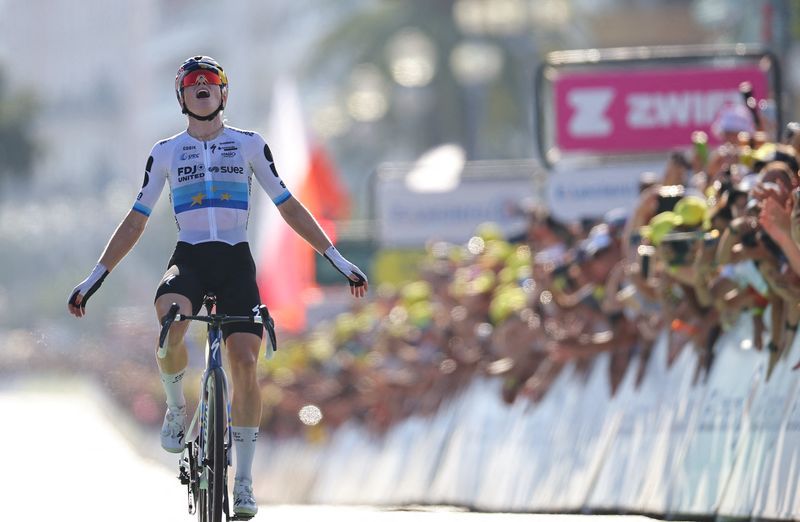
Dutch professional cyclist Demi Vollering has dramatically captured the overall lead at the Tour de France Femmes by winning the gruelling eighth stage on Saturday, overtaking Poland's Kasia Niewiadoma-Phinney just as the race entered its final day. The 171.9-kilometre mountain stage from Sisteron to Nice proved to be the decisive battleground, with Vollering launching a powerful attack on the steep Chemin de l'Arieta climb when just six kilometres of racing remained. Her acceleration proved decisive, as she distanced both Niewiadoma-Phinney and Italy's Elisa Longo Borghini before consolidating her advantage during the technical descent into the Mediterranean coastal city.
Vollering's ascension to the race lead represents a remarkable turnaround in fortune. The FDJ United-Suez rider had suffered a significant setback on Friday when she lost one minute and 16 seconds to Niewiadoma-Phinney during the Mont Ventoux stage, seemingly ceding control of the race to her Polish rival. However, professional cycling's day-to-day nature meant that losing time in one stage did not determine the overall outcome, provided a rider could respond effectively when opportunities presented themselves. Vollering's tactical acumen and physical strength combined perfectly on Saturday to reverse the previous day's misfortune.
The stage victory also marked the fifth time Vollering has worn the yellow jersey during this edition of the Tour de France Femmes, highlighting the competitive volatility of the 2026 race. Remarkably, five different riders have held the race lead at various points throughout the competition, demonstrating that no single competitor has established clear dominance until this penultimate stage. This unpredictability has made the event compelling viewing for cycling enthusiasts across Europe and beyond, as the outcome remained genuinely uncertain heading into the final 24 hours of racing.
Elisa Longo Borghini of UAE Team ADQ claimed second place on the stage after executing a decisive sprint finish against Niewiadoma-Phinney, who crossed the line in third position. The stage placings proved consequential for the overall classification, as cycling races award bonus seconds to the top finishers on each stage in addition to the time gaps established during racing. Combined with these bonuses, Vollering now holds an eight-second advantage over Niewiadoma-Phinney in the general classification, a narrow but meaningful buffer heading into Sunday's concluding stage.
The day's events were complicated by the pre-stage withdrawal of defending champion Pauline Ferrand-Prevot of Visma-Lease a Bike, who was forced to abandon the race due to illness. The departure of the previous year's victor was significant given her pedigree and strength in the mountains, removing a major contender who might have influenced the tactical dynamics of the stage. Her absence meant fewer riders could shape the race narrative, potentially allowing Vollering and her FDJ United-Suez team greater tactical flexibility in executing their planned attack.
Newiadoma-Phinney's frustration with the outcome extended beyond the physical demands of racing, as she levelled specific accusations regarding the conduct of FDJ United-Suez's support riders. She claimed that her rival's teammate Celia Gery had deliberately blocked her into the barriers during the critical Chemin de l'Arieta climb, forcing her to momentarily cease pedalling at the exact moment when intensity was required. Such tactical manoeuvres exist within cycling's grey areas, though they remain controversial within the sport's culture when they approach the boundaries of what competitors consider acceptable racing conduct.
Niewiadoma-Phinney's criticism reflected genuine frustration about competitive fair play, arguing that professional cycling should maintain standards of honourable competition rather than relying on aggressive blocking tactics. Her assertion that Gery's action was deliberately obstructive suggests a deliberate tactical choice by the FDJ United-Suez support rider, though such incidents occur regularly in mountain stages where road width becomes constrained and positioning becomes tactically crucial. The Polish rider's comments indicate she felt her opportunity to respond to Vollering's attack was compromised by circumstance rather than pure cycling strength, a distinction that carries weight within the sport's ethical framework.
Vollering's reflection on the competitive process illustrated the psychological resilience required to compete at professional cycling's highest level. She acknowledged the disappointment of losing significant time on Mont Ventoux but emphasized the importance of mental reset and tactical recalibration rather than allowing negative emotions to dominate her mindset. Her philosophy of approaching each stage with renewed focus and energy, rather than viewing the race as determined by any single day's outcome, proved vindicated by her Saturday performance. This mentality is essential for stage racers who must navigate week-long competitions with multiple opportunities for tactical repositioning.
Looking toward Sunday's finale, Vollering acknowledged the considerable difficulty that the concluding stage would present, cautioning against overconfidence despite her slender lead. She noted that final stages frequently deliver unexpected developments, meaning that her eight-second advantage, while tangible, could be surrendered through either tactical miscalculation or superior physical performance from competitors. Her determination to defend the yellow jersey through the concluding stage, rather than passively managing her time advantage, suggests she intends to race aggressively even with the overall lead.
The context of a cycling world championship series where Malaysian and Southeast Asian audiences have increasingly engaged with professional women's cycling adds resonance to Vollering's breakthrough performance. The growing investment in women's professional cycling infrastructure and media coverage across Asia means that major European races receive greater attention than in previous decades. Vollering's Dutch heritage also carries particular significance given the Netherlands' status as a cycling superpower with deep cultural traditions in the sport, providing additional narrative depth for European audiences.
The Tour de France Femmes has evolved significantly since its reestablishment as a major three-week women's stage race in 2022, establishing itself as genuinely prestigious rather than serving as cycling's secondary women's competition. The quality of professional cyclists competing for overall victory, the demanding mountain stages, and the unpredictable tactical developments throughout the race have elevated the competition's standing substantially. Vollering's emergence as the leading contender for this edition exemplifies how individual performances can define the narrative surrounding women's professional cycling's continuing development.

