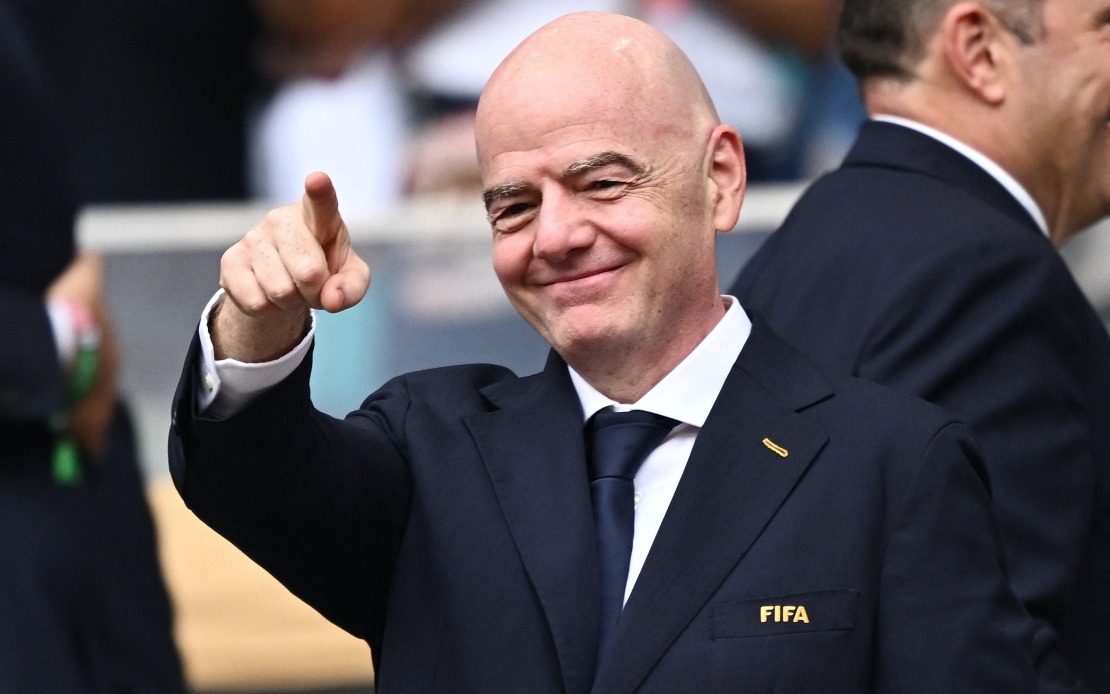
The Football Association of Wales has pulled its backing from FIFA president Gianni Infantino's attempt to secure re-election, marking a significant blow to his leadership credibility as global football governance comes under intense scrutiny. The FAW's reversal followed Infantino's controversial proposal to establish FIFA Forward Enterprise, a mechanism designed to attract private investment into the World Cup—a move that has fractured international football's governing structures and triggered widespread criticism across multiple confederations.
Infantino announced his intention to abandon the privatisation scheme last week after facing unified rejection from three major confederations. Nevertheless, his decade-long tenure atop world football now faces mounting pressure, with influential governing bodies questioning whether he remains suitable for the role. The timing of the FAW's decision reflects broader dissatisfaction that extends far beyond the failed FFE proposal, encompassing what many football administrators view as systemic lapses in leadership judgment and governance standards.
The Welsh governing body's formal statement articulated the depth of institutional frustration, declaring that Infantino had forfeited their confidence through "recent failures in good governance, processes, leadership, values, stakeholder management, communications and sound judgement." This language suggests the dispute transcends the single FFE episode, instead reflecting accumulated disappointment with how Infantino manages FIFA's complex operations and stakeholder relationships. For Malaysia's football community, this development signals potential instability in how FIFA allocates resources and development funds to regional associations, making leadership credibility at the world body a matter of direct consequence.
Britain's political establishment has also intervened, with Prime Minister Andy Burnham characterising Infantino as fundamentally unsuitable for FIFA's presidency, whilst England's Football Association formally called for comprehensive institutional review of his leadership. The English FA has reportedly communicated directly to FIFA, making clear that it no longer extends support to the incumbent president. Such coordinated pressure from Europe's footballing powerhouses represents unusually direct interference in FIFA affairs by national authorities, underscoring how thoroughly Infantino's credibility has eroded among traditional power centres.
Europe's governing confederation UEFA issued a statement indicating that "no option should be off the table," deliberately leaving room for formal no-confidence procedures. Under FIFA's procedural mechanisms, just 43 national associations could trigger an Extraordinary Congress designed to challenge Infantino's position. However, seasoned observers recognise that such constitutional moves would require substantial confidence that a clear majority among FIFA's 211 member associations would actually vote to remove him—a calculation that currently remains uncertain despite the high-profile defections.
CONCACAF, the confederation overseeing North American, Central American and Caribbean football, echoed similar concerns, demanding a full leadership review. Combined, UEFA and CONCACAF represent 96 member associations, constituting a powerful voting bloc. Significantly, CONCACAF's president Victor Montagliani, who currently serves as a FIFA vice-president, has apparently indicated willingness to contest for the presidency should circumstances permit—suggesting potential alternative leadership could materialise from within existing FIFA structures.
Yet Infantino retains meaningful support in other regions. Several African and Asian associations, including those from Morocco, Egypt and Qatar, have publicly endorsed his continued leadership. This geographical split in backing underscores how FIFA's internal politics remain dominated by regional dynamics and strategic alliances. For Southeast Asian nations, the fragmentation within FIFA's membership carries implications for World Cup qualification processes, youth development funding and continental competition structures that depend on presidential decision-making.
The FFE proposal itself represented an unprecedented attempt to monetise the World Cup through private equity arrangements, effectively treating football's premier tournament as an investment vehicle. Infantino's architects apparently believed this mechanism would generate revenues that could be redistributed to smaller associations through FIFA's development programmes. However, the scheme's design reflected apparent disconnection from how confederations and national associations view the tournament—not as a commercial asset to be leveraged, but as sacred institutional property whose integrity requires protection from market forces.
The convergence of pressure from Europe's strongest football nations, coupled with Infantino's visible misstep on the FFE matter, suggests that his re-election campaign faces genuine jeopardy despite formal voting not yet occurring. His decade in office has witnessed FIFA's rehabilitation following the corruption scandals of the 2015-2018 period, yet this evident improvement in ethical standards appears insufficient to overcome accumulated concerns about his strategic judgment and administrative competence. The distinction between cleaning up FIFA's reputation and providing visionary leadership has become increasingly apparent to the confederation leadership.
For Malaysian football observers and administrators, these developments warrant careful attention. FIFA's presidential stability directly influences how international competitions are structured, how development resources flow to regional confederations, and ultimately how opportunities permeate down to national associations. A leadership transition at FIFA, particularly if contested, could reshape priorities and funding allocations in ways that affect Malaysian football's strategic position within Asia's competitive hierarchy. The ongoing uncertainty surrounding Infantino's future therefore constitutes more than European or African institutional concern—it represents a potential inflection point affecting football governance across Southeast Asia.

