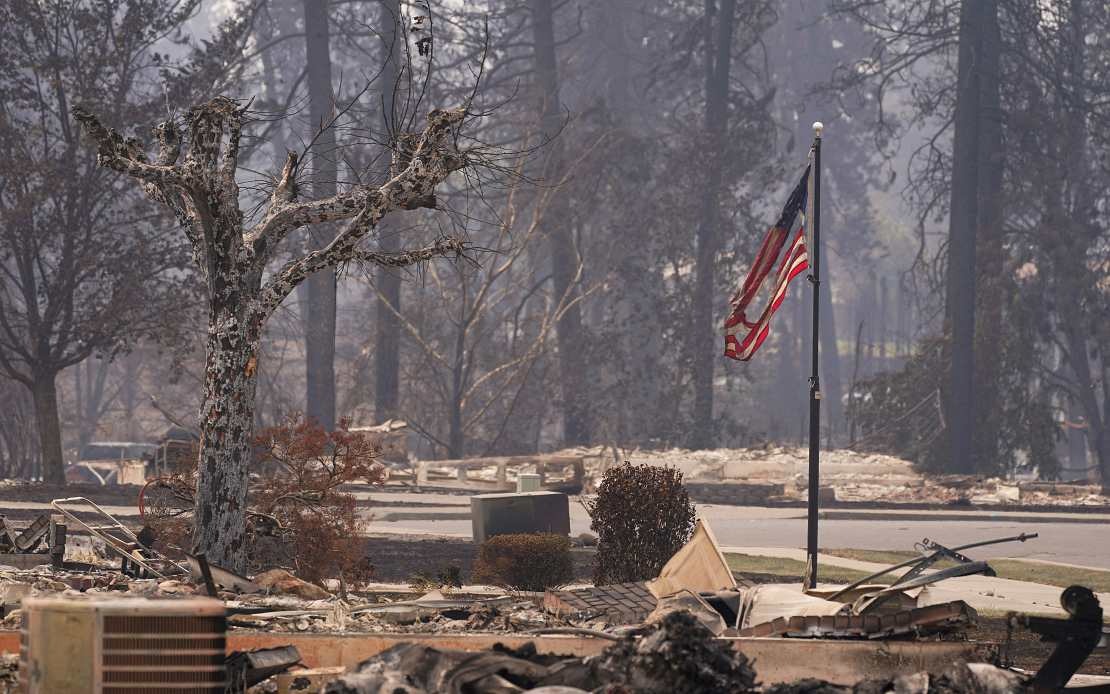
A major wildfire crisis unfolding across Washington state has forced more than 65,000 residents to evacuate their homes as multiple blazes spread across the landscape, with preliminary assessments confirming that at least 700 structures have been destroyed. The American Red Cross confirmed the scale of the evacuation on Monday, underscoring the severity of the disaster and the rapid pace at which the situation has deteriorated across several counties in the northwestern United States.
The situation took a significant turn when authorities arrested a 37-year-old suspect, Aaron F. Farinacci, on a first-degree arson charge in connection with the Old Trails Fire, one of several active blazes threatening the region. Spokane County Sheriff John Nowels announced the arrest at a press conference, disclosing that Farinacci was apprehended Monday afternoon local time and is currently held on a $1 million bond. The arrest highlights the complexity of wildfire management in the region, where natural causes such as lightning strikes compete with intentional acts as sources of ignition.
The fires ravaging Spokane and Stevens counties have already burned 8,026 acres since Saturday, according to data from InciWeb, an interagency fire incident management system. Despite the extensive destruction, these blazes remain completely uncontained, with crews struggling to establish firebreaks and slow the advance of the flames. However, the Spokane Complex Fire Incident Management Team reported some positive developments, noting that more favourable weather conditions are enabling firefighting personnel to make incremental progress along the fire lines, potentially providing a window of opportunity to gain the upper hand against the advancing flames.
The scale of the fire challenge extends well beyond the immediate Spokane area. The Sinlahekin fire has grown to a staggering 85,000 acres since being ignited by lightning on July 26, transforming it into one of the largest active blazes in the state. Battling this mammoth fire requires the efforts of more than 820 personnel working in coordination across multiple agencies, yet even this massive mobilisation has failed to contain the blaze, which stands at zero percent containment. Simultaneously, the Little Giant Fire northwest of Leavenworth has charred 51,298 acres within the Okanogan-Wenatchee National Forest, creating a triple-threat scenario that has stretched regional firefighting resources to their limits.
Washington Governor Bob Ferguson has been coordinating the state's response to the cascading disaster. While officials have successfully accounted for the vast majority of individuals who called for assistance, Ferguson disclosed that authorities are still attempting to contact 14 people to verify their safety and whereabouts. The governor emphasised that these individuals are not classified as missing persons; rather, officials simply wish to confirm their wellbeing in the aftermath of the rapid evacuations. Significantly, Ferguson reported that there have been no confirmed fatalities thus far, a small consolation amid the widespread property destruction and displacement.
For Malaysian readers, this crisis offers several instructive lessons about disaster preparedness and regional cooperation during environmental emergencies. Washington state's experience demonstrates how rapidly wildfires can escalate during periods of dry, hot weather, forcing authorities to make instantaneous decisions affecting tens of thousands of lives. The coordination between state agencies, county sheriffs' departments, and federal firefighting resources mirrors approaches increasingly employed in Southeast Asia, where transboundary haze from wildfire smoke regularly threatens the region's major urban centres and transportation networks.
The arrest of Farinacci underscores an often-overlooked dimension of wildfire management: the reality that human negligence or deliberate action can trigger catastrophes with consequences matching or exceeding those of natural disasters. This reality resonates particularly for Malaysia and neighbouring countries, where annual haze episodes during the dry season have frequently been attributed to large-scale land-clearing operations and agricultural burning. The investigation into the Old Trails Fire origins may provide valuable evidence about how quickly authorities can identify and apprehend suspected arsonists, knowledge that could inform responses to similar incidents in Southeast Asia.
The numerical scale of evacuation in Washington illustrates the capacity of modern natural disasters to displace populations comparable to entire cities. The 65,000 figure represents a significant portion of Spokane's metropolitan area population, emphasising the disruptive power of these events. When contextualised against population densities in Malaysian states such as Selangor or Penang, this scale suggests that a comparable wildfire event in a Southeast Asian setting could potentially displace even larger numbers of people and cause proportionally greater economic damage.
The uncontained status of these Washington fires, despite deployment of hundreds of firefighting personnel and modern suppression techniques, highlights the limitations of current firefighting capabilities when wildfires achieve certain scales. This reality carries important implications for fire management policy across Southeast Asia, where climate patterns and vegetation types differ significantly from North American conditions. As global temperatures continue to rise and dry seasons potentially extend, regional governments may need to reassess their wildfire suppression strategies and invest in new technologies and personnel training adapted to local environmental conditions.
The weather-dependent nature of firefighting progress reported by the Spokane Complex Fire Incident Management Team reflects the fundamental truth that controlling large wildfires ultimately requires environmental conditions to cooperate with human efforts. This dependency on meteorological factors has particular relevance for tropical and subtropical regions like Malaysia, where monsoon patterns and humidity levels interact with temperature extremes to create unpredictable fire behaviour. Preparation strategies must therefore incorporate flexibility to adapt to rapidly changing weather circumstances rather than relying on fixed operational protocols.
Governor Ferguson's emphasis on accounting for evacuated residents and the meticulous tracking of individuals who remain unaccounted for demonstrates modern disaster management's growing attention to comprehensive record-keeping and vulnerable population identification. This approach contrasts sharply with historical disaster responses and suggests a maturation in how authorities conceptualise their responsibilities to displaced populations. Malaysian emergency management agencies might draw lessons from this systematic approach, particularly regarding protocols for tracking vulnerable groups such as elderly residents, individuals with mobility limitations, and those lacking reliable communication devices during forced evacuations.

