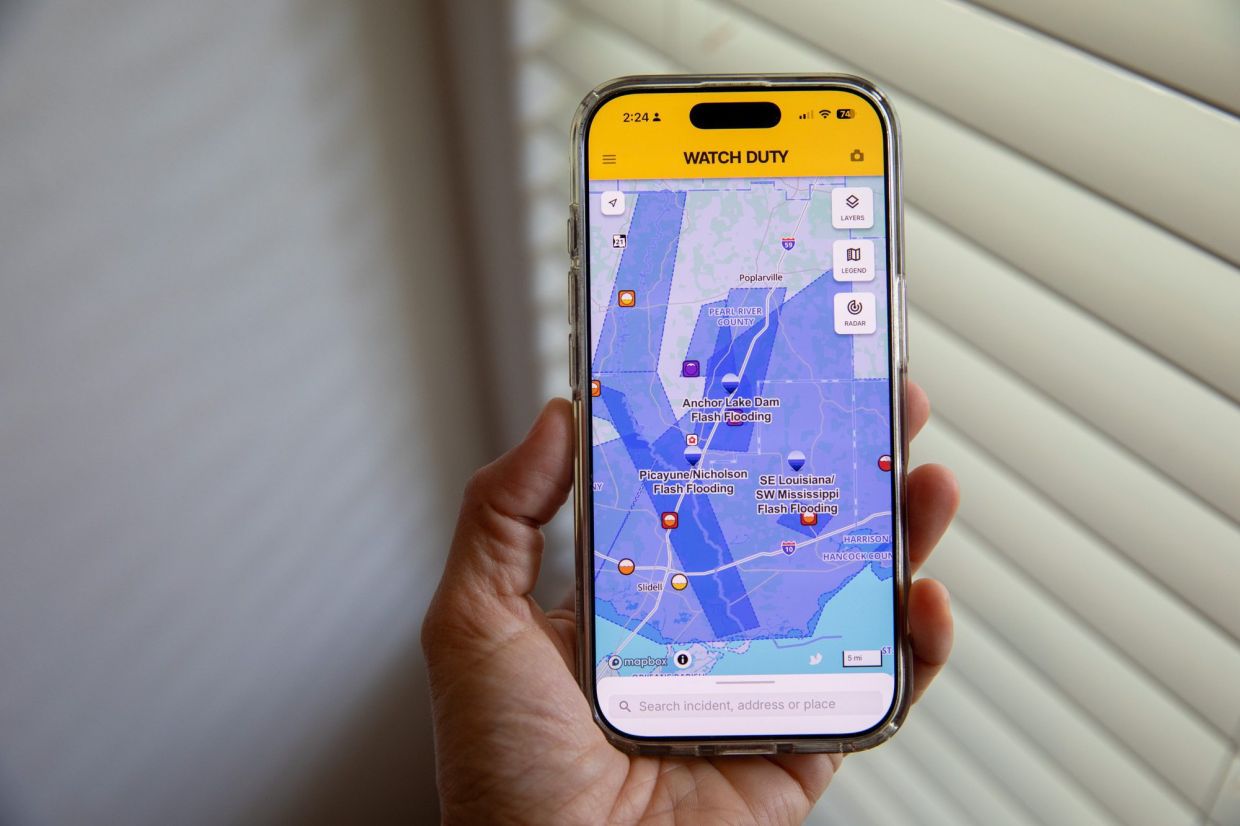
When a wildfire swept towards his Altadena home in California on the evening of January 7, 2025, Matt Blea faced an urgent question shared by thousands of residents: should his family shelter in place or evacuate immediately? A recommendation from a friend working in mountain rescue to download Watch Duty, a free application, proved decisive. Through the app's interface, Blea tracked the fire's expanding perimeter, monitored evacuation directives, and followed real-time updates on emergency response operations. The intelligence he gathered prompted him to leave with his wife and son that same evening, a decision that likely saved their lives when the Eaton Fire subsequently destroyed their home. Blea's experience reflected a broader pattern: more than 2.5 million users activated Watch Duty during the Los Angeles County fire crisis that week, relying on a small team of approximately two dozen paid staff members and over one hundred volunteers who continuously sifted through emergency radio frequencies, aircraft communications, and official agency bulletins.
The app's demonstrated value during the catastrophic January blazes underscores a persistent vulnerability in American emergency management infrastructure. David Hertz, a Malibu resident and fire brigade captain, characterizes Watch Duty's function as fundamentally democratizing access to critical information that bureaucratic channels often fail to distribute equitably or promptly. During the Eaton and Palisades fires that claimed 31 lives, numerous communities experienced minimal or delayed official warnings, highlighting the consequences when notification systems break down under extreme conditions. Watch Duty's success stems partly from its streamlined operational model: volunteers dedicate themselves solely to monitoring and synthesizing information from multiple sources including radio scanners, satellite imagery, cameras, and user submissions, then translating this raw data into accessible formats for mass distribution.
John Mills, the nonprofit's chief executive and co-founder, launched Watch Duty in 2021 following his own harrowing experience with inadequate emergency alerts when a fire threatened his Northern California residence. The app receives financial support through grants and donations, accumulating nearly six million US dollars in 2025 alone, which enables its expansion beyond the volunteer-dependent model that initially sustained it. Mills recognised early that emergency information often exists within government and agency systems but remains inaccessible to ordinary citizens during crises. The fragmentation of alerts across multiple government websites, social media channels, and notification systems creates precisely the communication failures that claimed lives during recent disasters. By consolidating this dispersed intelligence into a single, user-friendly interface with notifications capable of penetrating even silenced phones, Watch Duty addresses a genuine gap in public safety infrastructure.
The platform's expansion into flood tracking, initiated in June, responds to intensifying climate hazards that increasingly threaten communities beyond traditional wildfire zones. The timing coincides with peak flood season across the United States and arrives nearly one year after deadly Texas floods that killed over 130 people, an event that sparked widespread criticism of inadequate public warnings in Hill Country areas. Mills emphasises the urgency driving this expansion, noting that the fundamental challenge remains unchanged: authorities struggle to disseminate life-critical information through sufficient channels with adequate speed and clarity. The frustration embedded in his observation reflects systemic failures where information exists but fails to reach those facing immediate danger because official processes depend on human judgement exercised under extreme pressure, often with incomplete situational awareness.
Watch Duty's operational structure enables faster information dissemination than many official agencies can achieve. The nonprofit maintains approximately three hundred volunteer "reporters" who continuously monitor multiple information streams including radio scanners, satellite data, weather services, and public announcements, then verify and synthesize findings for immediate publication. Pete Curran, Watch Duty's chief meteorologist and a retired firefighter, explains that the app's speed advantage derives partly from role specialisation: volunteers focus exclusively on observation and communication, unburdened by incident command responsibilities that occupy official responders. The platform delivers information through maps, text updates, and push notifications available in five languages, consolidating resources that users would otherwise access through fragmented government websites, weather services, and emergency management portals. This consolidation appeals strongly to residents facing emergencies who lack time or cognitive capacity to navigate multiple information sources simultaneously.
The flood monitoring expansion addresses a critical blind spot in American emergency preparedness. Dr Lori Moore-Merrell, who served as US Fire Administrator under President Biden and now sits on Watch Duty's board, highlights how climate change is producing rainfall patterns in regions where such precipitation historically occurred infrequently or never. Communities lacking generational memory of flooding face particular vulnerability when unprecedented precipitation arrives, as residents and emergency planners struggle to conceptualise appropriate responses to conditions they have never witnessed. Watch Duty integrates data from the National Weather Service, National Oceanic and Atmospheric Administration, and the US Geologic Survey, displaying flood warnings and watches, river gauge levels, and alerts regarding potential dam or levee failures. Users can determine whether their residences fall within Federal Emergency Management Agency flood zones and establish customised notifications triggered when river levels reach specified thresholds, enabling proactive rather than reactive decision-making.
Despite Watch Duty's rapid expansion and impressive user adoption, sceptical observers in emergency management recognise fundamental limitations inherent to technological solutions for public safety communication. Chad Berginnis, executive director of the Association of State Floodplain Managers, characterises warnings as effective only when recipients understand how to respond appropriately. Merely delivering information about impending floods provides insufficient value if people lack evacuation routes, shelter resources, or practical knowledge of survival measures. Berginnis emphasises that effective emergency preparedness demands not only theoretical planning but repeated practical drills that build muscle memory and confidence for executing evacuation procedures under extreme stress. Many communities fail precisely at this implementation stage, possessing warning systems but lacking the coordinated infrastructure and public education necessary to translate alerts into appropriate protective actions.
The broader context of American emergency management infrastructure faces mounting pressures that technology alone cannot remedy. Federal agencies and local emergency warning systems have experienced funding constraints both in recent years and through proposed budget cuts that threaten the human and technological capacity necessary for robust monitoring and alerting. Berginnis underscores that effective eyes-and-ears systems require sustained financial investment; neither government nor nonprofit organisations can maintain sophisticated surveillance networks on limited budgets. This fiscal reality creates dependence on volunteer contributions that, while often heroic, cannot reliably substitute for professional staffing when emergencies overwhelm available personnel. Watch Duty's successful volunteer model demonstrates that motivated individuals will commit to life-saving work, yet relying primarily on volunteers for critical infrastructure raises sustainability questions as communities face increasingly frequent emergencies.
Mills carefully emphasises that Watch Duty functions as a supplement rather than a replacement for official emergency management systems. The nonprofit continues advocating that residents enrol in their local government alerting systems and remain engaged with National Weather Service forecasts and fire service communications. The app integrates and amplifies these official sources while filling communication gaps, but cannot substitute for the comprehensive jurisdiction-wide infrastructure that weather agencies and emergency services provide. This measured positioning reflects both practical reality and strategic prudence: Watch Duty's legitimacy and public trust derive partly from its status as a genuine partner to official agencies rather than a competitor claiming superior capabilities.
Critical accessibility limitations constrain Watch Duty's protective reach despite its impressive technological capabilities. The application provides value only to users who discover and install the software, and its real-time functionality depends on cellular coverage that remains unavailable or unreliable in many rural and underserved communities. Berginnis advocates for redundant warning systems that compensate for inevitable technological failures and coverage gaps; remarkably inexpensive NOAA weather radios can deliver critical alerts when mobile networks fail or users lack smartphones. This observation underscores a paradox in modern emergency management: technological sophistication sometimes obscures simple, proven solutions that function independently of internet connectivity or digital literacy. Communities achieving effective disaster resilience typically employ layered approaches combining multiple communication channels, practised evacuation procedures, and community preparedness education rather than depending on any single platform.
For Southeast Asian audiences, Watch Duty's expansion offers important lessons regarding emergency communication during climate-intensified disasters. The region experiences severe flooding with increasing frequency, yet many countries struggle with fragmented warning systems and delayed information dissemination that cost lives unnecessarily. Malaysia's experience with severe flooding in recent years demonstrates how inaccessible or confusing official alerts contribute to preventable casualties and property losses. Watch Duty's model of volunteer-powered information aggregation adapted to flood conditions could inspire regional responses, though implementing such systems would require addressing local technological infrastructure, digital literacy, and institutional coordination challenges. The app's success particularly validates the principle that citizen engagement in emergency monitoring can supplement government capacity, a principle with particular relevance in developing economies facing resource constraints during expanding climate emergencies.
The underlying lesson transcends any single application or technology: effective emergency communication demands deliberate, continuous effort to ensure that life-critical information reaches threatened populations through multiple channels, in comprehensible formats, with sufficient timeliness to enable protective action. Official agencies struggle with this challenge partly because emergency management competes for attention with routine responsibilities, leaving response systems underfunded and overtaxed when disasters occur. Watch Duty's growth reflects public appetite for reliable information during emergencies and demonstrates that citizens will voluntarily contribute to collective safety if infrastructure exists to coordinate their efforts. Yet sustainability requires stable funding, professional expertise, and integration with official systems rather than technological solutions alone. As climate change intensifies both wildfire and flood hazards globally, communities worldwide face urgent decisions about whether to sustain investment in early warning infrastructure or accept mounting preventable casualties from disasters that trigger increasingly predictable disasters with ever-wider geographic scope.

