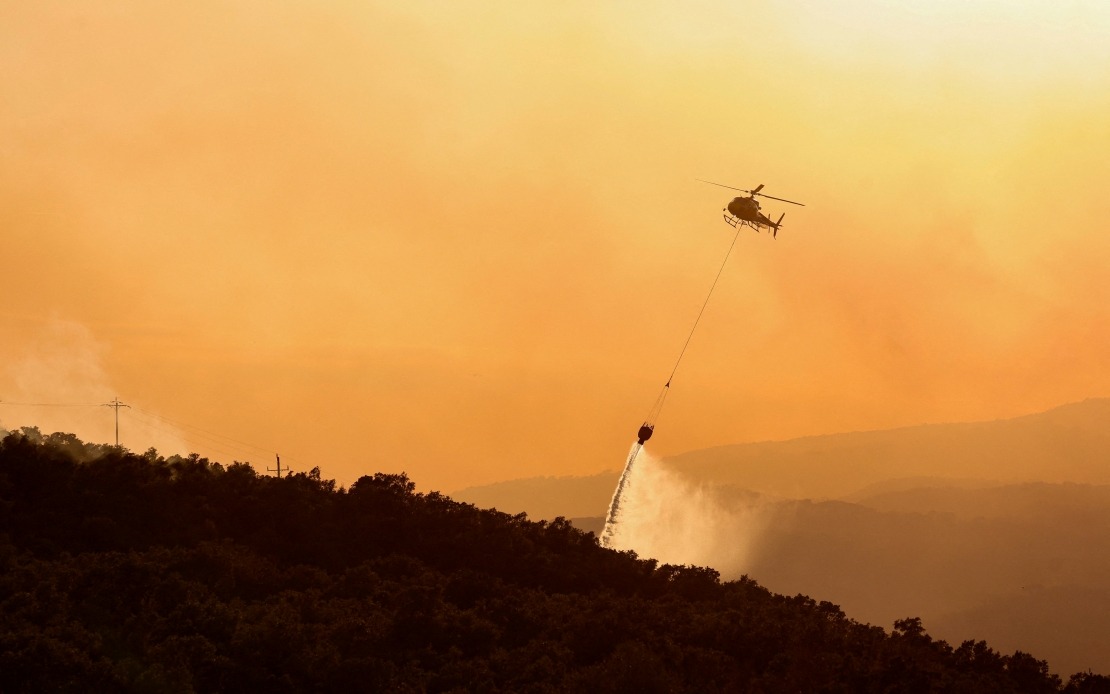
As the United States prepared to commemorate its 250th anniversary on July 4, communities across the western states found themselves forced to abandon one of the nation's most cherished traditions: Independence Day fireworks. A combination of severe drought conditions, active wildfires spanning multiple states, and dangerous weather patterns created an environment so volatile that local officials deemed the customary pyrotechnic celebrations an unacceptable public safety risk.
The scale of the wildfire emergency became evident in a national incident report released on Friday, which documented 41 large uncontained fires burning across the country. The situation was grave enough to elevate the nation's wildfire preparedness level to its second-highest threshold, a classification indicating that resources were already heavily committed to active suppression efforts. This context underscores why even a single day of widespread fireworks ignition could overwhelm an already stretched firefighting infrastructure.
Utah emerged as one of the most severely affected states, where Governor Spencer Cox issued a temporary statewide fireworks restriction effective through July 5. The executive order permitted local governments to designate limited zones where fireworks could still be used under controlled circumstances, representing a compromise between tradition and safety. The underlying crisis was stark: state drought data revealed that 94 percent of Utah was experiencing either severe or extreme drought conditions, creating tinderbox-like vegetation across vast areas.
The severity of Utah's wildfire situation transcended typical seasonal patterns. Jamie Barnes, the state's chief forester, characterised the conditions as fundamentally unprecedented, noting that fires were spreading with greater velocity than in recent memory. By early July, Utah had already burned more land than it had during the entire four-year period preceding 2024, a sobering metric that illustrated how dramatically fire activity had accelerated. This acceleration appeared linked to the combination of prolonged drought stress and extreme temperatures that amplified fuel vulnerability.
Colorado faced similarly dire circumstances, with more than a dozen major wildfires actively burning throughout the state during the week leading to Independence Day. The Colorado Division of Fire Prevention and Control reported widespread activity that prompted multiple municipalities to abandon their planned celebrations. Durango, Vail, and Pueblo all cancelled their Fourth of July fireworks displays, reflecting a coordinated recognition that public safety superseded holiday tradition. Vail's decision held particular significance, as the resort town had only cancelled its annual fireworks display six times since 1998, with the most recent cancellation occurring in 2021. This year's decision to cancel again testified to the exceptional nature of the current wildfire threat.
Colorado Springs, the state's second-largest city, implemented an even more stringent response by cancelling all July 4 fireworks shows scheduled throughout the week. The city's fire department justified the sweeping decision by citing extreme fire danger, drawing explicit parallels to atmospheric conditions preceding the 2012 Waldo Canyon Fire, which destroyed over 300 homes and caused massive evacuations. Such a comparison carried considerable weight with the public, as it invoked a recent catastrophe that remained vivid in local memory and demonstrated that the current risk level was comparable to circumstances known to produce major disasters.
Restrictions extended well beyond Colorado and Utah. Wyoming, Nebraska, and New Mexico all imposed varying degrees of limitation on fireworks, whether through statewide mandates or localized prohibitions. The geographic breadth of these restrictions illustrated the continental scale of the environmental crisis. Notably, most professional fireworks displays—which typically use licensed facilities with enhanced safety protocols and trained personnel—were expected to proceed as planned, suggesting that restrictions primarily targeted consumer and community-level celebrations where safety controls were more limited.
Meteorological forecasts further complicated the situation. The national incident report warned that strong winds combined with extremely low humidity would elevate fire danger across the southwestern United States during the Independence Day period. Simultaneously, much of the eastern and central portions of the country grappled with dangerously elevated temperatures, with heat indices exceeding 46 degrees Celsius in certain locations according to the National Weather Service. These concurrent weather phenomena—drought, low humidity, extreme heat, and wind—created precisely the atmospheric conditions under which fires ignite most readily and spread most rapidly.
The scientific understanding of fireworks' contribution to wildfire risk has become increasingly refined in recent years. Philip Higuera, a fire ecology specialist at the University of Montana, articulated a crucial insight when he observed that July 4 represents a singular day on which enormous quantities of ignition sources are deliberately introduced across the landscape. The concentration of fireworks-related fire ignitions on a single date creates a spike in fire initiation that exceeds any other day of the year, overwhelming normal fire-suppression capabilities across wide geographic areas.
Research synthesised by Lauren Lowman, an associate professor at Wake Forest University, provided quantitative perspective on the relationship between extreme heat and western wildfires. Analysis of burn records demonstrated that nearly half of all land burned across the western United States since 2001 had ignited during or in the immediate aftermath of heat wave events. This temporal clustering suggests that heat extremes do not merely contribute to fire conditions but actively catalyse the most destructive burning episodes. Historical fireworks records supported this pattern: approximately 15,000 wildfires were recorded on July 4 between 1992 and 2020, while comprehensive data from 2023 indicated that fireworks caused an estimated 32,000 fires nationwide throughout that single year.
For Malaysian and Southeast Asian readers, the unfolding crisis in the western United States carries cautionary implications. The region experiences its own fire seasons driven by drought and heat, particularly in Indonesia and occasionally affecting neighbouring countries through transboundary haze. The American experience demonstrates how concurrent environmental stressors—drought, heat, and low humidity—can rapidly overwhelm even well-resourced fire-management systems, a lesson applicable to nations with less developed fire-suppression infrastructure. Furthermore, the willingness of American communities to forgo beloved traditions in service of collective safety offers a model of risk-conscious governance that prioritises long-term community welfare over short-term satisfaction.
The cancellations and restrictions imposed across the western United States during July 2024 represented not a failure of Independence Day celebrations but rather a practical acknowledgment that climate and environmental conditions had shifted in ways that demanded adaptive responses. By accepting temporary sacrifice of customary practices, communities demonstrated a capacity to align behaviour with environmental reality—a flexibility that may increasingly characterise governance and public life as climate volatility continues to reshape the conditions under which societies operate.

