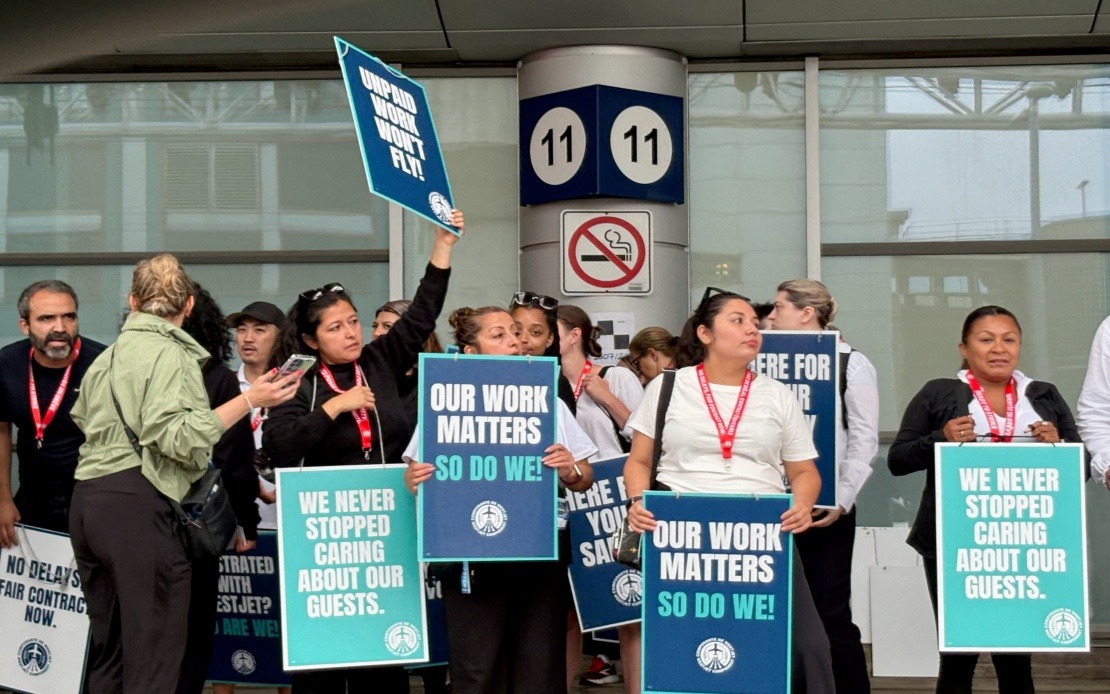
Canada's second-largest airline, WestJet, has come to a standstill following a strike initiated by more than 4,000 flight attendants on Sunday. The labor action has effectively grounded approximately 600 flights per day and left an estimated 250,000 passengers scrambling to reschedule their journeys. The timing could hardly be worse for the carrier, as the strike coincides with Monday's civic holiday in Canada, one of the busiest travel weekends throughout the year. The disruption is expected to inflict considerable financial losses on WestJet, adding to mounting pressure on the airline industry already grappling with operational challenges and competitive pressures across North America.
At the heart of this labor dispute lies a deceptively straightforward yet contentious issue: compensation for work performed on the ground. Flight attendants have been demanding that WestJet provide pay for the labour they undertake before passengers board and after they disembark, work that currently goes uncompensated in their existing contract structure. This demand reflects a broader industry shift toward recognising the full scope of cabin crew responsibilities beyond the actual flight hours themselves. The union representing the attendants, the Canadian Union of Public Employees, characterizes this as recognition of work that has historically been invisible in payroll calculations despite being essential to flight operations.
The compensation demand carries particular significance because other North American carriers have already moved in this direction. Delta Air Lines pioneered the concept in 2022 by becoming the first major airline to introduce paid compensation for ground work. Air Canada subsequently followed suit in February of this year, cementing a new contract that provides flight attendants with compensation of up to 70 per cent of their hourly rate for the hour immediately preceding takeoff. These developments have created an industry precedent that now pressures WestJet to align its terms with competitors, establishing a de facto standard that workers view as reasonable and achievable.
WestJet's flight attendants currently earn between $28.88 and $53.61 per credit hour, a compensation structure that does not account for pre-flight and post-flight duties. While these hourly rates appear competitive on the surface, the lack of ground work compensation represents a significant gap in total remuneration when calculated across an entire career in aviation. Flight attendants argue that this creates an artificial ceiling on their earnings relative to colleagues at Air Canada and other carriers that have recognised ground work pay. The Canadian Union of Public Employees emphasised in their official statement that the strike could have been avoided had WestJet demonstrated genuine willingness to address worker concerns throughout nearly eleven months of bargaining.
Union representative Alia Hussain articulated the frustration driving the labour action, stating bluntly that the strike would not have occurred if WestJet had taken union proposals seriously during the prolonged negotiation period. This rhetoric reflects a classic labour dispute pattern where extended bargaining without meaningful concessions eventually exhausts worker patience and triggers industrial action. The near-year-long negotiation period underscores the intransigence of both parties, each apparently waiting for the other to capitulate on what each views as a fundamental principle regarding fair compensation.
WestJet's response to the strike has been measured in tone while demonstrating concern about operational and reputational fallout. Chief Executive Officer Alexis von Hoensbroech told The Canadian Press that the airline regrets being in this position, acknowledging that the labour action directly damages the travel plans of passengers, employees, and the businesses and communities they serve. The carrier has committed to providing refunds to affected passengers, a standard but expensive commitment that underscores the financial impact of the disruption. However, WestJet has not indicated any shift in its negotiating position regarding ground work compensation, suggesting that further rounds of talks may be necessary before a resolution emerges.
Federal Jobs Minister Patty Hajdu weighed in on the dispute through social media, expressing disappointment that negotiating parties had failed to reach agreement despite their efforts to craft a new contract. Her intervention, while relatively soft in tone, signals that government is monitoring the situation. In Canada's industrial relations landscape, federal minister commentary typically precedes potential government intervention if labour disputes threaten broader economic stability or consumer hardship. The timing of the strike during a major holiday weekend, affecting hundreds of thousands of travellers, may increase political pressure on both sides to resolve the impasse quickly.
The WestJet strike arrives at a particularly sensitive moment for Canada's aviation sector, which has endured considerable disruption in recent years. Airlines across the country have faced staffing challenges, schedule delays, and capacity constraints as demand has rebounded post-pandemic. Any extended labour action by a major carrier creates cascading effects throughout the entire system, as passengers scramble to rebook on other airlines and cargo operations face delays. Competitors like Air Canada and smaller carriers may benefit from diverted passenger traffic in the short term, but industry-wide reputational damage occurs when travellers face widespread cancellations and uncertainty.
Looking at the dispute through a broader international lens reveals patterns familiar to Malaysian and Southeast Asian aviation observers. Labour unrest at major carriers often stems from compensation gaps relative to regional or global peers, particularly when new industry standards emerge. The precedent established by Delta and Air Canada essentially forces WestJet to choose between matching competitor terms or accepting ongoing labour tension. For Malaysian readers following international aviation trends, the WestJet situation illustrates how work recognition and compensation parity drive labour relations in developed aviation markets, principles that increasingly influence labour expectations in Southeast Asian aviation hubs as well.
The resolution of the WestJet strike remains uncertain, with both parties entrenched in their positions after months of unsuccessful negotiation. Flight attendants appear committed to maintaining strike action until WestJet agrees to meaningful ground work compensation, while management shows no sign of capitulating to demands it apparently views as unsustainable. Industry observers suggest that federal mediation or passenger compensation pressures may eventually force compromise, but absent intervention, the strike could persist for days or weeks, extending disruption far beyond the initial holiday weekend. The outcome will likely influence labour negotiations at other Canadian carriers and may establish precedent affecting aviation labour relations across North America.

