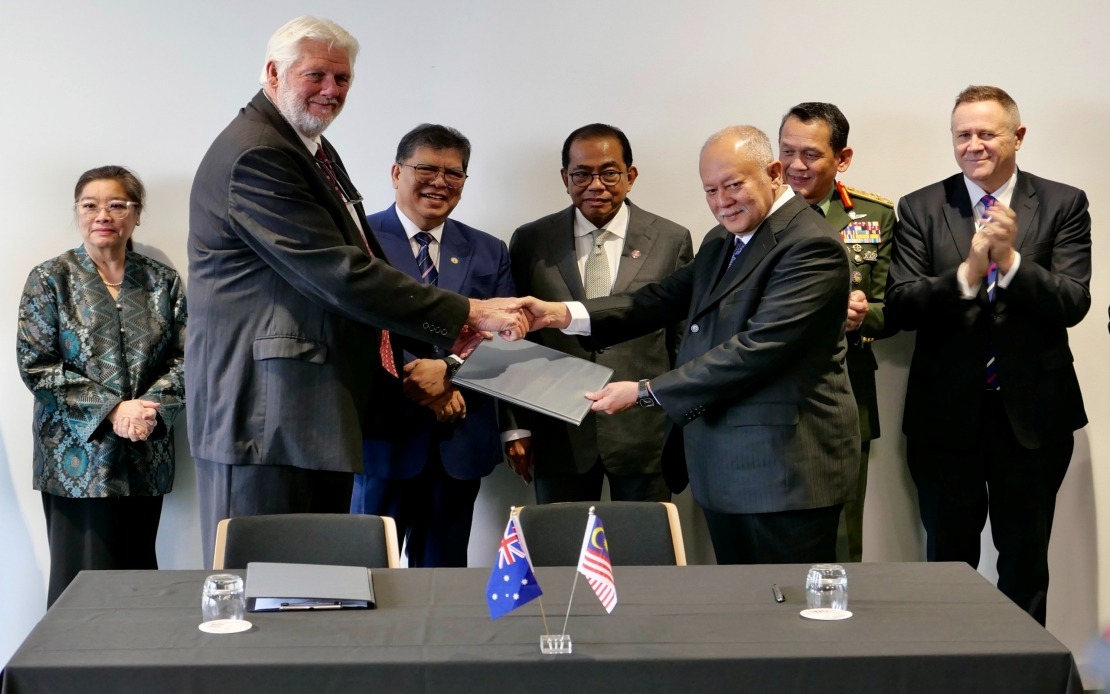
Malaysia's defence manufacturing ambitions took a significant leap forward with the establishment of a strategic partnership between homegrown Weststar Defence Industries and Australian rocket technology specialist Rocket Technologies International, signalling the country's determination to develop indigenous capabilities in advanced weapons systems. The collaboration, formalised during Defence Minister Datuk Seri Mohamed Khaled Nordin's working visit to Australia, represents a calculated investment in building local expertise for both rocket and subsequently missile production. This move reflects a broader regional trend of Southeast Asian nations seeking to reduce dependence on traditional defence suppliers whilst establishing sovereign manufacturing capabilities aligned with their strategic interests.
The partnership directly supports Malaysia's National Defence Industry Policy, a framework designed to nurture domestic defence manufacturing ecosystems and reduce reliance on foreign procurement for critical systems. By bringing Australian technical knowledge and manufacturing standards into Malaysia through Weststar, the arrangement allows the nation to leapfrog developmental stages that might otherwise require years of independent research and experimentation. For Weststar Group founder Tan Sri Dr Syed Azman Syed Ibrahim, the agreement represents validation of the company's capabilities and ambitions within the regional defence sector. The two-year timeline for commencing rocket production establishes a concrete deliverable, though industry observers will likely scrutinise whether this remains achievable given Malaysia's limited historical experience in advanced propulsion systems.
What distinguishes this arrangement from straightforward technology licensing is its integration into Rocket Technologies International's global supply chain. Rather than creating an isolated Malaysian production hub, the partnership positions Weststar as a node within an international network of defence manufacturers. This opens pathways for Malaysian subcontractors and component suppliers to participate in projects far exceeding domestic demand, creating economic spillover effects throughout the local aerospace and industrial sectors. The arrangement acknowledges an economic reality: developing countries cannot justify massive defence manufacturing investments solely to serve their own armed forces, but can become viable manufacturing hubs if integrated into larger international frameworks where economies of scale operate.
The minister's three-day Australian visit included substantive engagement with academic and research institutions, indicating that Malaysia's defence modernisation strategy increasingly recognises the critical role of university-industry partnerships in developing cutting-edge military technologies. The tour of the Institute for Space, Defence and Advanced Technologies at the University of Southern Queensland, alongside inspections of composite manufacturing and hypersonics research laboratories, underscores that rocket and missile development cannot be conducted in isolation from fundamental scientific research. This contrasts with some developing nations' approaches to defence acquisition, which often prioritise purchasing finished systems over building institutional knowledge bases. Malaysia appears to be taking a longer-term perspective, understanding that sustainable defence manufacturing capability depends on embedding advanced research competencies within local educational institutions.
The delegation's composition, including Royal Malaysian Air Force chief General Tan Sri Muhamad Norazlan Aris and Universiti Pertahanan Nasional Malaysia vice-chancellor Lt Gen Datuk Wira Arman Rumaizi Ahmad, reflects how thoroughly the Malaysian government has integrated this initiative into its defence planning apparatus. Military leadership involvement signals that the air force views this partnership as addressing genuine capability gaps, not merely as an industrial development exercise. The presence of academic leadership indicates recognition that universities must evolve from teaching institutions into innovation engines capable of contributing to weapons system development. Such integration mirrors successful models employed by nations with mature defence industrial bases, where military requirements directly shape university research agendas.
The bilateral dimensions of Mohamed Khaled's visit underscore the diplomatic weightings attached to this commercial arrangement. High-level meetings with Australian Deputy Prime Minister and Defence Minister Richard Marles, parliamentary engagements at Parliament House, and discussions with Speaker of the House of Representatives Milton Dick all signal that both governments view the Weststar-RTI partnership within a broader strategic context. For Australia, the arrangement represents an opportunity to influence Malaysia's defence trajectory towards compatibility with Western systems and operational standards, whilst diversifying its own industrial base through Malaysian manufacturing partnerships. For Malaysia, the engagement provides a pathway to deepen defence ties with a technologically advanced neighbour sharing similar regional security concerns, particularly regarding freedom of navigation and stability in contested maritime zones.
The emphasis on sovereignty in the minister's public statements warrants careful analysis. By repeatedly invoking Malaysia's sovereign defence capability and local expertise development, the government seeks to frame foreign partnership as empowerment rather than dependence. This rhetorical positioning becomes important domestically, where nationalist sentiment can sometimes resist collaboration arrangements perceived as subordinating Malaysian interests to foreign corporations. The government's framing suggests that technology transfer and local manufacturing capacity represent genuine sovereignty gains, since Malaysia will eventually possess knowledge and production infrastructure that cannot be unilaterally withdrawn by foreign partners. Whether this vision materialises depends on implementation effectiveness and the extent to which Weststar successfully transitions from serving as a Malaysian assembly point towards developing independent engineering and design capabilities.
From a Southeast Asian perspective, the Weststar-RTI arrangement carries broader implications for regional defence industrialisation. Thailand, Indonesia, and Vietnam have pursued similar strategies of attracting foreign defence manufacturing partnerships to build local capacity. Malaysia's success or failure in this instance will likely influence how other regional governments approach similar ventures, particularly regarding technology transfer terms and the balance between foreign investor interests and local capability development. The arrangement also introduces a new variable into regional defence dynamics, as Malaysian-manufactured rocket systems could potentially alter military balances within Southeast Asia, though current statements emphasise defensive purposes aligned with the country's stated security doctrine.
The timeline for missile production expansion following initial rocket manufacturing deserves scrutiny, as it represents an ambitious acceleration from civilian or defensive applications towards weapons systems carrying greater strategic weight and regulatory complexity. The decision to pursue missile production locally rather than through continued acquisition from traditional suppliers reflects Malaysia's assessment that indigenous manufacturing offers advantages in customisation, logistical sustainability, and strategic autonomy. However, missile development introduces proliferation considerations that may invite international scrutiny, particularly from non-proliferation regimes monitoring advanced weapons technology diffusion within the developing world.
Economically, the investment promises job creation across manufacturing, engineering, and supporting industries within Malaysia. The defence sector offers relatively high-wage employment for skilled workers, particularly those with backgrounds in advanced manufacturing, materials science, and systems engineering. Educational institutions, particularly those with defence focus like Universiti Pertahanan Nasional Malaysia, stand to benefit from increased industry engagement and potential research funding. The arrangement may catalyse broader development of Malaysia's aerospace and advanced manufacturing sectors beyond strictly defence applications, as technologies and expertise developed for military systems often find civilian applications.
Politically, the initiative allows the government to demonstrate commitment to strengthening national defence capabilities through concrete projects rather than relying solely on foreign acquisition. Defence procurement often generates domestic controversy regarding transparency and value-for-money; manufacturing partnerships offer an alternative narrative emphasising knowledge transfer and local capability building. Mohamed Khaled's emphasis on strategic investment for future generations suggests the government views this arrangement as establishing foundations for long-term defence self-sufficiency, even if full autonomy remains distant. The partnership thus serves multiple political purposes simultaneously: demonstrating government competence in defence matters, strengthening Australia bilateral relations, advancing industrial policy objectives, and building institutional capacity for future defence innovation.
The Weststar-RTI partnership represents a calculated bet that Malaysia can successfully transition from defence equipment importer to manufacturing nation within advanced technology domains. Success requires not only effective technology transfer but also building human capital, establishing quality assurance frameworks, integrating academic research with industrial production, and navigating the complex regulatory environment surrounding weapons manufacturing. The Australian government's approval and support suggests confidence in the arrangement's viability, though international investment in defence manufacturing by developing nations invariably involves risks regarding political stability, regulatory consistency, and technical competence. Malaysia's track record in managing complex manufacturing partnerships, combined with its strategic location and relatively stable governance, provides grounds for cautious optimism regarding this venture's ultimate success in advancing both national defence capacity and industrial development objectives.

