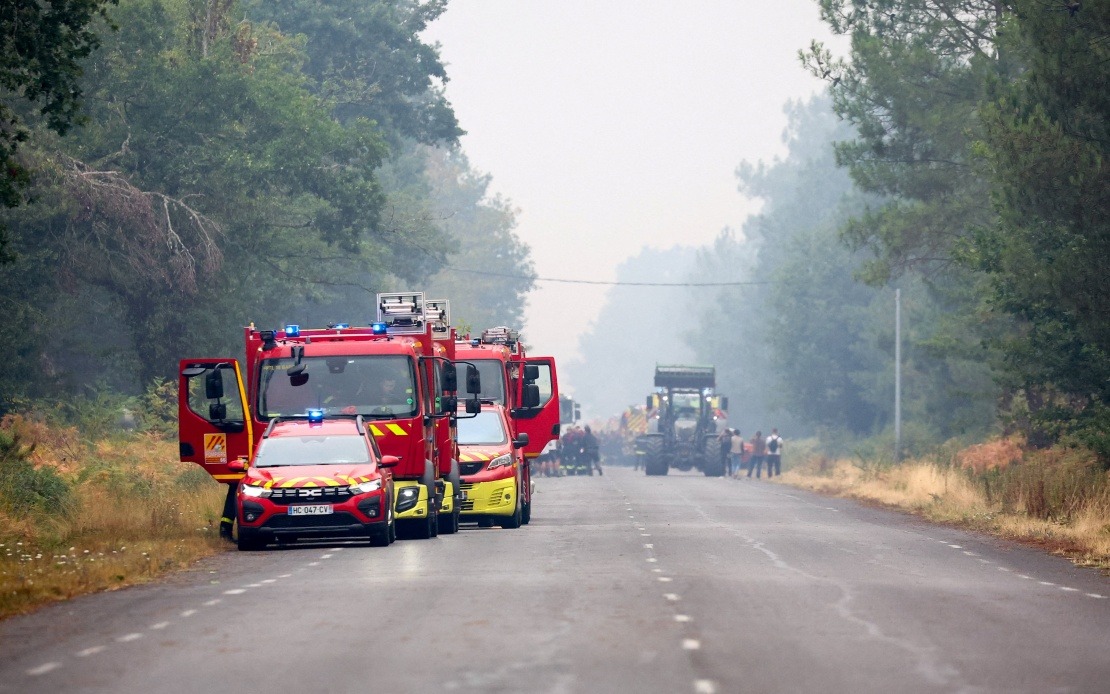
The massive wildfires that have consumed thousands of hectares across southwestern France and central Spain showed tentative signs of being brought under control by Wednesday, marking a slight respite in what has become one of Europe's most challenging fire seasons. However, the respite appears fragile, as weather forecasters warn of an imminent fresh heat wave that threatens to reignite the blazes and intensify firefighting efforts across both nations. The simultaneous challenges of managing active fires while preparing for worsening atmospheric conditions highlight the escalating threat posed by extreme weather patterns in Mediterranean Europe.
In Gironde, the southwestern French department that has borne the brunt of the disaster, authorities reported that the primary wildfire had stabilized by Wednesday morning, though overnight operations revealed several flare-ups that firefighters managed to suppress before they could spread. The prefecture noted that the preceding night had been comparatively calm, allowing 2,000 firefighters to consolidate their gains and work methodically through the still-active fire perimeter to eliminate remaining hotspots. The human toll has been substantial, with 126 firefighters sustaining injuries since the outbreak began. Across other affected French regions, the Var department in the southeast had its fire fully contained after it had ravaged nearly 4,800 hectares, while the Landes department to the southwest saw its blaze brought under control on Monday following the destruction of 3,600 hectares, though up to 350 firefighters remained positioned there to prevent recurrence.
The partial progress in containing individual fires across France masks the broader vulnerability of the region, with 65 departments placed under orange alert status for Wednesday due to elevated forest fire risk. This precautionary measure underscores how quickly conditions could deteriorate, as Meteo-France simultaneously issued orange heat alerts across 16 departments, signalling that the meteorological conditions favourable to large-scale fires are not yet departing the region. The dual emergency—managing existing fires while preparing infrastructure and personnel for potentially more severe fire weather—strains resources and attention across French emergency services.
Spain's situation presents a similarly complex picture, with firefighting operations continuing across multiple regions despite some progress in evacuation zones. The Sierra Oeste region near Madrid remained stable overnight without significant flare-ups, yet active fires continued burning in Madrid, Avila, Toledo, Castellon, and Almeria, indicating the distributed nature of the crisis across the country. The Spanish government authorized the return of residents from 15 municipalities in Madrid and Avila late Tuesday, while 9,000 residents in Castellon and 6,000 residents from 11 Toledo municipalities were permitted to leave temporary shelters and return home. However, these modest population movements cannot overshadow the continuing emergency in Castellon, where the Vall d'Uixo wildfire has burned uncontrolled since Saturday, destroying 10,000 hectares and forcing 10,000 people to evacuate.
The scale of infrastructure damage across the affected zones of Spain remains substantial despite some containment progress. Thirty roads remain closed spanning five provinces—Avila, Castellon, Madrid, Toledo, and Leon—disrupting commerce, tourism, and daily life across a significant swath of central Spain. This transportation paralysis, combined with ongoing evacuation pressures and the psychological trauma of residents who have lost homes or remain in uncertainty about their properties, extends the crisis beyond the immediate fire perimeters into broader economic and social consequences that will persist long after the blazes are extinguished.
For Malaysian and Southeast Asian observers, these European wildfires offer instructive parallels regarding climate vulnerability and emergency management capacity. Southeast Asian nations, particularly those with significant forest coverage like Indonesia and Malaysia, face analogous seasonal fire risks, particularly during dry seasons when drought conditions prevail. The scale of resource mobilization demonstrated by France and Spain—with thousands of firefighters deployed simultaneously across multiple jurisdictions—illustrates the institutional capacity that wealthier nations can marshal, yet even these resources prove strained when multiple fires rage concurrently across large regions. The coordination mechanisms, mutual aid agreements, and equipment stockpiles that European nations maintain represent an infrastructure investment that Southeast Asian countries might reference when assessing their own preparedness.
The looming heat wave presents perhaps the most troubling dimension of the current European crisis, as it suggests that meteorological patterns favourable to fire propagation have not yet exhausted themselves. Heat waves that arrive after fires have begun create conditions where even contained blazes can reignite from residual embers and hotspots, potentially undoing weeks of firefighting progress. For regions like Malaysia and Indonesia, where transboundary haze from neighbouring forest fires has proven a recurring policy challenge, such scenarios underscore how meteorological systems operating at continental scales can generate impacts felt across entire regions regardless of national boundaries. The European experience demonstrates that addressing fire crises requires not merely acute emergency response but sustained preparedness across extended seasonal windows when conditions favour fire behaviour.
Both France and Spain have activated their most intensive emergency protocols, reflecting the severity of the situation despite stabilization in individual fire zones. The fact that 65 French departments remain under orange alert and 16 under heat alert simultaneously indicates that the crisis, while perhaps reaching a temporary plateau, has not fundamentally resolved. Spanish authorities similarly maintain heightened vigilance across multiple regions, recognizing that the passage of a few calm hours or days does not eliminate underlying fire risk when heat and dry conditions persist.
The recovery phase now beginning in affected European communities will extend far beyond the immediate suppression of flames. Rebuilding homes, restoring infrastructure, managing displaced populations, and conducting environmental assessments of burn areas represent months or years of work. For Southeast Asian nations observing these events, the implications extend to understanding not only how to fight fires in real time but how to manage the longer-term consequences of major fire events and build resilience into communities and ecosystems vulnerable to recurrence. The European experience suggests that comprehensive fire management requires investment across prevention, preparedness, response, and recovery—a holistic approach that remains pertinent as climate change intensifies heat and drought conditions globally.

