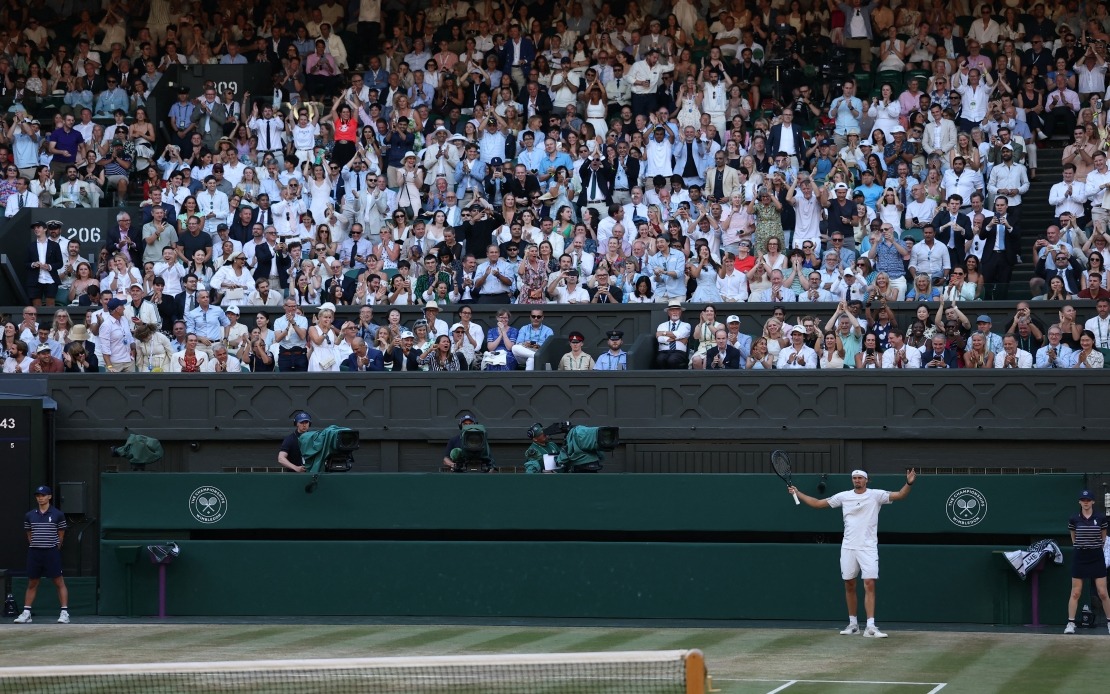
Jannik Sinner's commanding four-set victory over Alexander Zverev in the men's singles final provided Wimbledon 2026 with a triumphant conclusion to an eventful fortnight at the All England Club. The Italian's dominant performance capped a championship that produced numerous memorable moments beyond the traditional showpiece matches, showcasing the unpredictability and dramatic tension that continue to define grass-court tennis at its highest level.
First-time grand slam finalist Marketa Noskova's women's singles triumph came wrapped in the kind of emotional narrative that resonates throughout Wimbledon's history. The young Czech player squandered an extraordinary five championship points during a dramatic second-set collapse before ultimately prevailing in a thrilling decider that left observers questioning whether she possessed the mental fortitude to recover from such a devastating reversal. The parallel to former Czech champion Jana Novotna's experience was impossible to ignore—Novotna's heartbreaking loss to Steffi Graf in the 1993 final, where she surrendered an apparently unassailable advantage, remains etched in Wimbledon folklore as one of sport's most poignant moments.
Where Novotna endured a five-year wait before capturing her own Wimbledon crown in 1998, Noskova demonstrated remarkable composure in the immediate aftermath of her near-disaster. The 21-year-old reportedly took a bathroom break during the crucial juncture and, walking past the trophies displayed within the corridors, made a quiet promise to herself about claiming the championship. Her resolve proved decisive, transforming what could have been another tale of Wimbledon heartbreak into a triumph that underscores the fine margins separating glory from despair in professional tennis.
British wild card Cameron Fery emerged as the narrative thread binding together multiple remarkable performances across the fortnight, his improbable journey to the semi-finals capturing the imagination of home fans during what was otherwise a disappointing championship for the host nation. The 23-year-old from Wimbledon, ranked 114th in the world at the tournament's outset, found himself in an extraordinary battle on Court 18 where he trailed by four games in both the fourth and fifth sets while enduring three nosebleeds under punishing heat conditions. His opponent, Zizou Bergs, carried a ranking advantage of 77 positions and appeared positioned to eliminate the young Briton during their quarter-final encounter.
Fery's ability to level the match through a tense tie-break proved merely the prelude to his most impressive feat. As Bergs visibly lost his composure under the mounting pressure, the Wimbledon-based challenger displayed remarkable mental resilience in the decisive 10-point decider, ultimately securing a victory that marked only the fifth occasion this century when a British man has advanced to the second week of the All England Club. His achievement transcended sporting success, injecting genuine hope into a domestic tennis culture that has struggled for male representatives capable of contending at Wimbledon's highest levels.
Novak Djokovic's quarter-final marathon against fourth seed Felix Auger-Aliassime represented yet another age-defying performance from the 39-year-old Serbian, though the exhausting nature of the contest raised questions about his capacity to sustain such efforts against fresh opponents. The match stretched across five hours and fifteen minutes, establishing itself as the longest quarter-final in Wimbledon history and concluding just eight minutes before the 11pm curfew. The physical toll manifested immediately, with Djokovic requiring treatment for a calf problem following the opening set and subsequently engaging in a contentious dispute with tournament referee Denise Parnell regarding the roof's closure mechanism before the third set commenced.
The 24-time grand slam champion's capacity to overcome such obstacles against a highly-ranked opponent demonstrated technical mastery but also exposed vulnerabilities that would prove decisive in his subsequent semi-final encounter against Sinner. The psychological and physical reserves depleted during his battle with Auger-Aliassime left Djokovic operating at diminished capacity when confronting his younger, fresher opponent, illustrating how exhausting victories earlier in a tournament can compromise performance in later rounds.
The women's semi-final between Coco Gauff and Karolina Muchova distilled itself into a single pulsating tie-break that produced one of the tournament's most dramatic moments. Across eighteen minutes of intense play, both competitors earned match points under circumstances that exemplified the emotional and technical volatility of elite tennis. With the tie-break balanced at 8-8, tournament officials issued a time violation against Muchova before her return went long, presenting Gauff with the first opportunity to clinch victory. Yet the American inexplicably squandered the moment by dumping what appeared to be a straightforward drop-shot winner into the net, extending the tension further.
Muchova appeared positioned to convert her own match point opportunity, but a dramatic slip as she shaped for a volley proved decisive, allowing Gauff's cross-court forehand to pass her into open court. The Czech ninth seed demonstrated no such uncertainty with her subsequent opportunity, methodically constructing the point before Gauff's tired forehand found the net. The tie-break exemplified how professional tennis at Wimbledon's highest levels often hinges upon momentary lapses in concentration and marginal physical lapses rather than substantial tactical or technical deficiencies.
Serena Williams' return to competitive tennis on a wild card at age 44, nearly four years after publicly "evolving away" from professional sport, dominated the tournament's opening week and captured global attention. The American icon received a standing ovation upon entering Centre Court, having last competed in Wimbledon's semi-finals in 2019. Against Australian opponent Ajla Tomljanovic, who was 24 years her junior, Williams demonstrated that her fundamental skills and competitive hunger remained formidable, securing an early break in the decisive set and appearing positioned for a fairy-tale victory.
However, Williams' physical reserves proved insufficient for the demands of extended competition at the championship's highest level. As the match progressed into its final stages, the legendary competitor faded measurably against the younger player, who displayed impressive mental fortitude in managing both the intimidation factor inherent in opposing one of tennis's greatest figures and the extraordinary occasion itself. Tomljanovic's composed performance ultimately prevailed, though Williams later revealed that a knee injury sustained late in the opening set had compromised her capacity to operate at full effectiveness and subsequently precluded her participation in a doubles pairing with sister Venus, adding an element of physical setback to what had been billed as a triumphant return.

