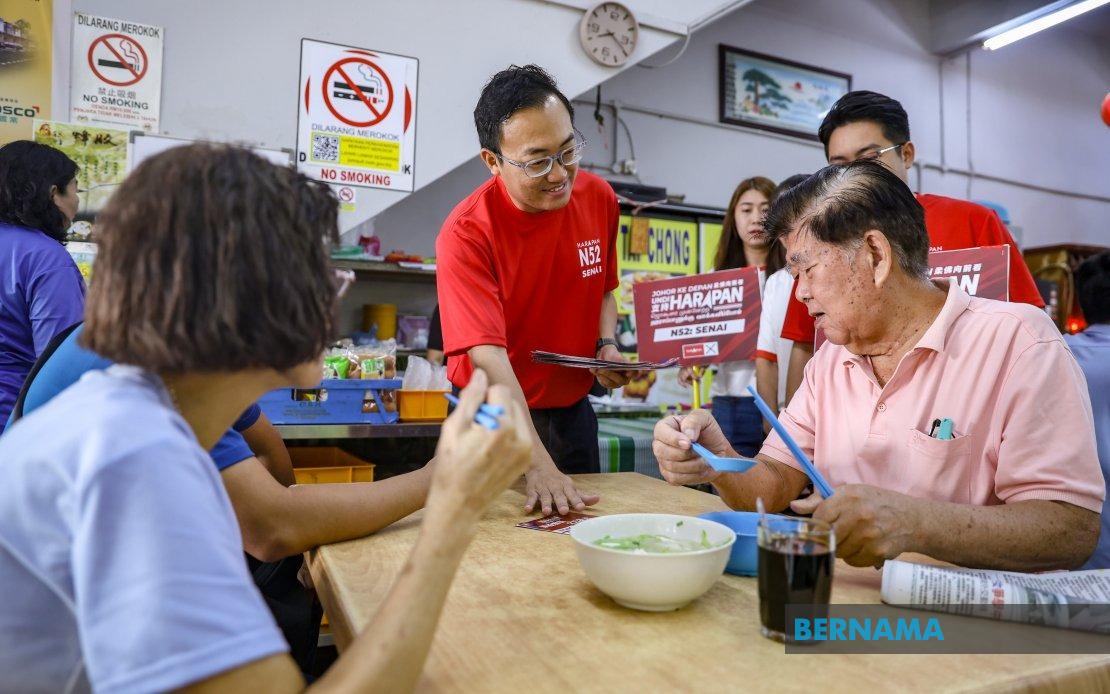
Wong Bor Yang, the incumbent assemblyman for Senai in Johor, is building his re-election campaign around tangible achievements during his previous term, confident that voters will reward Pakatan Harapan with another mandate. Citing his role in addressing long-standing infrastructure challenges and community development initiatives, Wong argues that his varied political experience uniquely positions him to continue serving the 66,635 registered voters in the constituency. Polling day for the 16th Johor state election is set for July 11, with early voting scheduled for July 7.
Wong's political journey spans over a decade of service across different institutional levels and political alignments. Since 2014, he has worked as a special officer in the Kulai Member of Parliament's office, transitioned into local government as a councillor in 2018, and eventually secured election as state assemblyman. This progression, Wong contends, has equipped him with practical problem-solving capabilities rather than mere partisan rhetoric. His background as a journalist, having studied at Shih Hsin University in Taiwan, has informed his communication approach and advocacy methods throughout his career.
The most concrete element of Wong's campaign platform centres on his efforts to resolve chronic flooding in Senai. During his previous term, he highlighted the challenge of securing approvals and funding from government agencies to tackle flash flood vulnerability in multiple areas. His persistence in using state assembly debates and petitions eventually yielded results: the state government approved RM1 million to upgrade the drainage system in Taman Aman and channel improvements into Sungai Skudai. In parallel collaboration with Kulai MP Teo Nie Ching, Wong facilitated an additional RM3 million allocation for drainage system upgrades in Peladang Kulai Besar and Saleng, successfully removing both areas from the district's flood hotspot designation.
Beyond infrastructure, Wong has directed attention toward heritage preservation and community amenities. He transformed a defunct cinema into a functional community operations centre and upgraded a two-decade-old badminton court into a recreational facility branded as Tiny Lake under the Sejati MADANI programme. These projects reflect his strategy of extracting value from existing assets and positioning Senai's historical significance—spanning more than a century—as an anchor for local pride and tourism potential. Such initiatives resonate with constituents seeking visible improvements to their everyday environment.
Healthcare emerges as a priority concern Wong intends to prioritise in a potential second term. He has consistently advocated for upgrades to Kulai Hospital, pointing out that its current 93-bed capacity cannot adequately serve the district's projected population of 500,000 by 2030. This argument carries weight given Malaysia's broader challenges with healthcare infrastructure in growing suburban and satellite communities. Wong has specifically targeted the longstanding land acquisition issue blocking construction of a new health clinic in Taman Mewah, Senai, which he attributes to bureaucratic delays at the state government level. Resolving this bottleneck and compelling the Health Ministry to commence construction represent his stated healthcare priorities.
Wong's positioning reflects a broader strategic shift within Pakatan Harapan's Johor campaign, which emphasises delivery and constituency-level problem-solving over grand ideological appeals. This approach acknowledges that suburban and semi-rural voters, particularly in constituencies like Senai where rapid population growth creates infrastructure pressures, evaluate candidates pragmatically. The emphasis on completed and ongoing projects rather than future promises suggests an attempt to differentiate incumbents from challengers and to counter perceptions of government ineffectiveness.
The electoral contest in Senai involves a three-cornered fight. Wong faces Tai Chee Chee representing Barisan Nasional, which traditionally commands significant support in Johor despite its diminished position at federal level, and Tew Chien How fielding for Bersama, a newer political entity that has sought inroads into state elections. The competitive dynamic reflects broader Johor political fragmentation, where neither Pakatan Harapan nor Barisan Nasional can assume dominance across all constituencies.
Wong's appeal to voter maturity and discrimination based on track record tacitly acknowledges that the Johor electorate, particularly in urbanising areas like Senai, has become less predictable along traditional partisan lines. His framing of himself as a practical administrator serving across different political configurations—from opposition to government—attempts to transcend conventional coalition loyalty arguments. Whether such positioning proves effective depends partly on how comprehensively voters perceive his previous accomplishments and whether competing candidates can articulate compelling alternative visions or superior delivery records.
The timing of the Johor election carries significance for Malaysian politics more broadly. The state represents one of the federation's most politically important regions, and electoral outcomes here often signal shifts in national sentiment. A Pakatan Harapan retention of seats like Senai would indicate the coalition's capacity to consolidate support in suburban constituencies facing rapid demographic and infrastructure change. Conversely, Barisan Nasional gains would suggest resilience in traditional strongholds and potential momentum toward the next federal election.
For voters in Senai specifically, the election presents a choice between continuity with measured progress and alternative approaches from candidates yet to demonstrate comparable constituency-level credentials. Wong's campaign strategy accepts that expectations have shifted: constituents now demand visible infrastructure delivery, tangible improvements to public facilities, and government responsiveness to persistent local problems rather than accepting ideological appeals or patronage politics. Whether this pragmatic positioning and recitation of achievements suffices to overcome any anti-government sentiment or challenger momentum will become clear on polling day.

