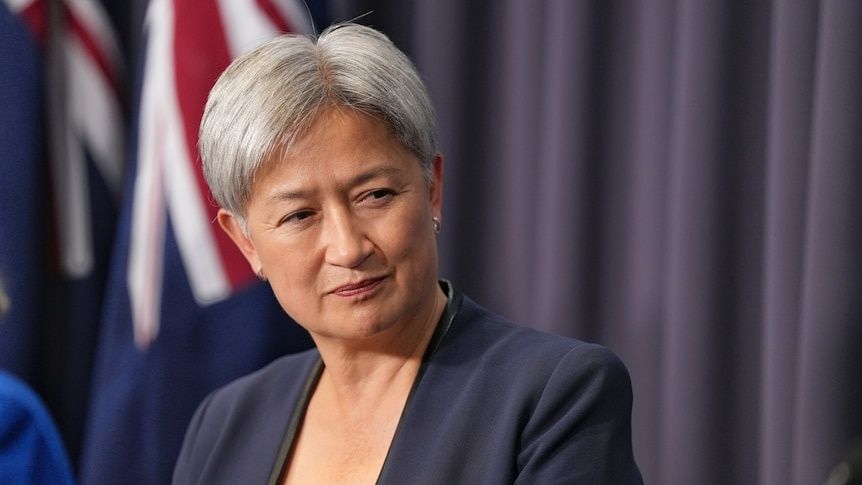
Australia's Foreign Minister Penny Wong is set to deliver a robust defence of the nation's multicultural identity this week, directly challenging the rising influence of the far-right One Nation party in a keynote address at the Lowy Institute in Sydney. The speech represents a significant political moment as the Malaysian-born minister—a trailblazer as the first Asian-Australian to reach federal ministerial rank—attempts to reframe the immigration debate ahead of the 2028 election, when far-right populism threatens to reshape Australian politics.
Wong's intervention comes as One Nation has surged dramatically in recent polling, positioning itself as a potential kingmaker in the next parliament. The party, under the leadership of Pauline Hanson, has explicitly championed a "monoculture" approach to Australia's future, seeking to curtail immigration, withdraw from international organisations, and slash foreign aid. This ideological direction marks a sharp departure from the post-war consensus that has shaped modern Australia, and Wong's response signals how seriously the government is taking the electoral threat.
The Foreign Minister will deploy a historical argument to counter what she calls the "melancholic fantasy of a monoculture." She plans to emphasise that multicultural Australia is not a modern invention or an ideological project but rather the only version of Australia that has actually existed. Census data substantiates this claim: half of all Australians were born overseas or have at least one parent born abroad, reflecting generations of migration spanning from British settlement through European displacement after World War II to contemporary Asian and other global migration patterns.
What distinguishes Wong's approach is her focus on strategic consequences rather than purely moral arguments. She intends to warn that a monoculture agenda would fundamentally damage Australia's international security posture and trade relationships at a moment when regional tensions are mounting and Australia's middle-power status faces growing constraints. As military power, economic coercion, and technological control increasingly shape global competition, Wong will argue that abandoning Australia's multicultural openness amounts to voluntarily weakening the nation's hand in navigating complex geopolitical challenges.
One Nation's ascendancy reflects genuine anxieties about housing affordability, wage pressures, and rapid demographic change that have destabilised voter confidence in the centre-left Labor government. Hanson's party has capitalised on these concerns by offering a stark alternative framing: that Australia's problems stem from excessive immigration and international entanglement. Notably, Hanson has controversially referenced the White Australia policy—the restrictive immigration regime that operated through much of the 20th century—as a model worth reconsidering, a rhetorical move that drew widespread condemnation but resonated with portions of the electorate.
The government has acknowledged that legitimate concerns about economic pressures and housing availability have fuelled One Nation's electoral gains. However, Prime Minister Anthony Albanese has signalled that the Labor response differs fundamentally from the far-right prescription. Rather than vilifying migrants or attempting to divide the community, Albanese has indicated that the government will adjust immigration settings downward from recent peaks whilst maintaining the nation's multicultural character. This represents an attempt to retain the centre ground by acknowledging voter concerns without embracing One Nation's divisive rhetoric or policy agenda.
Wong's particular positioning as a Malaysian-born minister of Chinese-Vietnamese descent carrying a Chinese surname lends symbolic weight to her defence of multiculturalism. Her career trajectory—from her background to the Foreign Ministry—is itself an embodiment of the opportunities that Australia's multicultural framework has created. As she warns against those seeking to divide Australians for "clicks and votes," she is implicitly highlighting how populist rhetoric, regardless of electoral appeal, ultimately diminishes Australia's collective capacity and international standing.
The Lowy Institute address also reflects a broader strategic calculation by the Australian government. As tensions mount across the Indo-Pacific and global institutions face strain, Australia depends on its regional relationships and ability to work across cultural and institutional divides. One Nation's call to withdraw from international engagement and reorient towards a narrower, ethnically-defined version of national identity represents a direct threat to the architecture of middle-power influence that Australia has cultivated. Wong's intervention therefore carries implications beyond domestic politics, signalling to regional partners and allies that Australia's commitment to multilateral engagement and multicultural openness remains intact despite populist pressures.
The timing of this debate reflects a critical juncture in Australian politics. With the next election in 2028, the government faces a window in which to stabilise voter confidence and rebuild its own electoral position whilst constraining far-right expansion. Wong's emphasis on how divisive politics weakens Australia at home and abroad attempts to reframe the debate from immigration policy specifics to fundamental questions about what kind of nation Australia chooses to be. By grounding her argument in strategic necessity rather than abstract principle, Wong is attempting to reclaim the political middle ground from those offering simpler but ultimately damaging alternatives.
The government's willingness to implement immigration policy adjustments whilst defending multiculturalism suggests recognition that electoral viability requires acknowledging real pressures without capitulating to One Nation's populist framing. This balancing act will determine whether Labor can stabilise its political position and prevent far-right consolidation of electoral momentum heading into 2028. Wong's speech represents a crucial moment in this broader struggle to define Australia's identity and future direction during a period of significant domestic and regional uncertainty.

