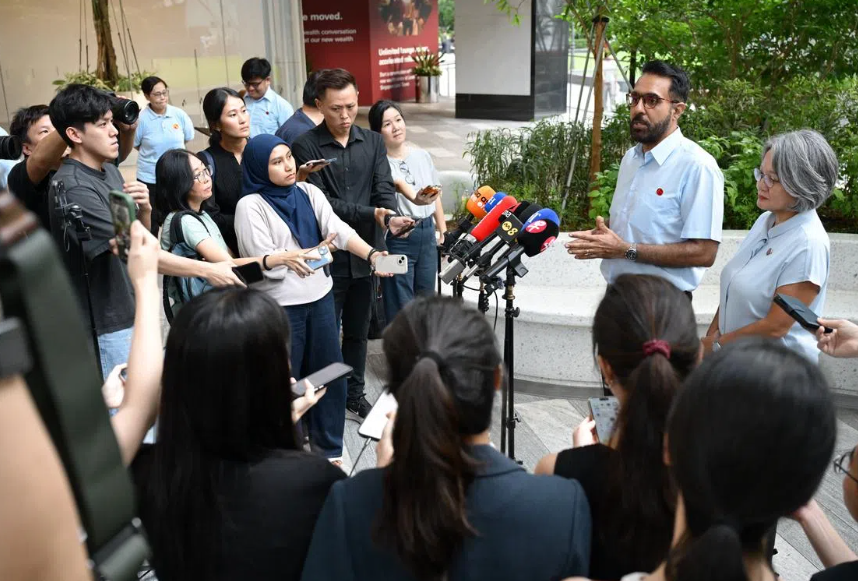
After six tense hours of meetings on June 28, Pritam Singh walked out to face journalists with an assured demeanor, declaring the opposition Workers Party "pretty united" following what turned out to be the most serious challenge to his leadership since he assumed the role in 2018. Having previously returned unopposed in every single party election, Singh this time confronted a formal vote of no confidence triggered by cadres unhappy with his conviction over misleading Parliament, followed by a regular party election. The results left little room for ambiguity: 82 of 106 cadres voted to keep him as party chief, with Singh himself abstaining from the ballot.
The conviction that sparked this internal reckoning traces back to events that have dominated Singapore's political landscape since 2021, when it emerged that former Sengkong GRC MP Raeesah Khan had fabricated an account of police misconduct involving a sexual assault victim during a parliamentary speech. The resulting scandal engulfed Singh when Parliament's Committee of Privileges found he had enabled Khan to prolong her deception. He was subsequently charged and convicted of lying to Parliament in his own right, a guilty verdict that withstood appellate challenge when the High Court upheld the conviction in December 2025. The reverberations extended into the broader political arena, with Parliament passing a motion to declare Singh unsuitable to serve as Leader of the Opposition, prompting Prime Minister Lawrence Wong to formally remove him from that designation.
The cadres who triggered the no-confidence vote had harbored hopes that the meetings would transform into a genuine reckoning, with substantive questioning of Singh's role in the Khan affair and pressure for an alternative candidate to emerge. Party sources indicate that while Singh did face interrogation from members, the atmosphere proved more nuanced than anticipated, with some cadres actually rising to defend him during proceedings. Those seeking to recruit a challenger found their efforts ultimately unsuccessful, unable to convince any potential rival to step forward even as they maintained organizing efforts through the week preceding the conferences. The outcome reflected a calculated determination within the party to weather the storm through demonstrated solidarity.
Perhaps most significantly, the party's senior figures threw their weight decisively behind Singh. Low Thia Khiang, the architect of modern Workers Party politics and Singh's predecessor as secretary-general, publicly stated his continued support ahead of the vote, lending his considerable influence and historical credibility to Singh's retention. This alignment of the party's elder statesmen with the incumbent sent a powerful signal to the broader membership about acceptable behavior within the organization. Simultaneously, the party's disciplinary process concluded with Singh receiving a formal letter of reprimand for constitutional violations—a sanction that observers have characterized as conspicuously mild given the severity of his conviction and the parliamentary motion against him, effectively silencing potential complaints about inconsistent standards.
The suppression of any visible internal friction carries strategic significance that extends beyond personality or institutional pride. Opposition parties across Southeast Asia have repeatedly suffered irreparable damage from public infighting and leadership instability, losing voter confidence and allowing ruling coalitions to capitalize on perceptions of incompetence or disorder. By presenting a united front and resolving the matter swiftly within party structures rather than through acrimonious public campaigns, the Workers Party has insulated itself from this common vulnerability. The closure of the Raeesah Khan saga within organizational processes means the party can now redirect its energies toward expanding its parliamentary presence and raising its national profile through substantive policy work and legislative scrutiny.
Party chair Sylvia Lim signaled during post-election remarks that internal regeneration represents an emerging priority, noting she has occupied her position for 23 years and emphasizing the party's consciousness of succession planning needs. Her suggestion that "hopefully in the next media conferences you will see someone else here" indicates the Workers Party recognizes the necessity of developing fresh leadership cohorts, both to demonstrate organizational health to voters and to create pathways for ambitious cadres seeking advancement. Singh's re-election paradoxically underscores the depth of this challenge: the party currently lacks alternative figures with sufficient public stature and parliamentary experience to mount credible challenges to the secretary-general, a limitation that both secures his position and reveals potential vulnerabilities in organizational depth.
The solidarity displayed in Sunday's vote does raise uncomfortable questions about whether organizational unity has taken precedence over accountability principles. When Singh responded to questions about being labeled a "convicted liar" by directing questioners to his website and reasserting his parliamentary positions unchanged, he sidestepped rather than directly addressed the substance of public concern. This rhetorical maneuver reflects a broader party posture that interprets the matter as fundamentally closed, despite the unusual spectacle of an opposition party leader retaining his position after parliamentary conviction and formal removal from leadership roles within the same legislature. The fact that such an outcome proves possible reveals distinctive features of Singapore's political environment and voter calculations.
The Workers Party can point to the May 2025 general election results as evidence that the public has rendered its own judgment on Singh's fitness for continued leadership. Held after his lower court conviction but before appellate proceedings concluded, those elections saw the party not merely consolidate its existing constituencies but achieve significant expansion through winning two Non-Constituency MP seats, indicating voters were willing to support Workers Party candidates despite the conviction narrative. This electoral validation provided psychological reinforcement to party cadres considering their votes, offering evidence that the political damage Singh feared—or that external critics predicted—had not fully materialized among the electorate. The election results suggested that for many supporters, Singh's legal troubles constituted a political misfortune rather than a disqualifying character revelation.
The Workers Party maintains a structural advantage in its competitive positioning that may explain why cadres could absorb the costs of backing Singh with relative confidence. As the primary opposition force facing the dominant People's Action Party, the Workers Party encounters substantially less intensive voter scrutiny than the ruling coalition experiences, benefits from less intrusive media examination, and operates within a political culture that often views opposition parties through a sympathetic lens of underdog status. This asymmetry in public attention creates space for parties to weather internal crises that might prove fatal in more intensely scrutinized political systems. Voters often tolerate greater organizational dysfunction in opposition parties than they would countenance from governing formations, viewing the opposition through a more forgiving framework that prioritizes its mere existence as a counterweight to executive dominance.
With internal questions ostensibly resolved, the Workers Party confronts a different strategic landscape heading forward. The party must convert its increased parliamentary presence into tangible legislative achievements and substantive policy proposals that elevate its standing beyond mere protest politics. Doing so requires leveraging the institutional platform Singh's continued leadership provides while simultaneously developing the younger cadres and alternative leaders that Lim has identified as organizational priorities. The party's ability to separate the Singh question from broader political renewal efforts will determine whether the June 28 votes represent genuine closure or merely postponement of deeper institutional questions. How the Workers Party navigates this transition will offer important lessons for opposition politics across Southeast Asia, where questions of leadership accountability and organizational renewal persistently challenge parties seeking to pose credible alternatives to entrenched ruling coalitions.

