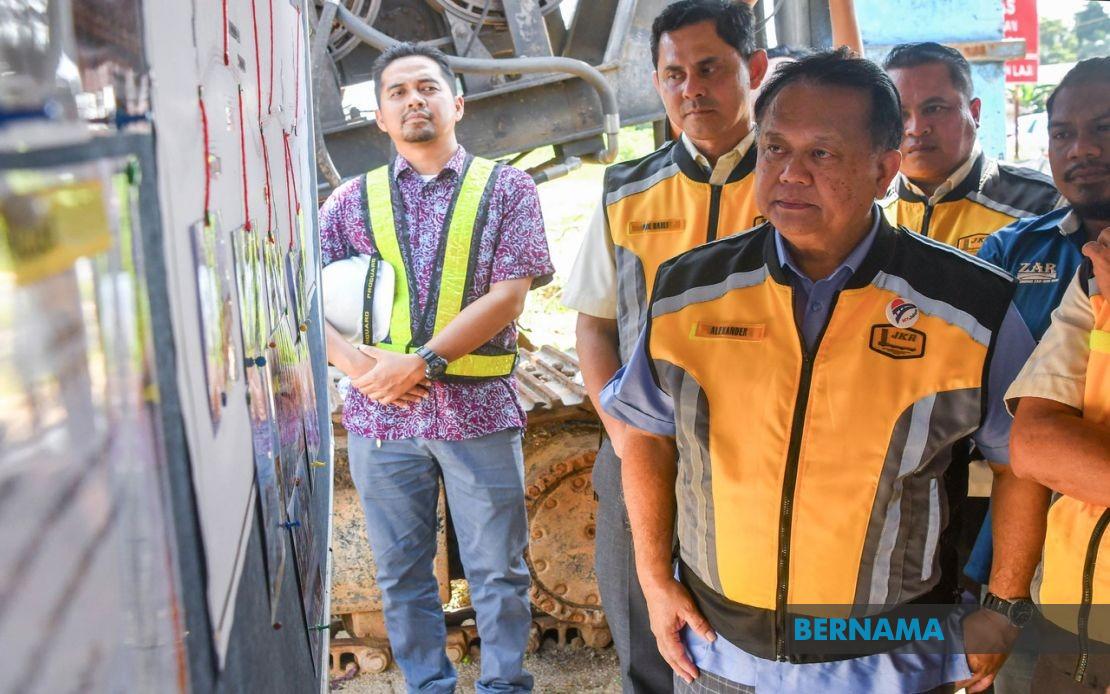
The Works Ministry has placed 50 infrastructure projects under intensive scrutiny as part of a systematic effort to combat implementation delays, according to Works Minister Datuk Seri Alexander Nanta Linggi. These flagged initiatives represent a fraction of the ministry's broader portfolio of 865 projects, signalling a targeted approach to address systemic bottlenecks affecting Malaysia's development pipeline. The identification and monitoring of these struggling schemes underscores growing ministerial concern about deadline slippages that have accumulated across the country's infrastructure landscape.
Of the ministry's 104 projects operating within Kelantan, merely seven have earned the designation of "sick" projects, indicating that the delays are geographically distributed rather than concentrated in specific regions. This dispersion suggests that the underlying causes transcend local factors, pointing instead to systemic challenges within project management frameworks and contractor capabilities. The relatively low proportion in Kelantan also indicates that certain jurisdictions have managed implementation more successfully, potentially offering lessons for other states grappling with similar difficulties.
The genesis of these delays spans multiple interconnected factors that illuminate the complexity of modern infrastructure delivery in Malaysia. Contractors facing financial instability or management deficiencies have proven unable to maintain momentum, whilst land acquisition complications—a perennial headache for large-scale development—continue to impede progress. Additionally, unexpected site conditions, including underground obstructions not identified during preliminary surveys, have forced costly reassessments and rescheduling. Utility relocation requirements, necessitated by the presence of existing telecommunications, water, and electrical infrastructure, have similarly consumed time and resources beyond initial projections.
Ministry officials have adopted a nuanced approach toward addressing delays, recognising that project termination is not always the most economical remedy. When schemes approach completion with only minor work remaining—typically between 10 and 15 per cent of total tasks—the ministry has granted extensions of time (EOT) rather than cancelling contracts and appointing replacement contractors. This pragmatic stance acknowledges that terminating agreements and commencing fresh procurement cycles often generate higher expenditures than allowing extensions, a calculation that prioritises fiscal efficiency over rigid adherence to original timelines.
The ministry's governance framework now incorporates rigorous weekly reviews of troubled projects, conducted immediately following Cabinet sessions. This systematic monitoring regime has elevated ministerial oversight to unprecedented levels, ensuring that performance data feeds directly into high-level decision-making structures. The deputy minister has been explicitly tasked with coordinating nationwide supervision of sick projects, institutionalising accountability and preventing issues from languishing without intervention. This hierarchical delegation ensures that monitoring extends beyond episodic attention, becoming instead an embedded feature of ministry operations.
For projects demonstrating persistent underperformance despite intervention attempts, escalated remedial measures remain available. The ministry has signalled willingness to replace underperforming contractors or terminate contracts entirely when circumstances warrant such drastic action. However, officials have emphasised that any contract termination must proceed through proper legal channels and governance protocols to mitigate exposure to litigation. This calculated restraint reflects awareness that hasty contract cancellations could invite costly dispute resolution or court challenges, potentially generating further delays and expenses.
The FT209 and FT131 road upgrading project in Kelantan exemplifies the ministry's current portfolio challenges and intervention strategies. This RM191 million undertaking, stretching six kilometres and designed to alleviate traffic congestion between Kubang Kerian and Pengkalan Chepa, has achieved 71.61 per cent physical progress as of the minister's July visit. Land acquisition alone—encompassing 300 separate lots—has consumed over RM200 million, demonstrating how property-related complications can substantially inflate project costs beyond initial budgets. Completion is targeted for September 2025, a timeline that will require accelerated execution across the final quarter of the work.
The project addresses a genuine regional transportation bottleneck, as Federal Road FT131 serves as a critical arterial route linking multiple population centres. Chronic congestion along this corridor has constrained economic activity and daily commuter mobility, making the upgrade a priority for Kelantan's development objectives. The substantial land acquisition expenditure, whilst substantial, reflects the premium associated with securing rights-of-way through already-developed areas, a cost dynamic that characterises urban and peri-urban infrastructure expansion throughout Malaysia.
Local parliamentary representation has successfully leveraged the minister's visit to secure additional mitigation measures addressing collateral impacts. Pengkalan Chepa Member of Parliament Datuk Dr Ahmad Marzuk Shaary raised concerns about flooding affecting nearby residents consequent to project works, prompting immediate ministerial action. The ministry instructed contractors to construct a temporary 40-metre drainage channel, demonstrating responsive governance that acknowledges construction-induced environmental consequences and acts to remediate them within reasonable timeframes. This intervention illustrates how parliamentary advocacy, when channelled through appropriate ministerial forums, can secure tangible improvements benefiting affected constituencies.
The ministry's comprehensive approach to project supervision reflects broader governmental expectations for infrastructure delivery improvement. With 50 projects now under intensified monitoring and formal weekly review cycles institutionalised, the Works Ministry has signalled that historical patterns of prolonged delays will no longer persist without consequence. The balance between permitting reasonable extensions for near-complete projects and enforcing accountability through contractor replacement or termination suggests a maturing institutional capacity to manage the complex variables inherent in large-scale infrastructure implementation.
For Malaysian stakeholders dependent on timely infrastructure completion—including businesses relying on improved transport corridors, residents facing construction disruptions, and contractors managing cash flows—the ministry's enhanced oversight regime offers both opportunities and challenges. Intensified monitoring may accelerate completion of previously stalled schemes, whilst stricter performance expectations could increase pressure on contractors with limited financial buffers. Southeast Asian investors observing Malaysia's infrastructure governance evolution will likely interpret this ministerial activism as indicating stronger commitment to project delivery, potentially influencing assessments of implementation risk in future infrastructure investment decisions.

