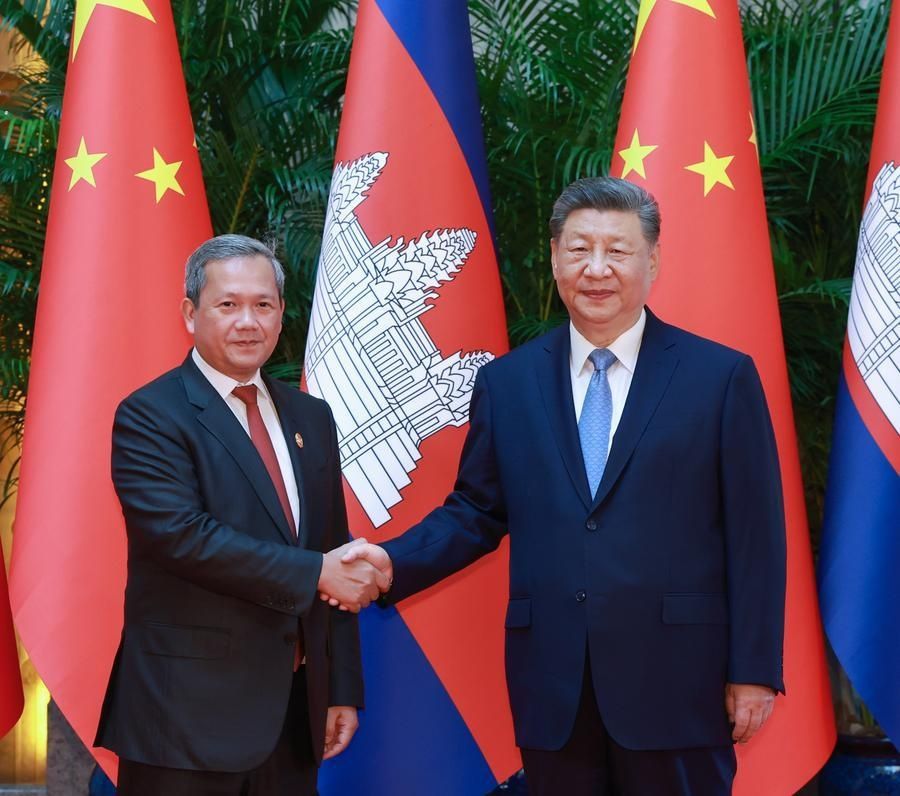
Chinese President Xi Jinping used a high-level meeting with visiting Cambodian Prime Minister Hun Manet in Shanghai on Friday to emphasise the enduring nature of bilateral ties, describing the relationship as an "ironclad friendship" rooted in decades of close cooperation between the two nations. The remarks, made during their encounter at the 2026 World Artificial Intelligence Conference and High-Level Meeting on Global AI Governance, underscored Beijing's commitment to maintaining Cambodia as a key strategic ally in Southeast Asia at a time of shifting regional geopolitical dynamics.
Hun Manet's presence in Shanghai as both a conference participant and official visitor signals Cambodia's growing alignment with China's technological ambitions while pursuing its own development agenda. The dual-purpose visit reflects the multifaceted nature of contemporary China-Cambodia relations, which extend beyond traditional diplomatic channels into sectors ranging from artificial intelligence to cross-border commerce. For Malaysian observers, the deepening of this partnership carries implications for regional technology standards, trade patterns, and security architecture across Southeast Asia.
The centrepiece of Xi's vision involves the "Diamond Hexagon" cooperation framework, a construct designed to systematise various dimensions of bilateral engagement. Within this structure, both leaders agreed to prioritise the Industrial Development Corridor and the Fish and Rice Corridor—initiatives that directly address Cambodia's need for economic diversification and infrastructure modernisation. These corridors represent more than symbolic gestures; they are intended to channel Chinese investment into Cambodian manufacturing and agricultural sectors, potentially reshaping supply chains and trade flows that affect the broader region.
Emerging sectors now occupy a prominent position in the bilateral agenda. Xi explicitly highlighted artificial intelligence and the digital economy as growth areas requiring joint development. This focus reflects China's broader strategy to establish technological standards and partnerships across Southeast Asia, positioning itself as the region's primary source of AI expertise and digital infrastructure. For Malaysia's own digital economy aspirations, the competitive landscape is being shaped by such bilateral partnerships, which may influence how quickly Chinese technologies and platforms penetrate Southeast Asian markets.
Traditional economic sectors have not been neglected, however. Xi stressed the importance of upgrading cooperation in electricity generation and agricultural production—sectors where Cambodia faces persistent challenges and where Chinese state enterprises already maintain significant presence. By framing these as priorities alongside cutting-edge technologies, the bilateral agenda reflects a pragmatic approach to development that combines immediate needs with long-term capacity building.
The security dimension of the partnership received particular attention, with both leaders emphasising joint efforts against transnational crime. Xi and Hun Manet specifically identified counterfeiting, smuggling, online gambling, and telecommunications fraud as cooperative targets. The focus on telecom fraud, in particular, reflects a genuine regional concern; such schemes have caused significant losses across Southeast Asia and involve sophisticated international networks. Enhanced China-Cambodia coordination in this space could yield spillover benefits for neighbouring countries, though it may also concentrate anti-crime intelligence-sharing within Beijing's sphere of influence.
Regional peace initiatives also featured prominently in the dialogue. Xi expressed support for Cambodia's efforts to resolve border disputes with Thailand, framing such resolution as serving the fundamental interests of both parties. He offered China's role as a constructive mediator, a position that appeals to Cambodia while simultaneously advancing Beijing's influence over Southeast Asian conflict resolution mechanisms. Hun Manet reciprocated by emphasising Cambodia's commitment to dialogue and negotiation, signalling that diplomatic channels remain open despite periodic tensions along the border.
Hun Manet's formal appreciation for China's "selfless support" to Cambodia's development reflects the asymmetrical yet mutually beneficial nature of the relationship. Cambodia remains heavily dependent on Chinese investment, infrastructure development, and technology transfer, while China gains strategic influence in a nation sitting astride crucial maritime and terrestrial trade routes. The Prime Minister's reaffirmation that Cambodia's close cooperation with China will persist "regardless of shifts in the international situation" represents a pointed commitment likely intended to signal stability to Beijing amid broader regional uncertainties.
Cambodia's unwavering adherence to the one-China policy carries symbolic weight in a region where such positions are sometimes contested or calibrated for diplomatic effect. By explicitly reaffirming this stance during his Shanghai visit, Hun Manet has positioned Cambodia as one of Beijing's most reliable partners, a standing that typically translates into preferential treatment in trade negotiations and infrastructure financing. This consistency contrasts with some ASEAN neighbours that maintain more nuanced positions on China-related geopolitical questions.
The bilateral agenda outlined during this meeting reflects broader patterns in China's Southeast Asian diplomacy: the integration of traditional development assistance with high-technology cooperation, the combination of economic incentives with security partnerships, and the cultivation of trusted allies who can amplify Beijing's influence within regional organisations and forums. For Malaysia and other ASEAN members, the deepening of China-Cambodia ties serves as a reminder that regional alignment with Beijing is increasingly multidimensional and institutionalised.
Looking ahead, the expansion of bilateral cooperation mechanisms will likely create both opportunities and challenges for the wider region. Enhanced Chinese infrastructure investment in Cambodia may accelerate that nation's development but could also entrench debt dependencies. Deepened technological partnerships may advance regional digital transformation but could subordinate some Southeast Asian interests to Chinese technological standards and security requirements. The outcome will significantly shape the trajectory of China's influence across Southeast Asia for years to come.

