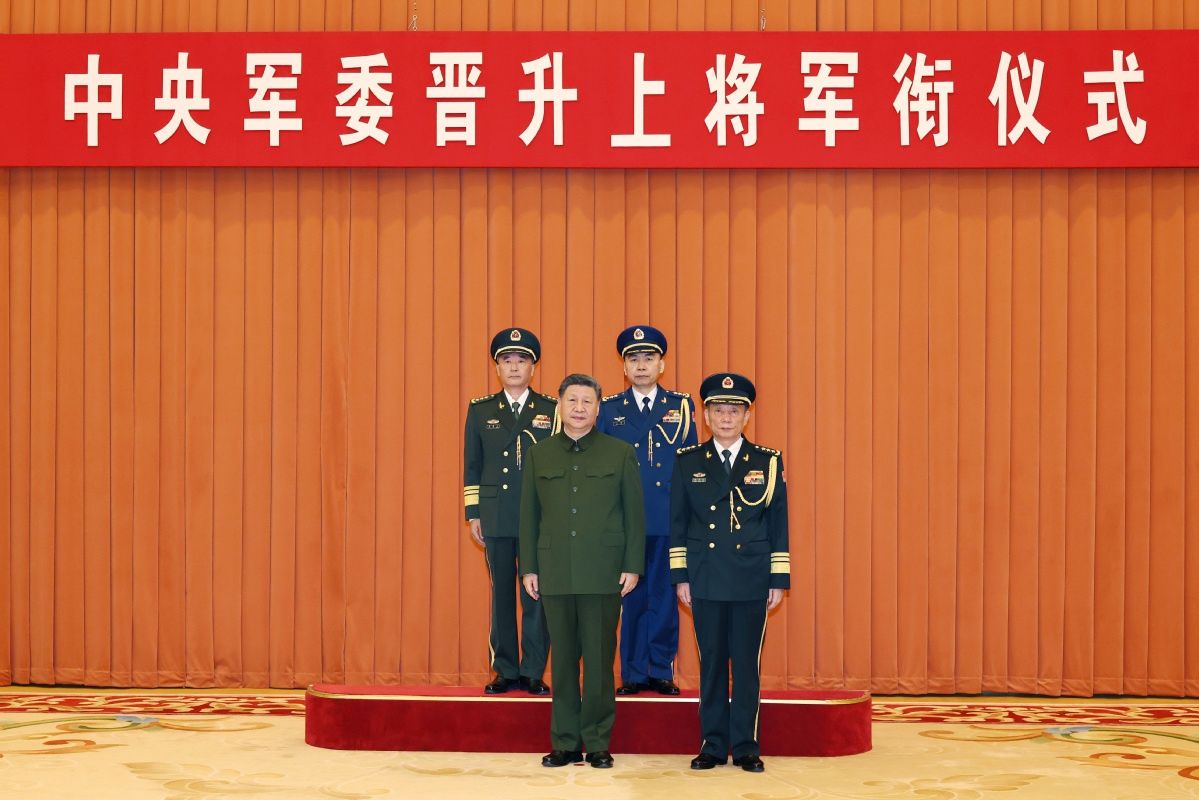
Chinese President Xi Jinping has appointed a new chief for anti-corruption operations within the military establishment, accelerating what has become the most comprehensive overhaul of the People's Liberation Army in fifty years. Zhang Shuguang now heads the Central Military Commission's discipline inspection commission following a ceremony in Beijing on Friday, July 3, where Xi presided over the leadership transition. Simultaneously, Wang Gang has assumed command of the People's Liberation Army Air Force. Both appointments came with promotions to the rank of general, the highest active-duty position in China's military hierarchy.
The reshuffling marks another significant step in Xi's sustained campaign against alleged corruption and misconduct throughout China's defence apparatus. Zhang Shengmin, who previously occupied the paramount anti-graft position within the military, has been reassigned as vice chairman of the Central Military Commission, a lateral move that effectively removes him from direct oversight of disciplinary matters. The trajectory of Chang Dingqiu, the outgoing Air Force commander, remains undisclosed, though such transitions in China's opaque military structure frequently signal either senior advisory roles or outright removal from influence.
Xi initiated his comprehensive anti-corruption offensive within the armed forces in mid-2023, consolidating his grip on military structures shortly after securing an unprecedented third consecutive term as China's paramount leader. The campaign represents more than routine administrative housekeeping; it signals deep institutional restructuring within an organisation traditionally wielding enormous political weight. Over the ensuing months, Xi's anti-corruption machinery has dismantled an extensive network of senior command, expelling two vice chairs of the Central Military Commission, three additional commission members, one former defence minister, and no fewer than twelve senior general-rank officers commanding major military regions and service branches.
The scope and intensity of this purge carries implications extending far beyond China's borders. For Southeast Asian nations, including Malaysia, the reconfiguration of China's military leadership carries strategic ramifications. A military establishment undergoing such fundamental restructuring may experience temporary operational disruptions, though it simultaneously reflects Xi's determination to centralise control over the armed forces—a development that could influence Beijing's assertiveness in regional disputes, particularly regarding the South China Sea where Malaysia maintains significant maritime interests.
Perhaps most remarkably, Xi's anti-corruption drive ensnared his own trusted ally, General Zhang Youxia. Earlier in 2024, Xi ordered investigations into Zhang Youxia, demonstrating that even proximity to the paramount leader offers no immunity from the purge. Zhang Youxia had occupied senior positions within the military hierarchy and was widely regarded as one of Xi's most loyal associates, making his investigation a stark illustration of the purge's comprehensive nature and Xi's willingness to sacrifice even close confidants in pursuit of centralised control.
The political calculations underlying these moves warrant careful consideration. By systematically removing military leaders, Xi effectively eliminates potential rivals and ensures that the officer corps remains subordinate to his personal authority rather than maintaining independent institutional power bases. This approach mirrors tactics employed during earlier periods of Chinese history when civilian leadership sought to forestall military factionalism through strategic appointments and removals. The anti-corruption framework provides political cover for what amounts to a concentrated assertion of civilian control over the military apparatus.
Last week, the National People's Congress expelled six military lawmakers from their parliamentary seats, further indicating systematic purges extending into civilian-military governance structures. These parliamentarians, selected from among senior officers, represent significant positions within China's nominal legislative body. Their removal suggests the purge encompasses not merely operational military command but also the political-administrative interface where military and civilian leadership intersect.
The implications for Malaysia and regional stability merit consideration. As ASEAN nations navigate increasingly complex relationships with Beijing, the composition and orientation of China's military leadership directly affects bilateral interactions, defence diplomacy, and regional security calculations. A military establishment undergoing fundamental restructuring may pursue different operational priorities than one operating under established command structures. Malaysian policymakers monitoring these developments must assess whether the emerging military leadership will pursue more aggressive regional postures or whether consolidation of control creates opportunities for stabilising dialogue.
Xi's anti-corruption campaign within the military also reflects domestic political imperatives beyond mere institutional housekeeping. By demonstrating that no one, regardless of seniority or historical association with Xi, remains above accountability, the campaign reinforces the paramount leader's authority throughout the state apparatus. This messaging extends beyond the military to the broader Communist Party bureaucracy, signalling that Xi's authority supersedes factional loyalty and institutional tradition—a crucial message in maintaining party discipline and preventing the emergence of alternative power centres.
The appointment of Zhang Shuguang and Wang Gang represents consolidation rather than fundamental policy shift. Both individuals were previously employed in senior positions, suggesting their elevation reflects Xi's confidence in their loyalty and competence rather than ideological reorientation. However, their prominence within the restructured military hierarchy indicates they will implement anti-corruption efforts in alignment with Xi's strategic preferences, ensuring that disciplinary processes serve broader centralisation objectives.
For regional observers, the significance extends beyond China itself. The demonstrated capacity of China's civilian leadership to execute comprehensive military restructuring without apparent institutional resistance suggests considerable institutional discipline within the People's Liberation Army. This cohesion, achieved through purge rather than consensus, may paradoxically enhance China's capacity for sustained strategic initiatives in the region, as military factionalism that might otherwise constrain Beijing's actions has been largely eliminated through these personnel changes.

