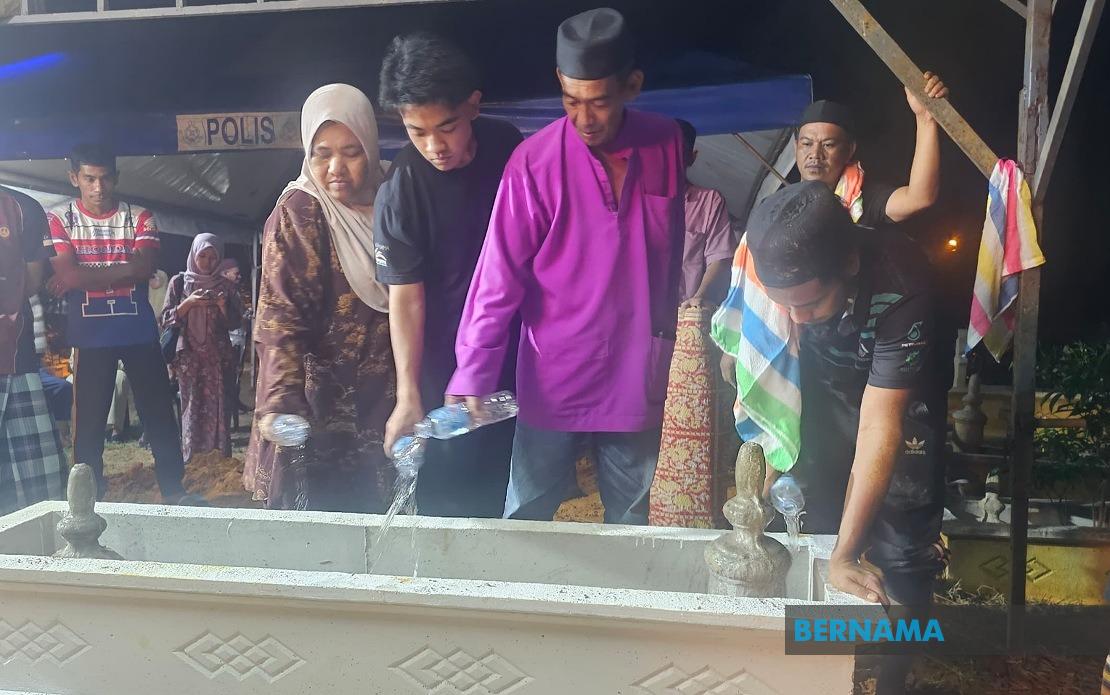
A 24-year-old police constable from Terengganu has been laid to rest following a fatal electrocution incident in Sabah that claimed the lives of three law enforcement officers. Constable Muhammad Raimi Ismarubee was buried at the Felda Kerteh 2 Muslim Cemetery in the early hours of August 8, concluding a solemn journey that saw his remains transported across Malaysia by military aircraft and ceremonial hearse.
The tragic incident unfolded at approximately 5.50 pm on August 7 along Jalan Weston in Kampung Weston, Beaufort, when the three officers came into contact with a live electrical source. Muhammad Raimi, stationed at Weston Police Station since September 2024, was among those who succumbed to the electric shock. His two colleagues, Corporal Chiu Teck Siong, 40, and Corporal Mohamad Nur Hafiz Ibrahim, 29, also perished in what appears to have been a workplace accident of devastating proportions.
The funeral arrangements reflected the gravity of the incident and the respect accorded to those who lose their lives in service. Muhammad Raimi's body was transported from Kota Kinabalu International Airport by Royal Malaysian Air Force aircraft to Kuantan Air Base in Pahang, after which a hearse conveyed him to his family home in Felda Kerteh 2. This coordinated movement across states demonstrated the ceremonial importance placed on honouring fallen police personnel.
Muhammad Raimi's residence in Felda Kerteh 2 became a gathering place for final respects on the evening of August 8, with the vehicle carrying his remains arriving at approximately 11.40 pm. The funeral prayers proceeded shortly thereafter, with Datuk Satiful Bahari Mamat, chairman of Terengganu's State Education, Higher Education, Science, Technology and Human Development Committee, leading the religious observance. This attendance by a state-level official underscored the significance of the tragedy within the broader context of public service.
The turnout for the funeral illustrated the solidarity within law enforcement circles and the wider community. Approximately 200 police officers and personnel attended the ceremony, alongside family members and friends of the deceased. Dungun District Police Chief Supt Nik Ab Halim Nik Mat was present to pay respects, reflecting the hierarchical acknowledgment of the loss and the department's commitment to supporting its fallen members.
Muhammad Raimi's personal circumstances added another dimension to the tragedy. At just 24 years old, he was unmarried and represented the second of three siblings in his family. His service tenure had been relatively brief, having only joined Weston Police Station in September 2024, meaning he had been in his posting for less than a year at the time of his death. This youthful profile highlighted the human cost of workplace hazards and the vulnerability of personnel in potentially dangerous environments.
The electrocution incident raises important questions about workplace safety protocols and electrical hazard management at police installations. In Malaysia's tropical climate, where electrical infrastructure is exposed to high humidity and frequent weather disruptions, the risks of contact with live wires are particularly acute. Police stations, as public facilities often operating in remote or challenging locations, require robust safety measures to protect personnel from such preventable tragedies.
For Malaysian families in security and uniformed services, the incident serves as a stark reminder of the occupational hazards that extend beyond the typically publicised dangers of law enforcement work. While policing conjures images of confrontational risks, electrocution illustrates how administrative and infrastructure failures can claim lives just as suddenly. The Weston Police Station incident will likely prompt a broader review of electrical safety standards across police facilities in Sabah and potentially nationwide.
The grief affecting Muhammad Raimi's immediate family reverberates through the broader police force and communities where these officers served. In small towns and rural areas like Beaufort and surrounding regions, local police stations often represent significant employment opportunities and community presence. The loss of three experienced and newer personnel simultaneously disrupts these service capabilities while deeply affecting the personal networks that bind these communities together.
The military's involvement in transporting Muhammad Raimi's remains through the RMAF also reflects the ceremonial respect extended to fallen public servants. This coordination between defence and civil law enforcement demonstrates institutional recognition of shared duty and sacrifice, and ensures that those who die in service receive dignified passage home regardless of geographical distance. For residents in Terengganu and Sabah alike, such gestures affirm the state's commitment to honouring those lost in official capacity.
Moving forward, the circumstances surrounding the Weston incident will likely generate scrutiny from occupational safety authorities and police administration bodies. Determining whether adequate safety protocols existed, whether personnel received appropriate training, and whether maintenance standards were upheld becomes crucial not merely for accountability, but for preventing similar tragedies. Malaysia's continued development requires that workplace safety be prioritised across all sectors, including those serving public security and governance.

