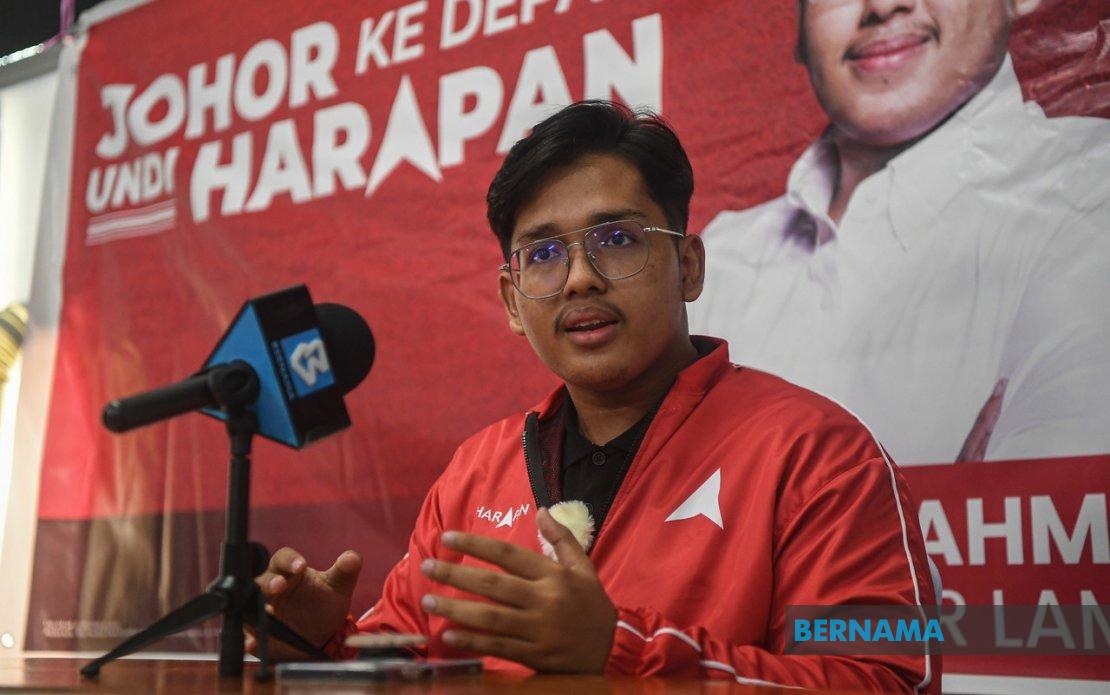
At just 23 years old, Danish Hossman Abd Rahman is making waves in the 16th Johor state election as the youngest contender, drawing on an energetic campaign strategy focused on direct engagement with voters across the Johor Lama constituency. The Pakatan Harapan candidate has framed the positive reception and widespread community acceptance he has received during his canvassing activities as a powerful morale boost, describing it as an "injection of enthusiasm" that reinforces his commitment to delivering meaningful change to the area.
A postgraduate student pursuing a Master of Information Technology at Universiti Tun Hussein Onn Malaysia (UTHM), Danish Hossman has distinguished himself through methodical groundwork and consistent presence throughout the constituency. His approach contrasts sharply with conventional political campaigning, emphasising repeated visits to communities rather than one-time appearances, a strategy he believes helps voters assess his sincerity and genuine interest in local concerns. This deliberate effort to build familiarity and trust reflects a broader recognition among younger politicians that sustained engagement resonates more powerfully than sporadic campaign visits.
Particularly noteworthy is the enthusiastic reception Danish Hossman has received from veteran voters and elderly residents, a demographic often sceptical of youthful candidates lacking political pedigree. These voters, he explains, view his age not as a liability but as an asset capable of revitalising community leadership. More significantly, they express frustration with politicians of their own generation or older who have grown distant from grassroots realities, rarely venturing into communities to directly address citizen grievances. This intergenerational frustration may present a strategic opening in Malaysian electoral politics, where voter dissatisfaction with established representatives can override traditional party loyalties.
Danish Hossman has articulated a deliberate positioning as a "strategic bridge" connecting the experiential wisdom of veteran leaders with the forward-looking aspirations of younger constituents. Rather than dismissing or discrediting older politicians, he frames his role as one of synthesis—acknowledging the value of accumulated experience while channelling the energy and innovation that younger generations bring to governance. This nuanced approach, particularly relevant for Southeast Asian contexts where respect for age and hierarchy remains culturally significant, avoids the alienation that can result from generational conflict in campaign messaging.
As the campaign enters its final week before polling day this Saturday, his team is intensifying efforts across diverse voter segments including towns, villages, and Federal Land Development Authority (Felda) settlements. The strategic emphasis on youth, women, and small business owners reflects recognition that these demographics carry significant electoral weight while facing distinct policy challenges. In rural Malaysian constituencies, Felda settlers represent a particularly influential voting bloc with concentrated economic interests, making direct engagement with this group essential for competitive viability.
The substantive policy agenda Danish Hossman emphasises aligns with documented demographic trends affecting Johor Lama. A critical shortage of affordable housing has become a recurring grievance across Malaysian constituencies, contributing to youth migration toward Kuala Lumpur and other urban centres where employment and housing markets offer greater accessibility. Job creation deficits in peripheral areas represent not merely economic concerns but existential challenges for rural communities watching their younger populations depart. By identifying these interconnected challenges, the candidate demonstrates awareness of structural economic problems rather than treating symptoms in isolation.
His proposed remedies centre on attracting investment and developing downstream industrial capacity calibrated to the region's comparative advantages. For Johor Lama specifically, he highlights agricultural cultivation and livestock production as sectors offering genuine growth potential and employment multiplication. This sectoral focus reflects practical understanding that not all constituencies can compete for high-technology or tertiary manufacturing investments; instead, strategic development must leverage existing capabilities and natural endowments. Creating pathways for youth to establish careers, families, and sustainable futures within their home communities addresses the brain drain challenge afflicting many rural Malaysian constituencies.
The electoral contest for Johor Lama represents a three-way competition, with Danish Hossman challenging incumbent Barisan Nasional representative Norlizah Noh and Perikatan Nasional's Aisah Esa. This triangular contest introduces complexities typical of contemporary Malaysian state elections, where traditional two-party dynamics have fractured into multipolar configurations. The presence of competing candidates from different coalitions suggests potential vote fragmentation, making incumbent performance and voter coalescence particularly consequential. Norlizah Noh's track record as the sitting representative will inevitably feature prominently in voter evaluations alongside the relatively untested profiles of both challengers.
In the context of Malaysia's broader electoral landscape, the emergence of young candidates like Danish Hossman within established coalitions signals evolving approaches to political recruitment and generational renewal. Pakatan Harapan's decision to field a youthful, grassroots-focused candidate reflects either genuine ideological commitment to democratic revitalisation or pragmatic recognition that certain constituencies respond positively to generational change messaging. The outcome in Johor Lama will provide insight into whether voter appetite for youth-led alternatives persists beyond isolated cases, particularly in rural settings where conservatism traditionally runs deeper.
The 16th Johor state election encompasses 172 candidates competing across 56 seats, making this a comprehensive electoral exercise that will reshape the state assembly's composition. Polling day on Saturday will determine not only the Johor Lama outcome but broader questions about coalition performance, voter sentiment toward incumbent governance, and the staying power of various political narratives. Early voting scheduled for the preceding day will capture voters unable to participate on polling day, a mechanism increasingly important as Malaysian society becomes more geographically mobile and professionally demanding.

