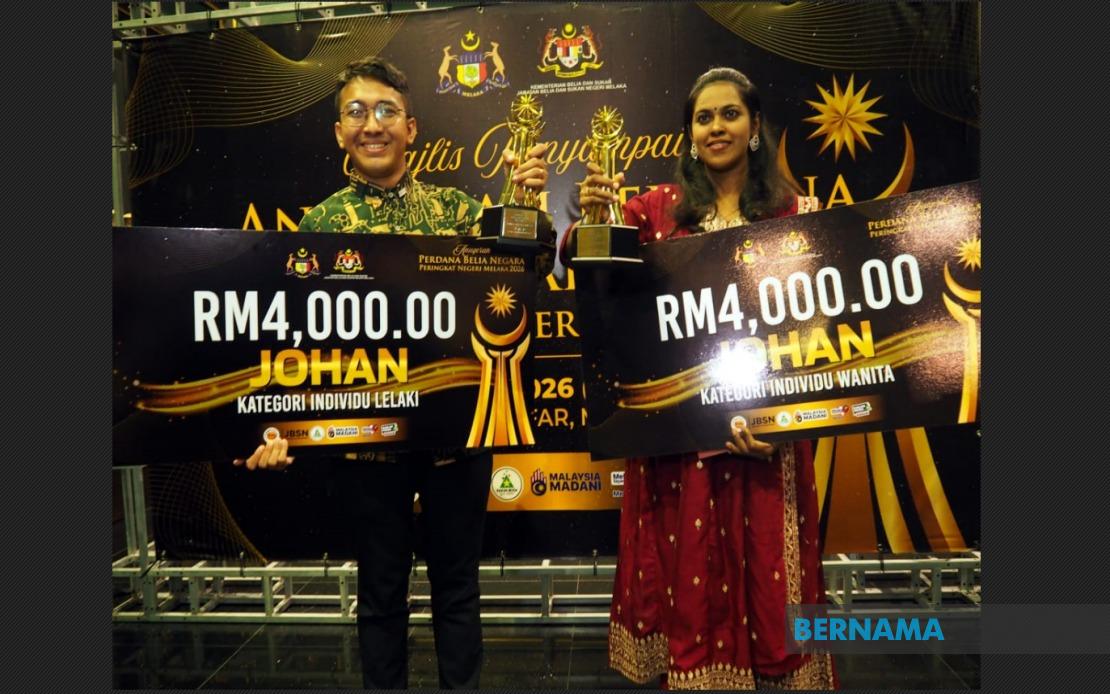
Two young professionals have been honoured for their exceptional contributions to youth development and community service at the 2026 Melaka State-level National Youth Awards, celebrated in a ceremony held in Ayer Keroh last night. Harris Daniel Hermee, a syariah lawyer who has just turned 28, claimed the top award in the male individual category, while SS Mayuri, a 30-year-old primary school teacher from Alor Gajah, secured the female category honour. The recognition underscores the state government's commitment to identifying and celebrating young leaders who are actively shaping their communities.
Harris's achievement represents a remarkable trajectory for someone who only recently returned to Melaka following his legal studies. An Islamic studies and law graduate from Universiti Sultan Zainal Abidin (UniSZA), he has channelled his professional expertise and youthful energy into multiple platforms for community engagement. His involvement began with Gerakan Belia 4B Hang Tuah Jaya, an organisation through which he has orchestrated programmes centred on youth empowerment, sports development, and volunteer initiatives. These efforts have involved substantial partnerships with government agencies and various youth-focused groups, demonstrating his ability to build coalitions and mobilise resources for broader social benefit.
Beyond grassroots organising, Harris has leveraged formal political channels to advance youth interests. His role as Youth State Assembly Member for Pengkalan Batu provides him with a legislative platform to propose ideas and drive policy-level initiatives for young people in his constituency. This combination of ground-level activism and institutional representation positions him as a bridge between civil society and government decision-making—a valuable role in Malaysia's governance landscape. Notably, Harris did not achieve this honour on his first attempt. He placed third in the previous year's competition, and rather than viewing this as a setback, he used it as motivation to expand his reach and deepen his impact, ultimately earning recognition through larger-scale participation in national and international youth development programmes.
Mayuri's recognition highlights the pivotal role educators play in youth development beyond classroom instruction. Her work through the Melaka and Malaysia Tamil Youth Club Council has focused specifically on supporting secondary school students in their final examination phase. By designing and delivering mentoring and motivation programmes targeting SPM candidates, she addresses a critical juncture when young people face academic and psychological pressures. Her approach recognises that youth empowerment extends beyond academics to encompass emotional support and confidence-building during vulnerable periods in their educational journeys.
The teacher's community-oriented initiatives reflect a broader understanding of youth development that encompasses health and social responsibility. She has championed blood donation drives as a means of cultivating civic consciousness among young people, transforming a health imperative into an opportunity for community participation and solidarity. This multi-dimensional approach—combining academic mentoring, motivational support, and civic engagement—demonstrates how educators can transcend traditional classroom boundaries to become catalysts for holistic youth development.
Melaka Chief Minister Datuk Seri Ab Rauf Yusoh officiated the awards ceremony, affirming the state administration's focus on youth as critical stakeholders in Malaysia's social and economic future. The presence of state Youth, Sports and NGO Committee chairman Datuk VP Shanmugam further underscores the institutional recognition given to youth development work. The awarding of honours at the state level serves multiple functions: it publicly validates the contributions of young people already engaged in service, while simultaneously inspiring peers who might be considering community involvement but lack visible role models or institutional recognition.
For Malaysian readers and policymakers, these awards signal important trends in youth engagement patterns. Both recipients demonstrate that meaningful youth development occurs across diverse sectors—law and education—and through varied mechanisms, from youth organisations and legislative bodies to mentoring programmes and community health initiatives. Neither achievement required high-profile corporate sponsorships or international visibility; instead, both are rooted in sustained, patient engagement with immediate communities and constituencies. This model is particularly relevant in Southeast Asia, where young populations constitute significant demographic shares yet often face limited employment prospects and political influence.
The awards also illuminate generational leadership succession in Malaysia. Harris and Mayuri represent young professionals who have not simply focused on individual career advancement but have deliberately invested in developing their peer group. This orientation towards collective uplift rather than individual aggrandisement is essential for sustainable governance and social cohesion. As Malaysia seeks to strengthen its democratic institutions and social fabric, investing in and recognising such leaders becomes strategically important.
For youth organisations and community groups throughout the region, the Melaka awards offer a valuable template. They acknowledge that youth development work requires persistence—Harris's second-time success after an initial third-place finish demonstrates this—and that excellence can emerge from culturally and professionally diverse backgrounds. The awards also validate mentoring and motivational support as legitimate forms of youth development, addressing what research consistently shows: that young people often benefit more from relational support and emotional encouragement than from formal programmes alone.
Looking forward, both recipients' continued engagement will likely influence how youth participation is structured in their respective fields. Harris's presence in legislative spaces may encourage other young lawyers and civil society activists to seek formal political roles, while Mayuri's recognition may embolden educators to view community engagement and youth mentoring as valued professional contributions. Their awards thus represent not merely past achievements but potential catalysts for broader shifts in how Malaysian institutions recognise and resource youth development work across the Melaka state and, by extension, throughout the broader region.

