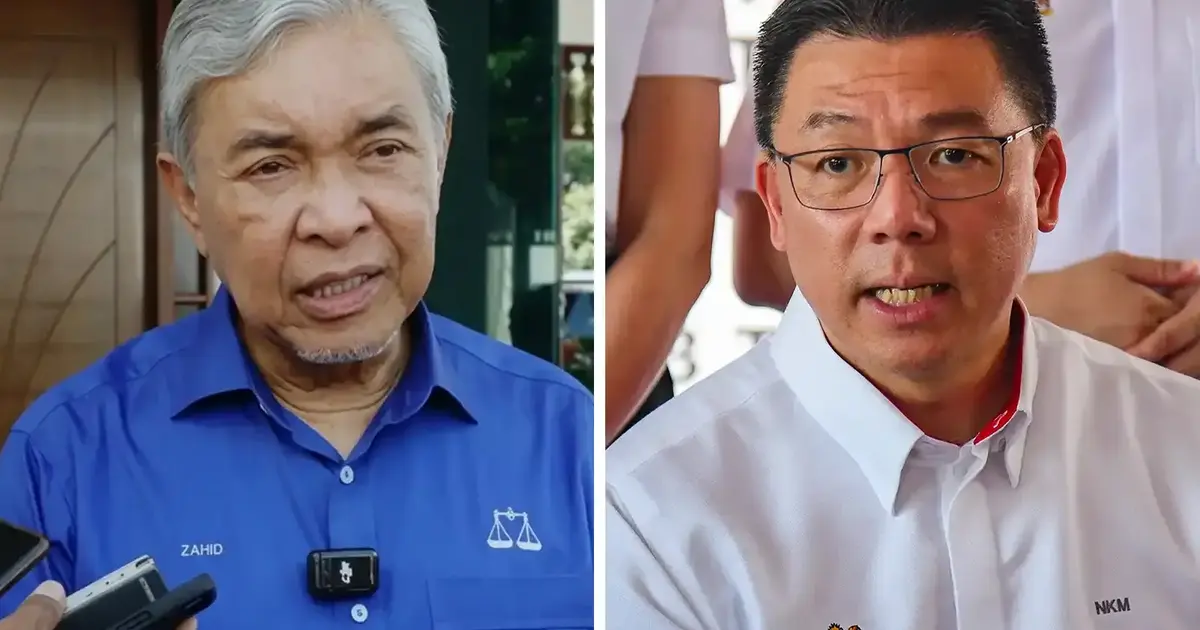
Deputy Prime Minister Zahid Hamzah has objected to remarks made by Nga Kor Ming regarding a potential resignation should former Prime Minister Najib Razak be granted early release from prison, intensifying scrutiny around judicial clemency decisions and coalition stability within Malaysia's governing alliance. The disagreement, which surfaced publicly, highlights lingering tensions tied to how the government handles sensitive matters involving high-profile convictions and the political loyalties of senior figures.
Zahid characterised Nga, a senior figure in the Democratic Action Party and a key component of the ruling Pakatan Harapan coalition, as a personal friend whilst simultaneously indicating that their positions on this matter diverge meaningfully. Rather than engage in public dispute, Zahid signalled an intention to resolve the issue through private dialogue, suggesting the two men maintain a working relationship despite their contrasting perspectives on how the administration should proceed if Najib's legal circumstances change.
The backdrop to this disagreement involves Najib's conviction in 2023 on charges related to the misappropriation of funds from state investment fund 1Malaysia Development Berhad (1MDB), a scandal that dominated Malaysian politics for years and contributed to the fall of the previous government. Najib's imprisonment at Kajang Prison has remained a contentious topic, with speculation periodically surfacing about possible clemency or early release applications, particularly following shifts in Malaysia's political landscape and the return of Umno to coalition governance.
Nga's public statement that he would resign his ministerial position if Najib were released represents a principled stand on accountability and the rule of law, reflecting broader concerns within the DAP and civil society about appearing to condone judicial interventions that might be construed as political. This position resonates with voters and party members who view the 1MDB scandal as emblematic of institutional corruption and demand reassurances that no backroom deals will reverse consequences imposed through legitimate legal processes.
Zahid's pushback against this conditional pledge, however, underscores a more pragmatic political calculation operating within Umno and segments of the Barisan Nasional component parties. For these actors, maintaining internal party solidarity and limiting overt criticism of senior figures—even those convicted of serious offences—remains strategically important as the coalition navigates ongoing electoral competition and the complexities of governing with coalition partners of fundamentally different ideological orientations.
The tensions revealed by this exchange reflect broader fault lines within Malaysia's current political settlement. The Pakatan Harapan coalition, which governed from 2018 to 2020, campaigned on promises of prosecuting corruption and ensuring institutional reform. The reintegration of Umno into government in 2021 created inherent contradictions, as the party that presided over the 1MDB scandal now sits alongside parties that had promised to hold power accountable. These contradictions periodically surface when decisions affecting convicted figures come into focus.
For Malaysian observers and regional analysts, the disagreement also illustrates the fragility of multi-party coalitions attempting to govern without ideological unity. Whereas Western democracies often feature stable two-bloc competition, Malaysia's coalition requires constant negotiation between component parties with divergent values around accountability, rule of law, and political patronage. Moments like these expose how decisions about judicial matters can threaten the cohesion that holds governing alliances together.
The question of whether Najib might receive clemency through official channels remains speculative, though it has periodically circulated in political circles and media reporting. Any such development would almost certainly trigger significant public reaction and create serious strains on the coalition's unity. Nga's advance declaration that he would not remain in government if this occurred can thus be interpreted both as a principled statement and as a pre-emptive political boundary-setting designed to insulate his party from accusations of complicity in potential clemency decisions.
Zahid's indicated intention to discuss the matter privately with Nga suggests an effort to contain the disagreement and prevent further public escalation that might embarrass either party or provide ammunition to opposition figures seeking to portray the government as fractious or inconsistent on corruption issues. The framing of Nga as a friend, whilst simultaneously registering disapproval of his position, represents a diplomatic formulation that acknowledges both the relationship and the substantive difference of opinion.
Looking forward, this episode underscores how Malaysia's criminal justice system and high-profile convictions remain fundamentally enmeshed with electoral politics and coalition management. The government faces ongoing pressure to demonstrate that judicial outcomes are genuine and not subject to political manipulation, even as the political composition of coalitions creates incentives and opportunities for exactly such manipulation. Navigating this tension will remain a defining challenge for Malaysian governance in coming months.

