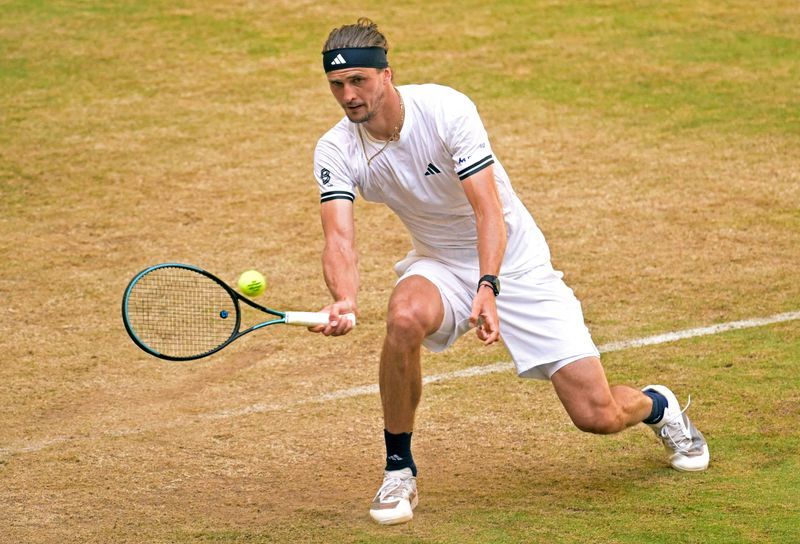
Alexander Zverev's hopes at the Halle Open came to an abrupt end on Saturday when he fell to American Taylor Fritz in straight sets, but the German world number three has pointed to a medical equipment failure rather than superior opposition as the primary culprit. The 6-7(4) 6-4 7-5 defeat, which stretched across two hours and 39 minutes of play, proved particularly frustrating for Zverev given that his glucose monitoring device malfunctioned during the contest, leaving him physically compromised throughout.
Zverev, who entered the semi-final already dealing with an unfavourable head-to-head record against Fritz—having lost their previous six consecutive encounters—struggled visibly as the match progressed. The malfunction of his glucose sensor, which is integral to his diabetes management system, created a cascade of complications that fundamentally altered his ability to compete at peak physical capacity. Rather than providing accurate readings of his blood sugar levels, the device displayed falsely elevated values, prompting him to administer far more insulin than his body actually required.
The miscalculation proved severe in its consequences. During the opening 45 minutes of the semi-final, Zverev found himself forced to consume approximately 350 grams of sugar in an attempt to counteract the effects of the excessive insulin injection. This emergency glucose intake represented an extraordinary intervention for any athlete during competitive play, and Zverev described the experience in unequivocal terms, stating he felt "absolutely terrible" throughout the early stages of the contest.
Despite these considerable obstacles, Zverev maintained his competitive spirit and acknowledged Fritz's legitimate claim to victory. Rather than dwelling on excuses, the German demonstrated characteristic sportsmanship by crediting his opponent for playing better tennis on the day. This gracious response highlights the professional maturity Zverev has developed while navigating the unique challenges of competing at an elite level while managing Type 1 diabetes, a condition he has lived with since his fourth birthday.
The technical failure represents an exceptional occurrence within Zverev's extensive history of diabetes management through advanced monitoring technology. He has relied on Medtronic's glucose sensor systems since 2016 or 2017, spanning approximately nine years of professional tennis competition. Throughout this lengthy period, Zverev had never encountered such a dramatic malfunction, making the Halle incident particularly unusual and unexpected. The magnitude of the error—displaying values in the opposite direction of actual glucose levels—suggests a fundamental failure in the device's sensing mechanism rather than a minor calibration issue.
Zverev's situation underscores the intersection of medical management and elite sports performance, a reality that distinguishes his career path within professional tennis. While many athletes benefit from straightforward physical conditioning and tactical preparation, Zverev must also maintain rigorous control over his metabolic processes to ensure his body functions optimally during matches. The reliance on sophisticated monitoring equipment introduces an additional layer of complexity that other players do not typically face, and the Halle incident reveals the vulnerability inherent in depending on such technology.
The broader implications for Zverev's immediate future, however, appear manageable. Despite the disappointing exit from Halle, he expressed confidence that the sensor malfunction would not impact his preparation for Wimbledon, the prestigious grass court championship scheduled to commence on June 29 and conclude on July 12. This timeline provides sufficient opportunity for Zverev to replace his malfunctioning equipment and return to his normal diabetes management protocols before one of tennis's most demanding tournaments.
The loss itself carries less significance in light of Zverev's recent form and standing within the sport. His previous six consecutive defeats against Fritz, extending beyond the Halle encounter, suggest that the American has developed tactical approaches that trouble the German competitor. Fritz demonstrated superior court positioning and execution on Saturday, taking advantage of Zverev's compromised physical state to secure a commanding victory. The third set proved particularly consequential, with Fritz converting his opportunities more efficiently as Zverev's energy reserves became increasingly depleted.
For Malaysian and Southeast Asian tennis enthusiasts, Zverev's situation carries relevance beyond the immediate tournament result. His management of Type 1 diabetes at the professional level serves as inspiration for young athletes in the region living with chronic health conditions, demonstrating that elite athletic achievement remains attainable despite such challenges. Furthermore, the incident illustrates the technological sophistication that contemporary professional tennis players employ to optimise performance, reflecting the sport's evolution into a domain where medical science and athletic excellence intersect continuously.
Looking forward, the Halle defeat, though disappointing, unlikely represents a significant setback for Zverev's broader seasonal objectives. The French Open champion retains sufficient ranking points and form to position himself competitively for Wimbledon and subsequent major tournaments. His demonstrated ability to maintain professional composure despite a disadvantageous situation, combined with his transparent acknowledgment of Fritz's superior play on the day, reflects the mental resilience required to sustain a career at tennis's highest echelon.
%22%2F%3E%3C%2Fpattern%3E%3C%2Fdefs%3E%3Crect%20width%3D%22100%25%22%20height%3D%22100%25%22%20fill%3D%22url(%23ph24037g)%22%2F%3E%3Crect%20width%3D%22100%25%22%20height%3D%22100%25%22%20fill%3D%22url(%23ph24037p)%22%2F%3E%3Ctext%20x%3D%2250%25%22%20y%3D%2250%25%22%20text-anchor%3D%22middle%22%20dominant-baseline%3D%22central%22%20fill%3D%22rgba(255%2C255%2C255%2C0.95)%22%20font-family%3D%22Georgia%2C%20'Times%20New%20Roman'%2C%20serif%22%20font-weight%3D%22700%22%20font-size%3D%22320%22%20letter-spacing%3D%22-0.02em%22%3EIran%3C%2Ftext%3E%3C%2Fsvg%3E)
%22%2F%3E%3C%2Fpattern%3E%3C%2Fdefs%3E%3Crect%20width%3D%22100%25%22%20height%3D%22100%25%22%20fill%3D%22url(%23ph1r7fsg)%22%2F%3E%3Crect%20width%3D%22100%25%22%20height%3D%22100%25%22%20fill%3D%22url(%23ph1r7fsp)%22%2F%3E%3Ctext%20x%3D%2250%25%22%20y%3D%2250%25%22%20text-anchor%3D%22middle%22%20dominant-baseline%3D%22central%22%20fill%3D%22rgba(255%2C255%2C255%2C0.95)%22%20font-family%3D%22Georgia%2C%20'Times%20New%20Roman'%2C%20serif%22%20font-weight%3D%22700%22%20font-size%3D%22320%22%20letter-spacing%3D%22-0.02em%22%3EIran%3C%2Ftext%3E%3C%2Fsvg%3E)