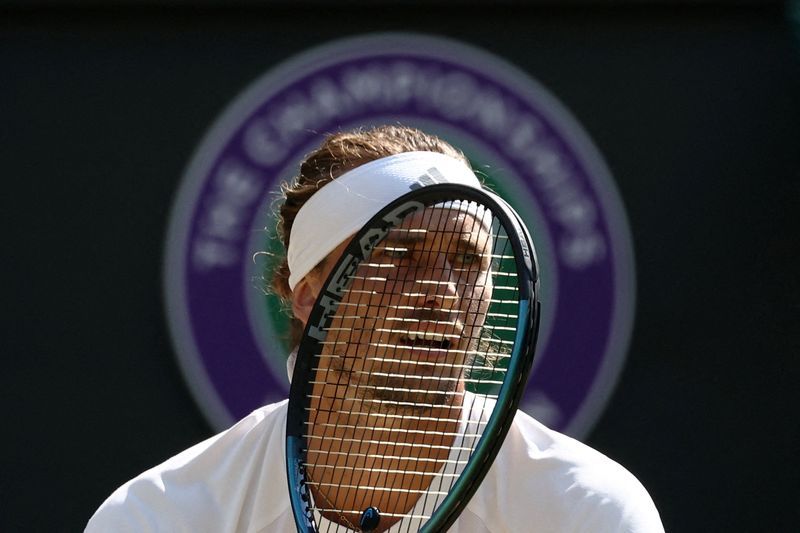
Alexander Zverev has finally conquered a psychological hurdle that has haunted him for more than two years. The German second seed delivered a commanding performance against Taylor Fritz on Court One, securing a 6-4 6-4 6-2 victory to advance to the Wimbledon semi-finals. This triumph marks a significant turning point in their head-to-head record, where Zverev had suffered seven consecutive defeats against the American, most painfully at the same venue just twelve months earlier. The win propels the French Open champion further along his path towards claiming back-to-back Grand Slam titles, with only a handful of matches separating him from the ultimate prize in southwest London.
The significance of Zverev's breakthrough extends beyond the immediate match result. By reaching his maiden Wimbledon semi-final, the 26-year-old has etched his name alongside some of Germany's greatest tennis ambassadors. He joins an exclusive club of German men who have achieved this milestone in the modern professional era—Boris Becker, Michael Stich, Rainer Schuettler, and Tommy Haas. This development underscores Germany's enduring influence in elite tennis, a tradition Zverev appears intent on continuing as he navigates the latter stages of the tournament.
The mental weight of facing Fritz cannot be understated. During their previous encounters, the American had developed a clear dominance in their matchup, and Zverev acknowledged that reversing this pattern required near-flawless execution. In post-match comments, the German explained how the memory of repeated failures against Fritz had been a constant distraction, forcing him to maintain absolute focus from the opening service game. When he faced three break points immediately in his first service hold, Zverev recognised that the burden of his recent losses could quickly overwhelm him if concentration wavered even momentarily.
Zverev's tactical approach centred on controlling the baseline exchanges with exceptional precision. He broke early in the opening set and constructed a commanding 5-4 lead under intense afternoon heat on Court One. When Fritz attempted a late recovery in the tenth game, Zverev demonstrated the composure required at this stage of a major championship, fending off the threat and closing out the first set with calculated aggression. The crowd's energy surge when news emerged that British hope Arthur Fery was dominating his match on Centre Court seemed to lift Zverev's performance to another level.
The turning point in the contest arrived when Fritz requested a medical timeout after just three games of the second set, nursing a troublesome right knee issue. Rather than exploit this development recklessly, Zverev methodically increased his intensity, capitalising on a crucial break that shifted momentum decisively in his favour. By securing a comfortable hold to extend his advantage, Zverev had essentially decided the match's outcome, leaving Fritz with diminishing hope as the third set beckoned. The American's physical limitations appeared to compound his difficulties against an opponent now operating at peak efficiency.
Zverev's performance in the third set bordered on the exceptional. A stunning backhand winner sealed a double break at 4-1, and from that position, the German required minimal additional effort to close out the set and claim his place in the semi-finals. This was tennis stripped of drama or suspense, replaced by controlled execution from a player who understood exactly what was required to vanquish a longstanding nemesis. His 12th major semi-final appearance represents steady progression through the sport's most demanding tournaments, yet this particular breakthrough felt distinctly personal and emotionally resonant.
The prospect of facing Fery in the semi-finals introduces a fascinating subplot, as both players are reaching their first Wimbledon semi-finals simultaneously. Zverev's gracious acknowledgment of the crowd's likely support for the home favourite demonstrated emotional maturity, though his competitive resolve remained unmistakably sharp. He recognised that competing at Wimbledon's most prestigious stage requires unwavering self-belief, regardless of external sentiment. The German's determination to trust his tennis and execute his game plan would prove essential against any opponent, particularly one blessed with home crowd advantage.
For Malaysian and Southeast Asian tennis followers, Zverev's progression carries broader implications for the sport's competitive landscape. The German contingent's consistent presence at tennis's highest levels reflects the commercial investment and talent development systems that produce elite players. Observing how established powerhouses like Germany maintain their standing amid evolving competition offers valuable lessons for developing tennis infrastructure in the region. Zverev's methodical approach to breaking through psychological barriers also illustrates the mental resilience required at professional tennis's apex, where technical proficiency alone proves insufficient.
The narrative of redemption through persistence resonates strongly within professional sports. Zverev endured extended failure against Fritz without losing faith in his abilities, instead using each defeat as motivation to refine his approach. This mentality—persistence beyond repeated setbacks—exemplifies the psychological characteristics that distinguish elite performers across all competitive domains. His willingness to acknowledge the difficulty of even seemingly straightforward victories, joking that beating his five-year-old daughter would constitute his only genuinely easy match, reveals the extraordinary standards to which top-ranked players hold themselves.
Looking ahead, Zverev's trajectory at Wimbledon will be shaped by his capacity to maintain the mental clarity and physical intensity demonstrated against Fritz. The semi-final against Fery presents a fresh challenge, devoid of the psychological baggage that accompanied their earlier contest. However, the confidence derived from finally breaching his personal barrier against Fritz has undoubtedly strengthened Zverev's overall position. Should he continue performing at this level, the possibility of a second consecutive Grand Slam title—and his first Wimbledon crown—moves substantially closer to reality, cementing his status among tennis's contemporary elite.

