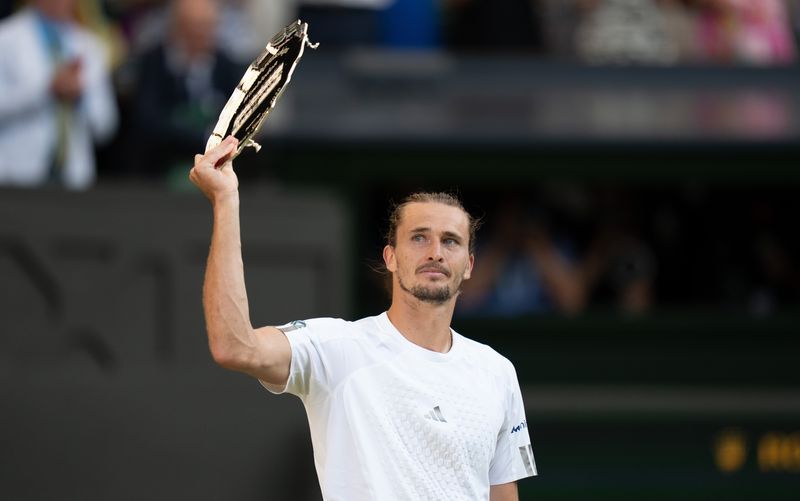
Alexander Zverev's Wimbledon runner-up finish will propel him to second place in the ATP world rankings on Monday, positioning the German at the apex of professional tennis below only Jannik Sinner. Yet despite this elevated status, the 29-year-old recognises that Sinner and Carlos Alcaraz have established themselves as the sport's dominant partnership, and he is intent on deploying a fundamentally different tactical philosophy to eventually bridge the chasm separating them from the rest of the field.
The Wimbledon final itself provided a microcosm of Zverev's evolving approach. His Sunday encounter with the world number one saw him compete fiercely against Sinner across a demanding four-set contest, ultimately falling 6-7(7) 7-6(2) 6-3 6-4 in a match that represented something qualitatively different from his previous nine consecutive defeats to the Italian. Most tellingly, Zverev snapped an alarming streak of 14 successive lost sets against Sinner during the early stages of the championship match, indicating that his tactical adjustments are yielding tangible results against the world's finest.
The narrative surrounding Zverev's recent resurgence cannot be divorced from his maiden Grand Slam triumph at Roland Garros last month, achieved at his 41st major tournament attempt. While sceptics have questioned the legitimacy of this breakthrough given that Sinner fell unexpectedly in the second round and Alcaraz remained sidelined through a persistent wrist injury, Zverev himself views the French Open victory as a transformative moment that has fundamentally altered his mindset and tactical confidence heading into the grasscourt season.
The philosophical cornerstone of Zverev's revised approach centres on an emphatic rejection of passivity, particularly with his forehand stroke. Throughout much of his career, this weapon was regarded as insufficiently aggressive, a potential liability against the tour's most potent ball-strikers. Yet at Wimbledon, Zverev deployed his forehand with remarkable conviction and destructiveness, using the stroke to systematically trouble Sinner and generate opportunities that would have been unimaginable under his previous, more defensive framework. This mechanical evolution reflects a deliberate commitment to positive shot-making rather than conservative baseline accumulation.
Zverev articulated this strategic reorientation with considerable clarity during his post-match media engagement, emphasising that his commitment to attacking tennis represents not merely a temporary tactical adjustment but rather a fundamental philosophy that he intends to sustain indefinitely. He acknowledged that the transition presented challenges earlier in the season, as developing proficiency in a radically different playing style inevitably produces inconsistency during the adaptation phase. However, he contended that the compounding benefits of consistent application would progressively enhance his execution and ultimately position him as a genuine contender for major titles. His statistical performance during the Wimbledon final reinforced this analysis: his first serve percentage hovered around 80 percent throughout the match, while his willingness to attack high-risk forehands created genuine pressure against Sinner.
The competitive landscape of contemporary professional tennis presents a particular challenge for players occupying Zverev's position in the hierarchy. Sinner and Alcaraz have accumulated 12 Grand Slam titles between them, establishing themselves as the unquestionable standard-bearers for excellence across the sport's most prestigious tournaments. The emergence of this dominant partnership has created what observers have termed the search for the third competitor, a position Zverev has occupied for several years but from a position of considerable distance. He remains cognisant that merely holding the third-ranked position offers insufficient reassurance if that ranking masks an unbridgeable chasm separating him from the championship contenders.
Zverev's assessment of his own competitive trajectory revealed a player increasingly confident that he possesses the capacity to pose genuine threats to his elite rivals, even if victories remain elusive thus far this calendar year. He pointed to his Australian Open contest against Alcaraz and his Wimbledon final appearance as evidence that he has begun successfully implementing the tactical adjustments necessary to transform theoretical competence into matches of genuine competitiveness. The Spanish titan and Italian champion have been pushed to their absolute limits in recent encounters, circumstances that represent a marked departure from Zverev's historical pattern of decisive defeats against these opponents.
The Wimbledon final itself contained a crucial narrative moment when Zverev incurred a fall at 3-3 in the third set at his only break point opportunity during the match. This incident proved consequential not merely in terms of the immediate tactical positioning but also in its physiological ramifications. Zverev subsequently disclosed that the tumble precipitated an over-extension of his knee similar to an injury he had sustained two years prior, thereby compromising his capacity to generate maximum velocity on his service delivery. The resulting reduction in serving pace coincided with a perceptible decline in his overall performance level during the third set, though he managed to regain his equilibrium during the fourth frame.
For Malaysian and Southeast Asian observers tracking the trajectory of men's professional tennis, Zverev's philosophical commitment to attacking tennis carries broader implications beyond individual tournament outcomes. The emergence of Sinner and Alcaraz as commanding figures has established a particular playing style and tactical blueprint as the contemporary template for success at the highest competitive echelon. Zverev's willingness to adopt a more aggressive, risk-embracing approach suggests that the next generation of competitive tennis will increasingly emphasise positive shot-making and tactical initiative rather than the defensive baseline grinding that characterised earlier eras of the sport.
The German's trajectory also illuminates the extended timeline typically required for elite players to achieve breakthrough success at the major championship level. His maiden Grand Slam victory arriving at his 41st major tournament attempt reflects the formidable competitive obstacles confronting players operating below the dominant tier. Nonetheless, Zverev's conviction that his tactical evolution positions him to challenge for additional titles suggests confidence that his breakthrough represents not an anomaly but rather the commencement of an extended period of championship contention. Should he continue refining his aggressive approach and translating philosophical commitment into consistent execution, Zverev may plausibly develop into the genuine third force capable of reliably challenging Sinner and Alcaraz for tennis's most coveted prizes.
The Wimbledon final ultimately encapsulates both the progress Zverev has achieved through his tactical reorientation and the remaining distance separating him from championship success against the sport's elite. While he fell short on this occasion, the quality of his performance and the apparent effectiveness of his more aggressive blueprint suggest that future encounters with Sinner and Alcaraz will present considerably greater challenges for these dominant competitors. For Zverev, the path forward involves consistent refinement and execution of these tactical principles, a commitment he appears genuinely prepared to sustain across the remainder of his career.

