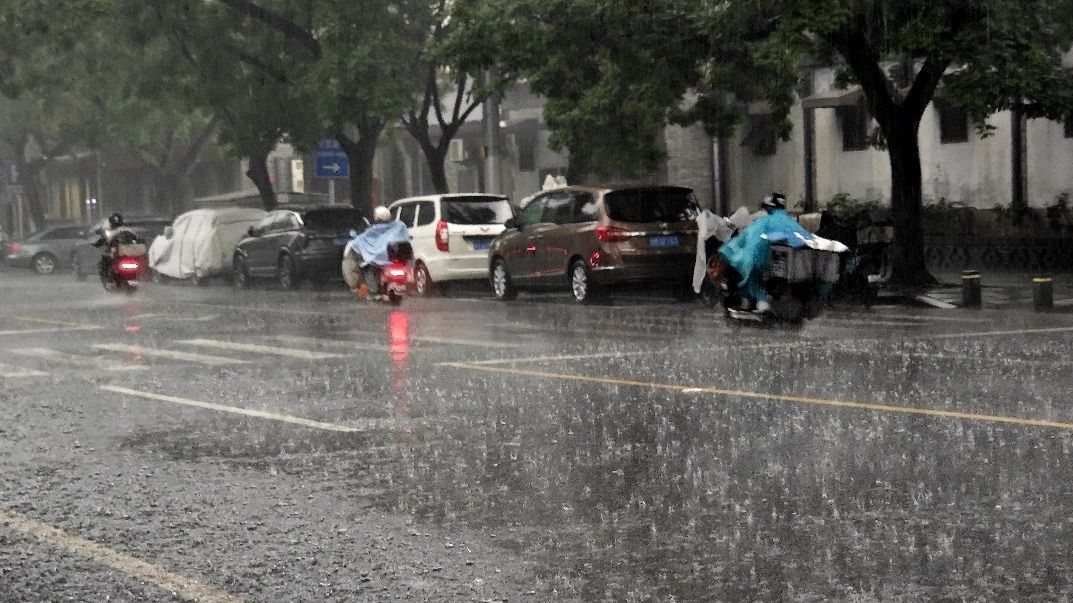
Beijing has declared its inaugural orange-level rainstorm alert for the 2026 flood season, with the city's meteorological observatory issuing the warning on Thursday afternoon as severe weather systems moved into position. The alert, announced at 1.30 pm, prompted the Beijing flood control office to simultaneously activate a Level-II flood control emergency response, signalling heightened preparedness across municipal infrastructure and emergency services. This marks a significant escalation in seasonal precautions as the region enters its vulnerability period for water-related hazards.
The precipitation event is anticipated to unfold over a 42-hour window beginning Friday afternoon, with forecasters predicting sustained heavy rainfall that will persist until Sunday morning at 8.00 am. Several densely populated and geographically vulnerable districts face the brunt of the expected downpour, with particular concern centred on Huairou, Miyun, Pinggu, Shunyi and Fangshan districts. Meteorological projections indicate that localised areas may experience hourly precipitation rates exceeding 70 millimetres, while cumulative totals over a 24-hour period could surpass 150 millimetres—levels that typically trigger significant surface runoff and urban flooding in inadequately drained zones.
The alert specifically identifies elevated risks in terrain characterised by elevation changes and slope gradients, where rapid water accumulation poses threats to both infrastructure and human safety. Low-lying urban and peri-urban areas face particular vulnerability to waterlogging, as stormwater drainage systems can become overwhelmed when precipitation intensity outpaces collection capacity. The municipal authorities have therefore issued comprehensive advisories cautioning residents to implement protective measures and maintain heightened situational awareness throughout the alert period.
Civilian conduct guidelines released by flood control authorities stress the importance of voluntarily limiting outdoor exposure during the heaviest precipitation phases. The public has been directed to remain attentive to real-time weather notifications and official emergency communications, which will provide granular updates as conditions develop. Additionally, authorities have recommended that residents rely on mass transit systems rather than private vehicles to reduce congestion on roads that may become compromised by standing water or debris flows.
The municipal employment and institutional sectors have been encouraged to implement adaptive work schedules that either reduce on-site presence or distribute arrival and departure times to prevent concentration of commuter traffic during peak rainfall hours. This workplace flexibility represents a pragmatic acknowledgement that conventional office attendance patterns are incompatible with extreme weather scenarios that impair transportation networks. Schools operating in Beijing have similarly received guidance to suspend in-person instruction, structured training programmes and outdoor educational activities based on evolving meteorological conditions, prioritising student and staff safety over rigid academic calendars.
Public health and safety messaging has explicitly prohibited recreational activities in mountainous and riverine environments, underground shopping districts, and geological hazard zones where secondary risks such as rockfalls or mudslides may accompany heavy precipitation. Residents have been specifically warned to maintain distance from flowing waterways and artificial channels, where current velocity and water depth can increase unpredictably during intense rainfall events. These restrictions reflect the cascade effects that severe weather can trigger across multiple environmental systems simultaneously.
Industrial and commercial operations throughout the capital have been directed to suspend outdoor work, temporary construction activities and any operational procedures dependent on unimpeded access to external areas. This suspension of commercial activity extends to formal construction sites, which represent particular hazards during precipitation events due to exposed earthworks, elevated structures and heavy machinery that may become unstable on saturated substrates. The breadth of these operational restrictions underscores the seriousness with which Beijing's governance structure approaches Level-II emergency scenarios.
China's meteorological warning classification system employs a graduated four-category framework designed to communicate hazard severity to the general population and administrative bodies. The red alert designation represents the maximum warning tier, indicating catastrophic conditions requiring immediate shelter and cessation of virtually all non-essential activities. The orange alert, which Beijing has now implemented, constitutes the second-highest severity classification and triggers substantial preventive measures and resource mobilisation. Yellow and blue alerts represent progressively lower threat levels, employed for monitoring evolving conditions or issuing precautionary guidance before hazards materialise.
For Malaysian and Southeast Asian observers, Beijing's activation of emergency protocols during the 2026 flood season provides instructive perspective on how major metropolitan regions in East Asia operationalise extreme weather responses. The integration of meteorological forecasting with unified emergency command structures, combined with explicit public guidance on behaviour modification during hazard windows, reflects institutional coordination practices that have developed through accumulated experience with recurring monsoon and frontal systems. The metropolitan area's density—with millions of residents and complex infrastructure systems operating in parallel—necessitates precisely calibrated communication and enforcement mechanisms to prevent cascading failures across transportation, utilities and commerce sectors during severe weather events.

