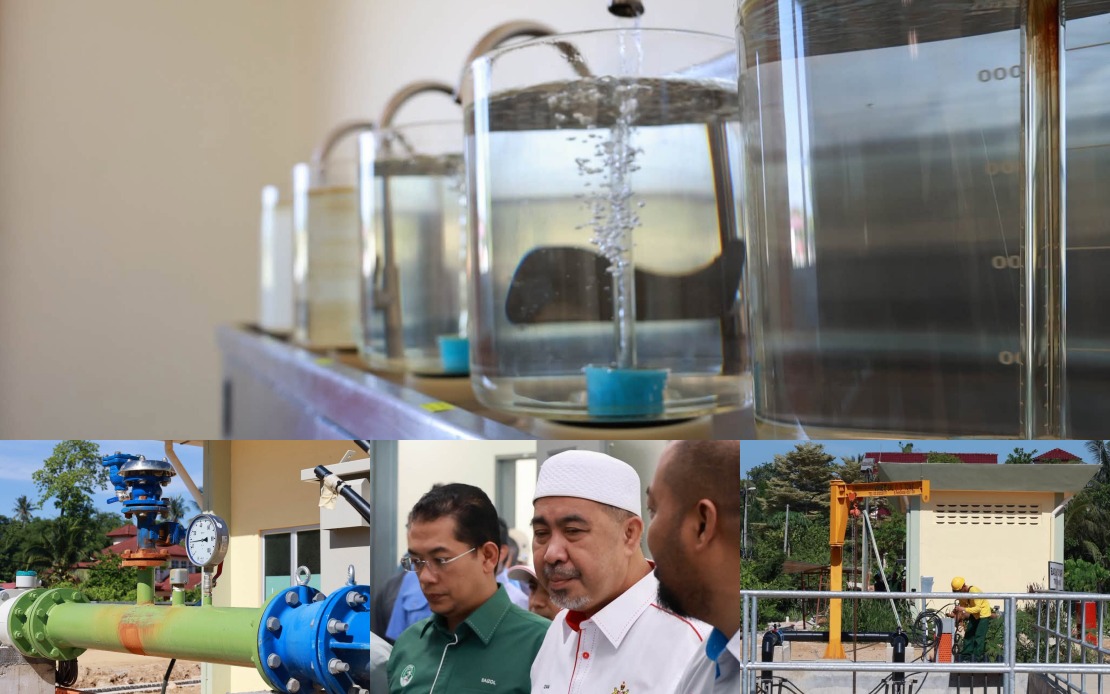
The Chicha 2 Water Treatment Plant (WTP) located in Pasir Hor near Kota Bharu is approaching its completion phase and will begin serving the region's water consumers from September onwards. Datuk Dr Izani Husin, chairman of Kelantan's State Public Works, Infrastructure, Water and Rural Development Committee, announced that the RM54.98 million infrastructure project has achieved 97 per cent physical completion, with the remaining work expected to conclude within weeks. The facility's imminent launch represents a significant milestone for addressing water scarcity challenges that have persisted across portions of Kelantan's northern region.
The treatment plant boasts a production capacity of 20 million litres per day, positioning it as a substantial addition to Kelantan's water supply infrastructure. Upon becoming operational, the facility will channel treated water to communities across Pasir Hor, Telipot, Kota Seribong, Mulong and Tunjong. These five localities have historically experienced inconsistent water supply, making the new plant's arrival particularly important for residents who have endured extended dry periods. The targeted beneficiary population exceeds 13,000 consumers, though the facility's actual impact may prove considerably broader as the authority activates dormant water accounts throughout the service area.
A compelling aspect of the Chicha 2 project involves its innovative water treatment methodology. The plant employs aeration-based water treatment technology that harnesses groundwater extracted from excavations reaching depths of 100 metres below the surface. This aeration system represents the first application of this particular treatment approach within Kelantan, distinguishing the facility as a technological advancement for the state. Water authorities view this method as potentially replicable at other treatment plants across Kelantan, suggesting the state government sees promise in scaling this technology to address broader supply deficiencies.
The reactivation of approximately 10,000 inactive consumer accounts constitutes another substantial benefit of the Chicha 2 commissioning. Across Kelantan's water distribution network, tens of thousands of households and establishments remain disconnected from treated water supplies, either due to supply unavailability or infrastructure gaps. Many properties have dormant accounts registered with water authorities but receive no service. The new plant's capacity will enable reconnection initiatives, allowing previously underserved communities to access quality water through formal supply channels rather than relying on groundwater wells or supplementary sources.
Kelantan's water supply challenges have deep structural roots that extend beyond simple capacity constraints. Dr Izani acknowledged that non-revenue water losses currently exceed 50 per cent of treated supply, a concerning figure reflecting systemic inefficiencies. These losses stem from multiple infrastructure vulnerabilities including aged and corroded pipes, underground ruptures, and faulty measurement equipment. Such leakage represents wasted water resources and financial losses for water authorities, essentially meaning more than half the treated water produced never reaches paying customers. Addressing this reality requires simultaneous investment in both new supply capacity and network rehabilitation.
The state government has articulated an ambitious timeline for resolving Kelantan's water supply crisis comprehensively by 2030. This ten-year horizon acknowledges the scale of required interventions across multiple fronts simultaneously. The strategy encompasses constructing additional water treatment plants beyond Chicha 2, implementing distribution network upgrades to reduce leakage, and expanding coverage to presently unserved areas. Executing this multiphase infrastructure program demands sustained capital investment, technical expertise, and effective project management across government agencies. Progress achieved so far, represented by Chicha 2's near-completion, suggests the state government is advancing this agenda, though the complexity of comprehensive water system rehabilitation extends well beyond any single facility.
For Malaysian observers tracking regional water security developments, Kelantan's experience reflects challenges shared across several states where population growth, ageing infrastructure, and climate variability converge to create supply pressures. The state's reliance on groundwater extraction through deep wells indicates surface water sources may be constrained or unreliable for meeting current demand. This dependency on subsurface resources requires careful management to prevent aquifer depletion, adding another dimension to the state's long-term water sustainability equation. Other Malaysian states wrestling with similar supply constraints will likely monitor Chicha 2's operational performance and the aeration technology's effectiveness.
The economic implications of Kelantan's water infrastructure investment extend beyond direct consumer benefits. Construction expenditure of RM54.98 million represents immediate economic activity within the state, supporting employment in engineering, construction, and project management sectors. More substantially, reliable water supply attracts industrial investment and residential development, as businesses and families require assured access to quality water. Conversely, water scarcity deters economic expansion and reduces property values in affected areas. Kelantan's water infrastructure push therefore functions as an economic development strategy alongside its public health dimensions.
Public patience represents a critical variable in infrastructure rehabilitation programs spanning multiple years and requiring staged implementation. Dr Izani's explicit appeal for consumer forbearance reflects recognition that water supply disruptions may continue temporarily as different project phases proceed. Some communities may experience service interruptions during network maintenance work, while others remain unconnected pending later project stages. Transparent communication about timelines and progress thus becomes essential for maintaining public confidence in the government's commitment to resolving chronic supply problems. Consumer frustration could undermine political support for continuing necessary but expensive infrastructure programs.
The September commissioning of Chicha 2 WTP provides a concrete demonstration of progress on promises that water authorities have made regarding supply improvements. Following months or years of construction activity, the facility's transition to operational status will be tangible evidence that capital investment translates into improved services. For the 10,000 households reactivating dormant water accounts and the existing 13,000 consumers expecting improved reliability, September's launch becomes a meaningful benchmark. However, the facility's individual impact, while significant, represents one component within Kelantan's broader water system transformation necessary to achieve the 2030 resolution target. Sustained political will and continued resource allocation beyond this one project will ultimately determine whether the state successfully addresses its water security challenge.

