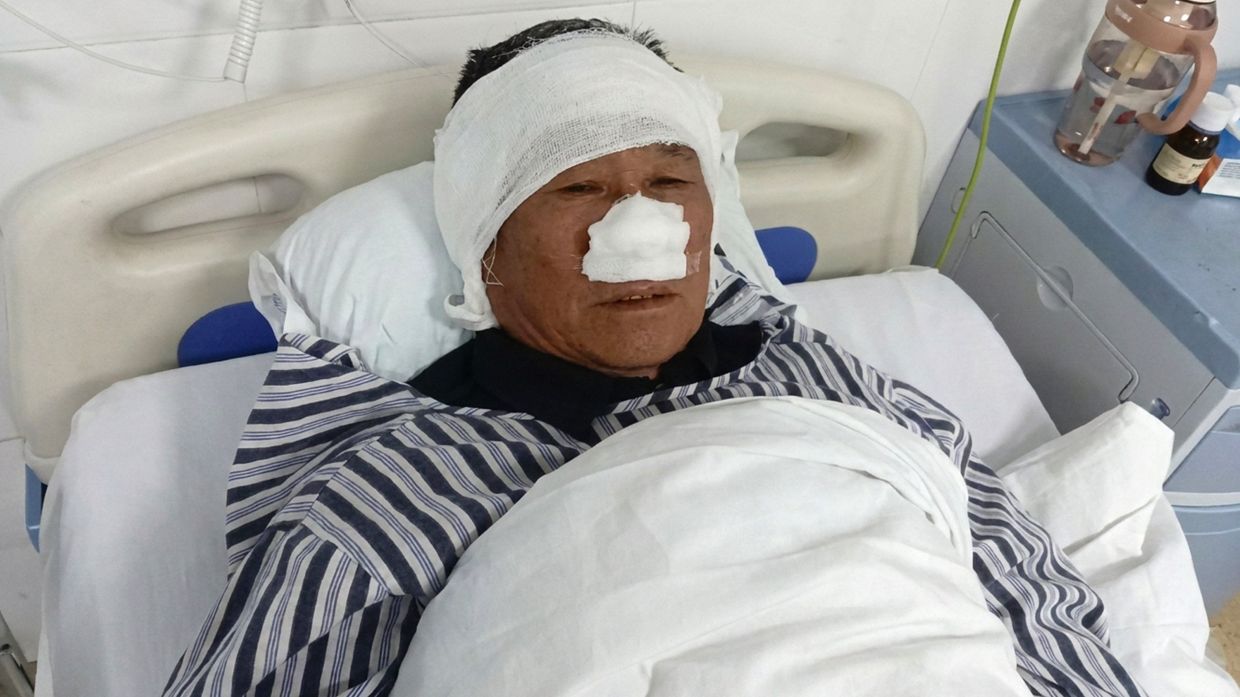
Zeng Fanlin, a 69-year-old resident of Chenzhou in Hunan province, has been officially recognized by the Chinese government as a national hero for his extraordinary bravery during a violent street attack in April. The incident, which left him severely disfigured, tested his commitment to protecting his community and ultimately demonstrated the moral courage that defines his character. His recognition comes as part of a broader national commendation programme honouring acts of selfless intervention and civic responsibility.
The crisis unfolded when a man in his 20s arrived at Zeng's village and began a rampage of violence targeting random individuals. The attacker kicked at doors, assaulted pedestrians, and created widespread panic among villagers who were unsure how to respond to such unprovoked aggression. The situation escalated dramatically when the attacker targeted a woman riding an e-bike, grabbing her by the neck and creating an immediate threat to her life. Faced with such a dangerous confrontation, most bystanders retreated and contacted police, recognizing the gravity of the situation but uncertain whether direct intervention would increase harm.
Zeng's response was instinctive and decisive. Rather than waiting for authorities to arrive, he rushed forward to confront the attacker and physically restrained him. Two other villagers quickly joined Zeng's effort, and together they managed to subdue the increasingly violent man until police officers could take custody of him. During this intense physical struggle, the attacker bit off a significant portion of Zeng's nose, inflicting an injury that would permanently alter his appearance and quality of life. Despite experiencing what must have been excruciating pain, Zeng maintained his grip on the attacker and did not release his hold until law enforcement had secured the suspect and could assume control of the situation.
The medical consequences of Zeng's heroism proved substantial and complex. Doctors at the hospital determined that he had lost most of his nose, making reconstructive surgery exceptionally challenging from a technical standpoint. The surgical team warned him of potential long-term complications, including chronic pain and visible scarring that would be difficult to fully conceal. The initial reconstruction plan, as reported by People's Daily, anticipated a recovery period of at least six months and required multiple surgical interventions. The total medical expenses exceeded 70,000 yuan, equivalent to approximately US$10,000, though government support helped alleviate this financial burden for the patient.
Zeng has subsequently undergone two major surgical procedures to restore his facial structure. Surgeons employed a skin graft harvested from his scalp to rebuild the damaged tissue and restore the wings of his nose, which was essential for maintaining normal respiratory function. While he can now breathe adequately again, Zeng continues to experience daily pain from his injuries, a reminder of the price he paid for his intervention. His willingness to endure ongoing discomfort reflects his philosophical approach to sacrifice, embodied in his statement to local media: "Compared with saving a life, everything I have given is worth it."
Beyond the immediate medical recovery, Zeng's background illuminates the character that drove him to act with such courage. Orphaned during his childhood, he was raised by his village community and later received government assistance to attend school without cost. This early experience of collective support instilled in him a deep conviction that he owed something to society and to the people around him. Throughout his adult life, he channelled this sense of obligation into constructive roles: first as a village official, then as a volunteer mediator specializing in resolving disputes among residents. His daughter has described him as someone with an intense commitment to justice who could not tolerate wrongdoing, noting that he previously aided police in apprehending a thief in 2016.
The legal framework surrounding the attack reflects the seriousness with which Chinese authorities treat violent crime. Under current Chinese law, the intentional infliction of grievous bodily harm carries potential prison sentences ranging from three to ten years, depending on the specific circumstances and severity of the injuries caused. The investigation into this case remained ongoing, with police indicating that the suspect's violent behaviour stemmed from a loss of emotional control. The attacker had targeted strangers indiscriminately, suggesting possible mental health issues or psychological disturbance rather than premeditated violence directed at specific individuals, though this assessment did not diminish the severity of his actions.
Recognition of Zeng's heroism came through multiple channels. The Alibaba Foundation and local media outlets jointly awarded him 20,000 yuan in recognition of his bravery and sacrifice. More significantly, on July 9, the Chinese government formally named Zeng among 86 individuals honoured in its latest national recognition programme for "heroes for a just cause." This official designation places him among the country's most celebrated exemplars of civic virtue and selfless action. The accolade carries considerable prestige in Chinese society and acknowledges that ordinary citizens can demonstrate the kind of extraordinary moral courage that societies depend upon for their functioning.
The case has resonated widely on Chinese social media, where observers have reflected on the implications of Zeng's sacrifice. Online commentators emphasised that he represents an authentic embodiment of everyday heroism—not a celebrity or professional emergency responder, but a village resident motivated by simple moral conviction. Many have called for proportionately severe punishment of the attacker, arguing that society must not allow perpetrators of such violence to escape meaningful consequences. The underlying sentiment reflects broader concerns about ensuring that good people who shed their blood for others are not rendered victims in vain by inadequate justice system responses.
For Malaysian and Southeast Asian observers, Zeng's story offers important lessons about community resilience and the cultivation of civic responsibility. It demonstrates how societies benefit when individuals possess both the moral clarity to recognize wrongdoing and the personal courage to intervene directly, even at significant personal cost. The recognition he received from his government signals how societies can incentivize and honour such behaviour, creating cultural expectations that transcend legal obligations. His trajectory from an orphaned child supported by his community to an adult devoted to mediating disputes and protecting vulnerable residents illustrates how early experiences of collective care can cultivate lifelong commitments to community welfare.
Zeng's case also raises questions about the balance between individual safety and collective action. While modern protocol emphasises calling emergency services rather than confronting violent actors—a reasonable safety precaution—Zeng's willingness to act decisively during the critical moments before police arrival may have prevented the woman's death or serious permanent injury. The tension between personal safety and collective responsibility remains unresolved in most societies, and Zeng's example forces communities to consider what values they wish to cultivate in their members and how they should recognize those who choose sacrifice over self-preservation.

