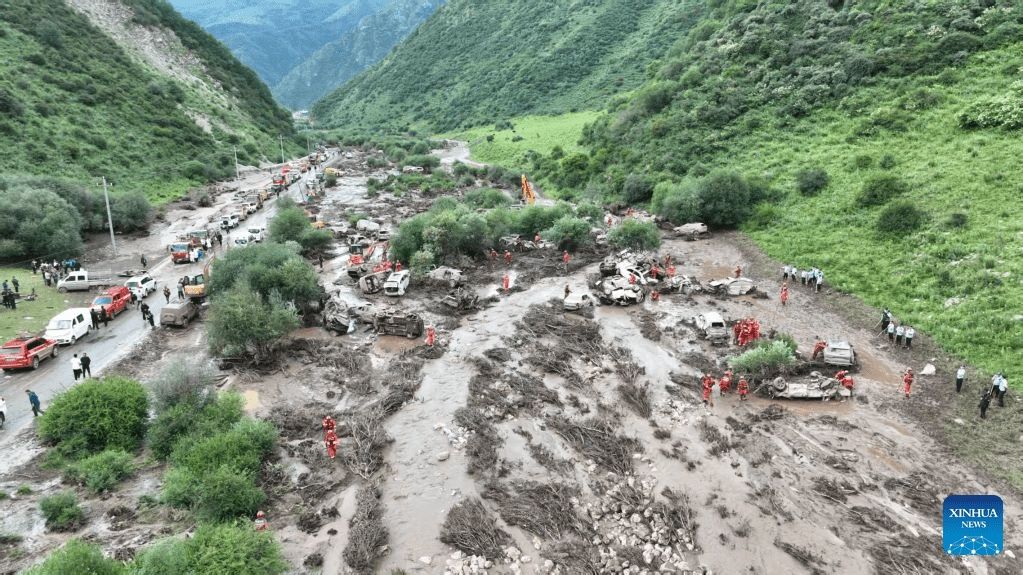
A devastating flash flood swept through a tourist destination in northwest China's Gansu Province on Sunday afternoon, claiming at least ten lives and leaving 23 others injured. The disaster struck the scenic area in Weiyuan County within Dingxi City, where visitors had been camping when the sudden deluge overwhelmed the region. Emergency responders from local public security and fire-and-rescue units mobilized search-and-rescue operations immediately after the incident, working through the evening to locate survivors and assist the wounded in what became one of the most serious incidents during an exceptionally active typhoon season.
The tragedy unfolded as Typhoon Noul made landfall near Huidong county in Guangdong Province at approximately 3:50 a.m. on Sunday morning, marking the 12th tropical cyclone of the year and the third major typhoon to strike China within the month. The system, whose name derives from a Korean term meaning the glow of sunrise or sunset, generated formidable wind speeds and torrential precipitation as it crossed into Chinese territory. The timing and intensity of the weather system created compounding hazards across multiple regions, with meteorologists projecting that the typhoon would continue weakening as it penetrated further inland while maintaining the potential to deliver substantial rainfall.
The Gansu flooding represents just one casualty zone within a much broader disaster footprint. Authorities issued China's highest-level red alert for flash flooding, a designation spanning seven provinces and regions including Jiangxi, Hunan, Guangdong, Sichuan, Shaanxi, Gansu, and southeastern Xinjiang. The Ministry of Water Resources and the China Meteorological Administration jointly activated this emergency warning from Sunday evening through Monday evening, signalling the exceptional nature of the meteorological threat. The joint alert reflected growing confidence that the typhoon's moisture content and atmospheric dynamics would generate flash-flood conditions across geographically diverse territories, from coastal southern provinces to interior mountain regions previously thought less vulnerable.
The scale of human displacement underscores the severity of Noul's impact on populated areas. Authorities relocated more than 700,000 residents in Guangdong Province alone, representing one of the largest emergency evacuations in recent years. This massive logistical undertaking involved coordinating transportation, temporary shelter, food supplies, and medical facilities across provincial systems already straining under emergency conditions. The relocation figures illustrate how modern typhoons, even when technically classified as weakening systems, retain the capacity to displace entire urban and rural populations as a precautionary measure to prevent potential casualties.
Precipitation forecasts indicated that the most extreme rainfall would concentrate in certain zones through Tuesday, with Fujian Province and other localities potentially experiencing extremely heavy downpours that could exacerbate flooding conditions in river valleys and mountain terrain. Authorities specifically cautioned local governments to monitor flood-prone environments including mountain regions, river valleys, construction sites, and bridge approaches—locations historically vulnerable to flash-flood propagation and structural collapse. The warning reflected hard-learned lessons from previous typhoon seasons when secondary flooding disasters claimed lives in unexpected locations as water accumulated in topographically constrained areas.
Hong Kong, situated adjacent to the landfall zone, experienced the storm's outer bands and sustained southwesterly gale-force winds throughout Sunday. The offshore territory passed through approximately 80 kilometres of the typhoon's core system, though the Observatory noted that Noul had begun measurable weakening by the time maximum impacts reached the financial centre. All typhoon warning signals were cancelled by Sunday evening as the system's local intensity diminished, though not before forcing the temporary suspension of Hong Kong International Airport operations for more than twelve hours. Airport authorities initiated gradual flight resumals during Sunday afternoon as wind conditions moderated, though airlines continued managing disruptions from the extended closure.
The convergence of the Gansu flash flood and the broader typhoon impacts reflects the interconnected nature of extreme weather phenomena in East Asia. The same atmospheric circulation pattern that generated sufficient moisture transport to create dangerous conditions across southern coastal provinces simultaneously produced localized convective systems capable of dropping torrential rainfall over landlocked northwestern territories. This seemingly paradoxical situation—a weakening typhoon still spawning deadly floods in remote inland regions—demonstrates how tropical cyclones retain destructive potential even as their formal classification and measured wind speeds suggest diminishing threat levels. For regional meteorologists and emergency managers, the pattern underscores the necessity of maintaining high alert statuses across extensive geographic areas when major typhoons approach population centres.
The incident carries particular implications for Southeast Asian nations that frequently experience similar typhoon impacts and face analogous challenges in coordinating cross-provincial emergency responses. Malaysia, lying further south and typically spared the most intense direct typhoon strikes, nonetheless experiences monsoon rains and flash-flood hazards that mirror the mechanisms evident in the Gansu tragedy. The scale of China's emergency response and the speed of casualties accumulation in the Gansu incident provide instructive lessons regarding the unpredictability of flash-flood generation and the vulnerability of concentrated tourist populations in scenic but topographically challenging terrain. Regional governments monitoring the situation will note both the effectiveness of coordinated national emergency protocols and the persistent difficulty in preventing casualties when sudden weather events overwhelm localized areas where large numbers of people congregate.

