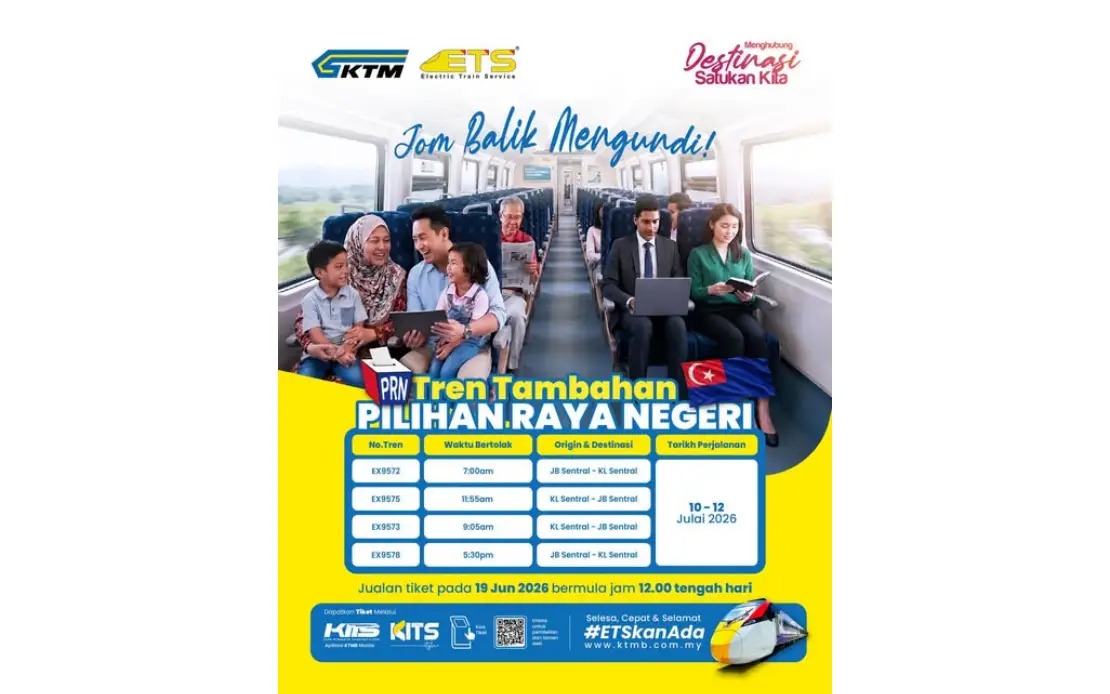
Keretapi Tanah Melayu Berhad has rolled out supplementary ETS train services on southbound routes to accommodate the anticipated surge in passenger traffic during the Johor state election period. The state's election commission scheduled polling for July 11 following the dissolution of the Johor State Legislative Assembly in early June, prompting KTMB to prepare enhanced rail capacity for voters travelling back to their constituencies.
The additional train services will operate across a three-day window spanning July 10 through July 12, a timeframe designed to capture both pre-election travel and post-polling movement. This scheduling reflects practical recognition that many registered voters living and working outside Johor will need transport options on the eve of polling day and potentially in the immediate aftermath. For a state election in Malaysia's second-largest economy by GDP and third-largest population centre, such logistical planning ensures accessibility to the democratic process across dispersed voter communities.
Ticket purchasing commenced at noon on June 19, with KTMB offering multiple convenient channels for transactions. The state-owned operator activated sales through its proprietary KTMB Mobile app and the KITS Style platform, both smartphone-based reservation systems that allow real-time booking and digital ticketing. Passengers preferring traditional methods retain access to the company's official website at online.ktmb.com.my, whilst those without digital literacy or requiring assistance can visit physical KTMB ticket kiosks at railway stations throughout the network.
The multi-channel ticketing approach reflects evolving passenger expectations in Malaysia, where digital adoption among rail users has accelerated substantially. By offering both app-based and website reservations alongside counter service, KTMB aims to eliminate barriers to ticket acquisition across demographic groups. For rural voters or those less digitally engaged, the retention of staffed kiosks preserves accessibility whilst simultaneously reducing bottlenecks that cash-based queues might create at popular departure times.
Johor's electoral significance extends beyond state-level governance. As the southernmost peninsular state and home to major economic zones including the Iskandar Malaysia development corridor, Johor's political direction influences federal coalition dynamics and regional economic policy. The state's approximately 2.9 million population makes it a substantial electoral prize, and facilitating voter participation through improved transport infrastructure underscores the electoral commission's commitment to inclusive democratic participation.
Rail transport carries particular importance for Johor voters dispersed across the Klang Valley, Selangor, and as far as Kuala Lumpur, where many southern natives reside for employment in the federal capital's commercial and civil service sectors. The ETS network's relative affordability compared to road transport, combined with travel time advantages on the Kuala Lumpur-Singapore corridor, positions rail as an attractive option for cost-conscious voters managing last-minute travel arrangements. Journey times from Kuala Lumpur to Johor Bahru via ETS typically range between five and seven hours depending on the service tier, making overnight or early-morning departures practical for polling day participation.
KTMB's public messaging around the additional services, framed through the rallying cry "Let's head home to vote," reflects official commitment to reducing friction in the voting process. State and federal authorities recognise that transport accessibility directly correlates with voter turnout, particularly among younger and more mobile populations. By proactively communicating service enhancements and simplifying booking procedures, the rail operator removes logistical excuses that might otherwise deter time-constrained voters from making the journey.
The election itself follows prolonged political instability in Johor. The dissolution of the State Legislative Assembly on June 1 terminated the preceding legislature ahead of schedule, reflecting shifting coalition configurations in the state. This context lends heightened stakes to the July 11 polling, as the electoral outcome will reshape Johor's political trajectory and potentially influence broader federal power dynamics. Enhanced transport connectivity acknowledges the state's significance and the commission's recognition that maximising voter accessibility serves democratic legitimacy.
For Southeast Asian observers, Malaysia's experience demonstrates how state electoral bodies coordinate with transport providers to facilitate participation. Unlike some regional democracies where voter mobility constraints artificially depress turnout, Malaysia's approach integrates infrastructure planning into electoral administration. This coordination extends beyond KTMB to encompass public road transport operators and Rapid KL systems in Kuala Lumpur, creating an integrated transport response to periodic electoral demands.
The timing and scale of KTMB's service expansion also reflects institutional learning from previous elections. Rail operators have accumulated data on passenger flows during previous state and federal elections, enabling more precise capacity planning and service scheduling. By announcing enhancements well in advance and opening ticket sales immediately, KTMB allows travellers time for planning whilst preventing catastrophic last-minute congestion that might create transport bottlenecks or service breakdowns.
For Malaysian businesses with operations spanning multiple states, the election-related service enhancements present both operational challenges and predictability. Companies aware of likely transport disruptions and staff absences can schedule accordingly, whilst the confirmation of dedicated services reduces uncertainty. This transparency supports business continuity planning in a region where internal labour mobility remains substantial.
Beyond the immediate election context, KTMB's willingness to flex capacity for democratic purposes signals ongoing institutional support for voter participation infrastructure. Whether these enhanced services become permanent fixtures or return to baseline levels post-election remains to be seen, though temporary augmentation represents the current approach. As Malaysia continues navigating multi-ethnic coalition politics and state-level federalism complexities, the practical details of election administration—including transport access—sustain the institutional foundations upon which democratic participation rests.