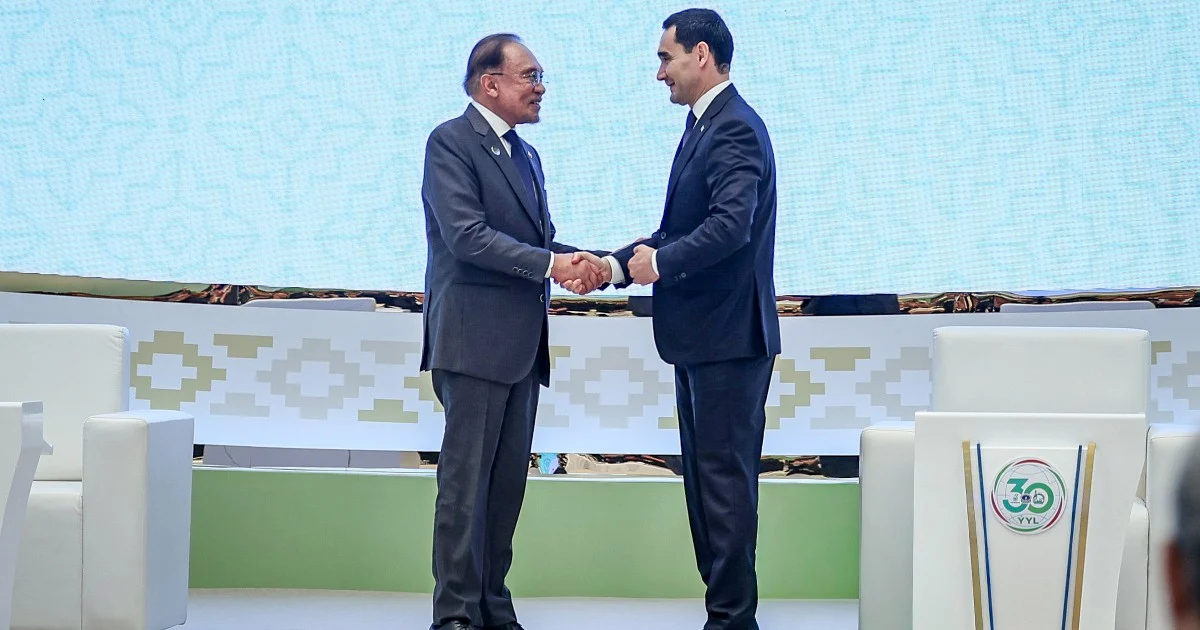
Malaysia and Turkmenistan have pledged to strengthen their bilateral relationship across multiple sectors, with particular emphasis on energy collaboration, following Prime Minister Datuk Seri Anwar Ibrahim's recent official visit. The two nations have established a framework for deepening ties that extends well beyond traditional hydrocarbon commerce, encompassing trade, investment, transportation infrastructure, educational exchanges, and technological innovation.
The visit represents a strategic effort by Malaysia to diversify and expand its international partnerships, particularly within Central Asia where economic opportunities remain largely underdeveloped for Southeast Asian nations. Turkmenistan, with its substantial natural gas reserves and geographic position linking Asia to Europe, presents significant potential for Malaysian businesses seeking to extend their regional footprint and explore new markets. The agreements reached during the prime minister's engagement signals willingness from both governments to move beyond diplomatic courtesy into substantive commercial collaboration.
Energy cooperation stands as the cornerstone of the bilateral understanding, reflecting Malaysia's continued need for diverse energy sources and stable supply agreements. Turkmenistan possesses substantial natural gas reserves, ranked among the world's largest, making it an attractive partner for Malaysia as the country navigates energy transition challenges and seeks long-term supply security. For Turkmenistan, access to Malaysian expertise in liquefied natural gas production and export infrastructure—built through decades of Petronas operations—offers valuable technical knowledge and market connectivity that could enhance its global energy positioning.
Beyond the energy sector, the two nations have identified trade and investment as critical pillars for cooperation. Malaysian companies operating across manufacturing, palm oil processing, and financial services could find receptive markets in Turkmenistan and throughout Central Asia, regions where Southeast Asian business presence remains comparatively limited. Conversely, Turkmenistan's companies may gain exposure to Malaysian expertise in sectors ranging from logistics to digital innovation, fostering a balanced exchange that benefits entrepreneurs on both sides.
Transportation cooperation carries particular significance given geographic and infrastructural considerations. Strengthening connections through air, sea, and potentially rail corridors could facilitate more efficient trade flows and reduce transaction costs for businesses operating in both regions. Malaysia's well-developed ports and strategic location on global shipping routes position it as a natural hub for Turkmenistan's goods destined for Southeast Asian markets, while Central Asian corridors offer Malaysian companies access to larger Eurasian trading networks.
Educational initiatives outlined in the agreement reflect longer-term strategic thinking about building enduring ties. Student exchange programmes, institutional partnerships, and knowledge-sharing arrangements create generational bonds that typically outlast political cycles and economic fluctuations. Malaysian universities and vocational institutions could attract Turkmen students, while simultaneously offering opportunities for Malaysian academics and professionals to engage with Central Asian expertise in fields ranging from petroleum geology to historical preservation.
Technological cooperation addresses emerging economic priorities for both nations. Malaysia's established information technology sector, digital innovation ecosystem, and experience with e-commerce and fintech development could provide valuable models for Turkmenistan's digital transformation agenda. Conversely, Turkmenistan's engineering capabilities and experience in large-scale infrastructure projects may offer insights relevant to Malaysian industries pursuing technological advancement in industrial automation and construction innovation.
The timing of Prime Minister Datuk Seri Anwar Ibrahim's visit reflects broader regional geopolitical considerations. Malaysia has increasingly emphasised ASEAN centrality while simultaneously pursuing strategic partnerships beyond Southeast Asia. Central Asia remains geographically distant yet economically accessible, representing untapped potential for diversified growth. By engaging Turkmenistan directly at the highest political level, Malaysia signals serious intent to Malaysian businesses considering expansion into the region, effectively reducing perceived barriers to entry.
For Malaysian investors and traders, the governmental agreement provides important political cover and bureaucratic facilitation. Business-to-business relationships function more smoothly when supported by bilateral frameworks, reducing uncertainties and clarifying expectations. Trade missions, investment forums, and regulatory harmonisation discussions typically follow high-level diplomatic visits, creating practical pathways for commercial engagement that might otherwise face considerable friction.
Turkmenistan's perspective similarly reflects economic diversification imperatives. As a nation heavily dependent on energy exports, developing relationships with economically dynamic Asian partners provides alternatives to traditional Russian and Chinese trading relationships. Malaysia's position as a developed economy with significant Muslim population presence creates natural cultural and religious resonance, potentially facilitating smoother business negotiations and longer-term partnership sustainability.
The broader implications extend to regional geopolitics and supply chain resilience. As global commerce increasingly prioritises supply chain diversification and reduced dependency on single-source suppliers, new partnerships between Malaysia and Central Asian nations strengthen alternative routes and sources. For multinational corporations operating in Malaysia and seeking broader Asian network expansion, access to Turkmenistan through enhanced bilateral frameworks reduces operational complexity and opens new value chain configurations.
Moving forward, the practical implementation of these agreements will determine their lasting significance. Establishing joint commissions, facilitating visa procedures, eliminating tariff barriers, and organising regular high-level consultations will translate political goodwill into measurable commercial outcomes. Malaysian and Turkmen business associations should expect increased government support for trade delegations, sector-specific investment missions, and facilitated networking opportunities in coming months.
The Malaysia-Turkmenistan partnership ultimately represents rational economic calculation dressed in diplomatic language. Both nations seek growth through diversified international engagement rather than reliance on traditional relationships. By moving decisively toward deeper cooperation across energy, trade, investment, transport, education and technology, Malaysia and Turkmenistan position themselves to benefit from emerging opportunities in an increasingly multipolar global economy where middle powers must actively create, rather than passively inherit, competitive advantage.