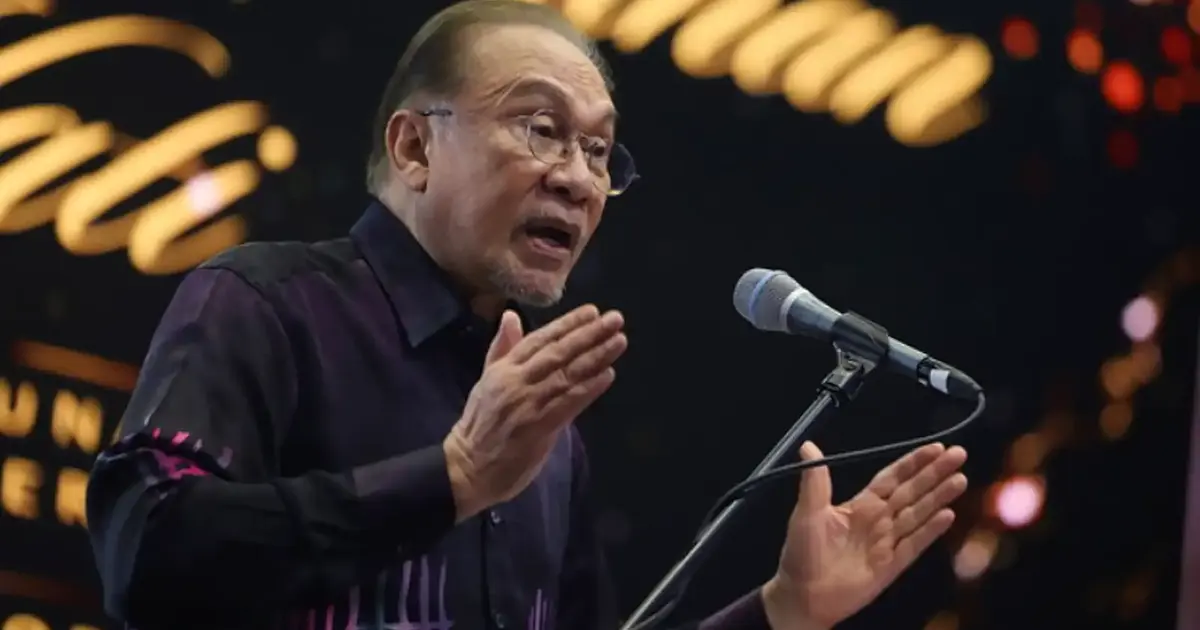
Prime Minister Anwar Ibrahim has appealed to Malaysians to move beyond inflammatory rhetoric propagated by a select group of political figures, positioning the country's multicultural fabric as its defining competitive advantage. In remarks that reflect growing concerns about polarising discourse within the political landscape, Anwar underscored the importance of transcending sectarian divisions as the nation navigates complex governance challenges and international engagement.
The prime minister's statement arrives amid a period of heightened political tension, where certain segments of Malaysia's leadership have increasingly weaponised identity politics to mobilise their respective constituencies. By framing ethnic and religious diversity as a source of national strength rather than contention, Anwar sought to counter narratives that characterise Malaysia's pluralistic society as inherently fractious or unstable.
Malaysia's multiethnic composition—encompassing Malays, Chinese, Indians, and numerous indigenous communities—has historically been presented by the government as a distinctive asset that distinguishes the country within the region. This framing becomes particularly significant in the context of Singapore and other Southeast Asian neighbours that have navigated their own trajectories regarding ethnicity and national identity. Anwar's invocation of diversity as strength attempts to reclaim this narrative from those who deploy exclusionary rhetoric.
The timing of the prime minister's comments reflects broader domestic anxieties. Recent years have witnessed intensifying contestation over constitutional provisions relating to Malay-Muslim primacy, the role of Islam in governance, and resource distribution between communities. Rather than engaging in tit-for-tat sectarian disputes, Anwar appears to be advocating for a return to a unifying national vision that transcends such divisions.
Certainly, Malaysia's track record on interethnic relations is mixed. While the country has largely avoided the communal violence that has plagued some neighbours, periodic tensions—often ignited by incendiary political messaging—continue to surface. The 1969 riots remain a cautionary historical reference point, and contemporary political operators remain acutely aware of the fragility that can underlie apparent stability. Anwar's appeal to rise above divisive rhetoric thus carries implicit warnings about the consequences of unchecked polarisation.
The prime minister's emphasis on institutional and societal resilience also serves a strategic purpose within Malaysia's broader regional context. As the country seeks to position itself as a stable, inclusive democracy in Southeast Asia, external perceptions matter considerably. International investors, diplomatic partners, and civil society observers monitor Malaysian political discourse closely, and persistent hate speech or communal tension could undermine the country's appeal as an investment destination and diplomatic player.
Anwar's call to transcend sectarian divisions also reflects the practical necessities of governing a heterogeneous nation. Cabinet decisions, parliamentary legislation, and bureaucratic implementation require at least functional cooperation across ethnic and religious lines. When political leaders systematically stoke communal animosity, they compromise these governmental processes and degrade institutional effectiveness. The prime minister's appeal thus carries implicit reminders about the instrumentality of political moderation.
Yet the challenge facing Anwar extends beyond rhetorical appeals. Malaysian politics has become increasingly fragmented, with the rise of ethno-religious parties and movements that explicitly mobilise along sectarian lines. Some political organisations have built their entire platforms around identity-based grievances and zero-sum competition for communal interests. For Anwar's calls for unity to gain traction, they must be paired with substantive policy measures that demonstrate that inclusive governance produces tangible benefits for all communities.
The prime minister's formulation of diversity as strength also requires careful articulation. In Malaysian public discourse, such statements can be misinterpreted as either an assertion of Malay-Muslim dominance or, conversely, as a dilution of constitutionally recognised communal rights. Anwar must navigate these conceptual landmines, articulating an inclusive vision without appearing to surrender on issues that command deep emotional and constitutional significance for various communities.
Looking forward, the effectiveness of Anwar's appeal depends heavily on whether other political figures—particularly those within his own coalition and within the Malay-Muslim community—amplify this message. If prominent leaders from dominant communities fail to reinforce calls for transcending hate speech, such appeals risk becoming dismissed as mere political theatre. Conversely, visible commitment from multiple quarters of the political spectrum could create space for broader societal conversations about the costs of polarisation.
Furthermore, addressing hate speech and divisive rhetoric requires mechanisms beyond exhortation. Enforcement of existing laws against incitement, transparent investigation of complaints, and clear consequences for political figures who transgress boundaries all contribute to establishing norms. Anwar's emphasis on the strength of diversity must therefore be complemented by institutional measures that make such principles operational.
Setting aside sectarian divisions remains fundamentally critical for Malaysia's future trajectory. As the nation confronts economic restructuring, climate challenges, and technological disruption, these existential issues demand political energy and resources. Diverting attention toward communal conflict diverts focus from pressing policy priorities that affect all Malaysians. By calling for transcendence of hate speech, Anwar is simultaneously advocating for a return to issue-based rather than identity-based political contestation.
Ultimately, the prime minister's message represents both an aspiration and an implicit diagnosis of Malaysia's current political condition. The diagnosis suggests that hate speech and divisive rhetoric have become sufficiently pervasive to warrant direct prime ministerial intervention. The aspiration envisages a Malaysia where ethnic and religious diversity is celebrated as foundational strength rather than exploited as a point of fracture. Whether this vision can be realised depends on sustained commitment from political leaders across the spectrum and genuine institutional reform to support more inclusive governance.