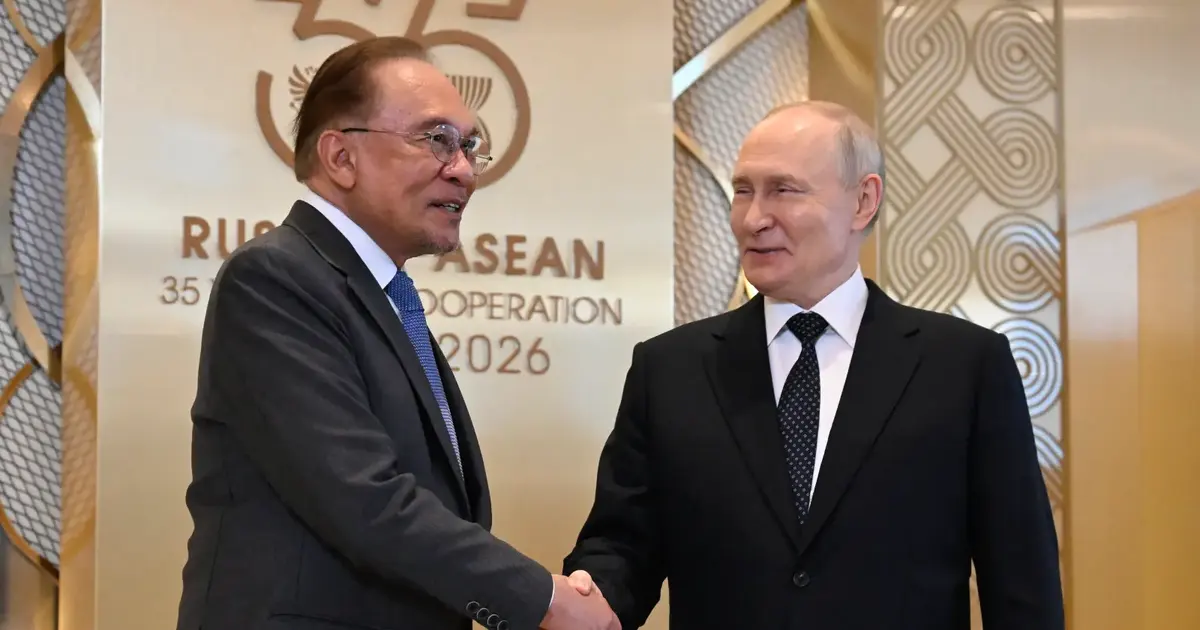
Prime Minister Anwar Ibrahim announced that Russia has provided assurances of continuous oil and gas supplies extending across the next two decades, reinforcing energy security arrangements between Kuala Lumpur and Moscow. The commitment represents a significant vote of confidence in bilateral relations at a time when global energy markets remain volatile and supply chains face persistent disruption.
The undertaking, made at the highest political level, carries substantial implications for Malaysia's energy independence and long-term economic planning. With domestic hydrocarbon reserves gradually depleting, securing reliable external sources through formalised agreements reduces exposure to market price volatility and geopolitical uncertainties. A 20-year horizon provides Malaysian policymakers and energy companies the predictability needed for infrastructure investment and capacity planning.
Russia's energy sector, despite international sanctions and global pressure, remains one of the world's largest exporters of crude oil and natural gas. For Malaysia, which sits at the intersection of major Asian energy markets, maintaining diversified supply sources from established producers offers strategic flexibility. The arrangement suggests both nations view energy cooperation as foundational to their broader economic partnership, transcending temporary political tensions affecting other trading relationships.
Simultaneously, Anwar outlined complementary objectives during a concurrent visit to Turkmenistan, positioning Southeast Asia's largest economy to leverage Central Asian markets and transit corridors. Turkmenistan itself ranks among the world's significant natural gas exporters, and Malaysia's engagement with the country opens pathways for enhanced commercial cooperation beyond energy purchasing.
The Prime Minister's focus on expanding Malaysian exports to China, Japan and South Korea through Turkmenistan represents strategic thinking about regional value chains. Rather than simply importing raw materials, Malaysia seeks to position itself as a conduit for manufactured goods and services flowing toward Central Asian markets. Such positioning could enhance margins for Malaysian companies and create employment across logistics, trading, and professional services sectors.
China's role as a primary destination for Malaysian exports reflects both the historical depth of bilateral trade and China's enormous consumer base. Japan and South Korea represent technologically sophisticated markets where Malaysian products—particularly those incorporating renewable energy technologies, semiconductors, and advanced manufacturing—command premium valuations. Establishing firmer commercial bridges through Central Asian intermediaries could unlock incremental demand.
Geopolitically, the dual engagement with Russia and Turkmenistan signals Malaysia's commitment to multi-vector foreign policy. Rather than tilting exclusively toward Western alignments, Kuala Lumpur cultivates relationships across the Eurasian space. This approach reflects both pragmatism—recognising that energy security demands engagement with major suppliers—and an understanding that Southeast Asia's prosperity depends on maintaining constructive ties across ideological divides.
Energy security remains paramount for Malaysia's manufacturing competitiveness and household welfare. Industrial sectors ranging from petrochemicals to fertiliser production depend on stable, affordable hydrocarbon inputs. Consumer electricity prices, in turn, influence purchasing power for ordinary Malaysians. The long-term supply commitment therefore carries implications extending far beyond bilateral relations into the fabric of daily economic life.
Turkmenistan's geographic location along historic Silk Road corridors and its emerging role in connecting Central Asia with Southeast Asian markets warrant closer Malaysian attention. The country has invested substantially in transportation infrastructure and port development, creating opportunities for Malaysian traders and logistics firms. Anwar's visit signals recognition of these evolving commercial possibilities.
The broader context reveals Malaysia navigating complex global energy transitions. While pursuing fossil fuel security with Russia and Turkmenistan, Malaysia simultaneously invests in renewable energy capacity and positions itself as a green technology hub. This dual approach—securing conventional energy while building clean alternatives—reflects pragmatism about realistic energy transition timelines for developing economies.
For Southeast Asia more broadly, Malaysia's energy diplomacy carries spillover significance. The region's growing electricity demand and industrial expansion require diverse, stable supply sources. Successful Malaysian negotiations with major producers establish templates other regional economies might emulate, potentially strengthening collective energy security across ASEAN.
The 20-year timeframe itself merits consideration. Extending commitments two decades ahead requires confidence in political stability and relationship continuity. The fact that both Russia and Malaysia accepted such extended terms suggests underlying strategic commitment transcending immediate political fluctuations. This long-term perspective contrasts with short-term transactional approaches characterising some international energy relationships.
Moving forward, Malaysia's challenge involves translating these supply assurances into concrete benefits for consumers and businesses. Implementation mechanisms, pricing formulas, and dispute resolution procedures will determine whether diplomatic pledges translate into reliable, cost-effective energy flows. Equally important is ensuring that energy security gains simultaneously advance Malaysia's climate commitments and support the transition toward more sustainable economic models.