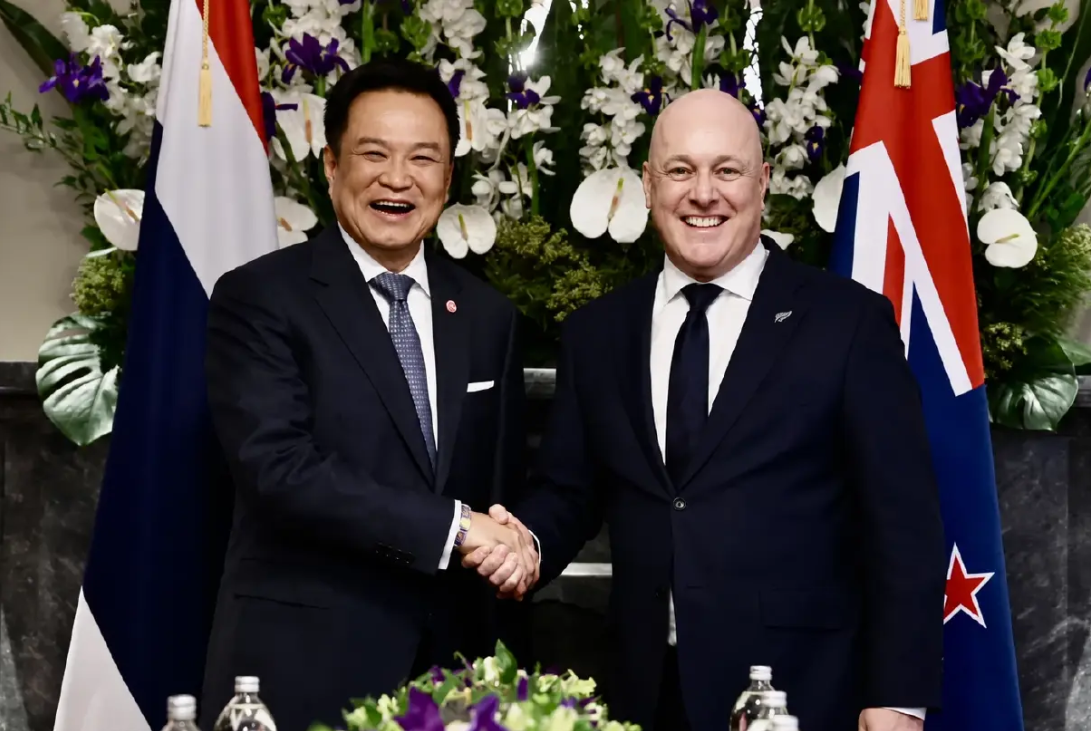
Thailand and New Zealand have formally upgraded their diplomatic relationship to a strategic partnership, with both nations committing to ambitious economic expansion and enhanced connectivity. Prime Ministers Anutin Charnvirakul and Christopher Luxon signed the Joint Declaration on the Strategic Partnership during bilateral talks in Wellington on Friday, marking a significant milestone in their countries' 70-year diplomatic history. The elevation represents a substantial shift in how the two nations intend to cooperate across multiple domains, moving beyond traditional diplomatic courtesy to structured frameworks addressing contemporary regional challenges and opportunities.
The centrepiece of this partnership is an audacious economic target: tripling bilateral trade to US$7.5 billion, equivalent to approximately 246 billion baht, by 2045. This ambitious figure reflects confidence in both economies' growth trajectories and suggests policymakers view the relationship as having untapped commercial potential. Currently, trade volumes fall far below this target, indicating substantial headroom for expansion in traditional sectors such as agriculture, food processing, and manufactured goods where both nations possess competitive advantages. The timeline extending to 2045 signals a long-term commitment transcending electoral cycles and political transitions, providing stability for businesses seeking to develop sustained commercial relationships.
Connectivity emerges as a cornerstone of the partnership's implementation strategy. Thai Airways International is preparing to restore direct services between Bangkok and Auckland commencing March 2027, a development carrying symbolic and practical significance. The airline previously operated this route, and its reinstatement addresses a critical gap in Southeast Asia-Oceania connectivity that has constrained tourism, educational exchanges, and business travel. Anutin indicated willingness to accelerate this timeline if operationally feasible, suggesting both governments recognise the immediate benefits of direct air connectivity. For Malaysian readers, this development highlights how bilateral aviation agreements shape regional travel patterns and economic integration, potentially creating indirect benefits through enhanced tourism flows and business confidence across Southeast Asia.
The four cooperation agreements signed alongside the joint declaration reveal the partnership's operational specificity. Cultural cooperation frameworks address people-to-people connectivity, recognising that sustainable diplomatic relationships depend on robust societal linkages. A memorandum between Thailand's Office of the Civil Service Commission and Education New Zealand signals educational cooperation, potentially opening pathways for student exchanges and administrative knowledge-sharing. Police cooperation agreements between the Royal Thai Police and New Zealand Police address transnational crime, online scams, and human trafficking—issues resonating across Southeast Asia where criminal networks operate across multiple jurisdictions. The private-sector agreement between Chata Instruments and Aeroqual Limited demonstrates that strategic partnerships must extend beyond government channels to cultivate genuine commercial relationships.
The Thailand-New Zealand Joint Plan of Action 2026-2030 organises cooperation into four pillars addressing contemporary geopolitical priorities. Political and security cooperation focuses on strengthening law-enforcement coordination and information-sharing mechanisms, reflecting concerns about transnational threats that transcend borders. This emphasis parallels Malaysian and regional security frameworks, where cooperation with distant but technologically advanced partners like New Zealand enhances domestic capabilities against sophisticated criminal operations. The second pillar explicitly addresses economic dimensions including innovation, food security, energy security, sustainable agriculture, and environmental conservation—priorities increasingly central to ASEAN member states confronting climate change and resource constraints.
Education and cultural cooperation form the third pillar, recognising that strategic partnerships require generational investment in human capital and mutual understanding. Skills development and capacity-building initiatives suggest both nations view technical knowledge transfer as a partnership component, potentially enabling Thai institutions to access New Zealand expertise in areas ranging from agricultural science to digital innovation. For Malaysia, observing successful educational cooperation frameworks between Thailand and New Zealand provides models for similar arrangements with non-traditional partners. The fourth pillar emphasises regional and multilateral engagement, specifically mentioning Mekong cooperation frameworks, ASEAN-led mechanisms, and APEC participation. This language signals that Thailand views New Zealand not as a bilateral relationship in isolation but as a gateway to broader Indo-Pacific integration.
Australia and New Zealand represent increasingly significant players in ASEAN affairs, and Thailand's strategic partnership elevation reflects recognition of this reality. New Zealand's geographic position, economic stability, and technological capabilities position it as a valuable partner for Southeast Asian nations navigating great-power competition and economic diversification. The partnership signals Thailand's willingness to deepen engagement beyond traditional ASEAN frameworks, potentially setting precedent for other member states seeking enhanced relationships with developed democracies possessing complementary economic structures. This geopolitical dimension carries implications for Malaysia's own strategic positioning, where balanced engagement with multiple international partners has become essential policy.
The reference to Anutin seeking New Zealand backing for Thailand's Organisation for Economic Co-operation and Development (OECD) membership application underscores how bilateral partnerships serve instrumental diplomatic purposes. OECD membership would elevate Thailand's economic standing and potentially attract investment, though membership requires meeting rigorous governance and regulatory standards. New Zealand's support carries weight given its own OECD status, though the pathway to Thai membership remains complex and contested. This element demonstrates how strategic partnerships extend beyond bilateral benefits to encompass each nation's broader international positioning and institutional integration.
Marking the 70th anniversary of Thai-New Zealand diplomatic relations during this partnership elevation provides historical context for understanding the relationship's durability. Seven decades of continuous relations through multiple geopolitical eras—from Cold War alignment to contemporary multipolar dynamics—suggest institutional mechanisms and reciprocal interests have maintained engagement despite geographic distance and limited overlapping security concerns. The decision to formalise enhanced cooperation during this anniversary year reflects deliberate timing, associating new initiatives with historical continuity rather than presenting them as opportunistic departures. This approach appeals to both electorates by grounding contemporary partnership within established diplomatic traditions.
For Southeast Asian nations including Malaysia, Thailand's strategic partnership with New Zealand exemplifies how middle-power states can cultivate diversified international relationships offsetting dependence on traditional great-power alignments. New Zealand's explicit support for rules-based international order and multilateral systems aligns with ASEAN's foundational preferences for institutional approaches to regional management. The partnership's emphasis on economic expansion, educational cooperation, and environmental sustainability reflects shared regional priorities despite geographic separation. Thai Airways' resurrection of direct flights will facilitate the practical connectivity underlying any strategic partnership, transforming diplomatic agreements into tangible experiences for businesspeople, students, and tourists moving between the two nations.
The success of this partnership hinges on implementation capacity and sustained political commitment beyond ceremonial occasions. Both governments have established joint planning mechanisms covering 2026-2030, providing structured accountability frameworks. However, translating tripled trade targets into reality requires addressing regulatory harmonisation, investment protection frameworks, and logistics infrastructure improvements. The emphasis on innovation and green economy cooperation suggests both nations recognise that traditional resource-based trade has limited growth potential, necessitating movement toward knowledge-intensive sectors. For Malaysia and other ASEAN economies observing this partnership's development, the institutional architecture and sectoral priorities offer lessons applicable to strengthening their own international economic relationships in an increasingly competitive global environment.

