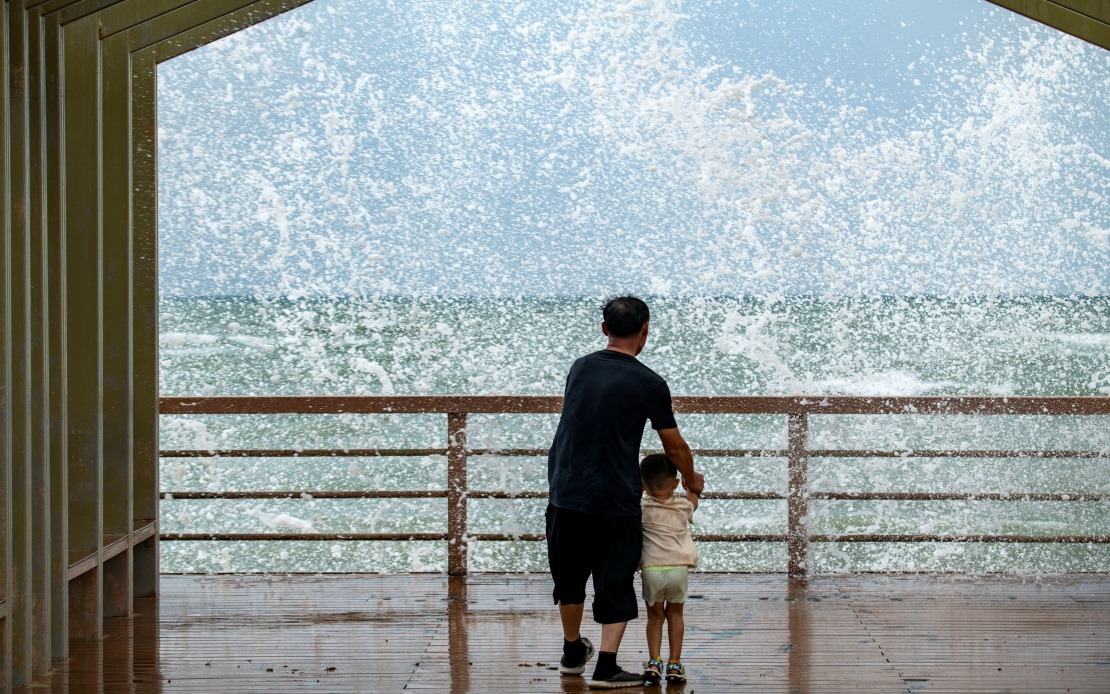
Typhoon Maysak arrived in Hainan Province as the region's most disruptive weather system so far this year, making landfall Friday evening near Yelin Township in Lingshui Li Autonomous County with sustained winds reaching 23 metres per second. The 10th typhoon to develop in the Western Pacific basin this season created immediate havoc across one of China's most strategically important coastal provinces, where tourism, shipping and trade corridors converge. Local meteorological authorities confirmed the precise landing coordinates and wind speeds as the system crossed the province's southeastern shores around 6.20 pm local time.
The impact on transportation infrastructure was swift and comprehensive. China's railway system completely halted all services connecting to and departing from Hainan for both Friday and Saturday, trapping travellers and disrupting supply chains that rely on the island's crucial links to the mainland. Sanya Phoenix International Airport, serving one of Asia's premier tourism destinations, ceased accepting and departing flights from 5 pm Friday onwards, effectively closing the airfield during the typhoon's passage. The Qiongzhou Strait, which separates Hainan from Guangdong Province and carries significant volumes of commercial and passenger ferry traffic, closed to all vessel operations from 2 am Friday, with authorities indicating disruption would likely persist for one to two days pending weather improvement.
The broader economic implications extend throughout the region. Hainan functions as a crucial logistics hub and free-trade zone for southern China, meaning a multi-day transport shutdown ripples through supply chains across Southeast Asia and beyond. Businesses dependent on time-sensitive shipments face immediate disruptions, while the tourism sector confronts cancellations during what would typically be peak summer travel season. The ferry closure particularly affects commercial operations, as the Qiongzhou Strait represents one of the region's primary cross-strait transport corridors.
Civil authorities prioritised public safety through targeted closures of educational facilities. Schools and child-care centres in Sanya and Ledong Li Autonomous County shut down, prioritising student protection and parental peace of mind during a natural disaster. These closures extended beyond the storm's actual arrival, reflecting the uncertainty inherent in typhoon forecasting despite modern meteorological advances. Parents across these areas faced sudden childcare disruptions, a secondary impact of extreme weather that often receives less attention than infrastructure damage.
Meteorological projections indicated the typhoon would track northwest through central Hainan, traversing populated towns including Baoting, Wuzhishan, Baisha and Danzhou before moving offshore into the Beibu Gulf. This inland trajectory meant communities throughout the province's interior faced wind, rain and potential flooding rather than merely coastal areas. The Beibu Gulf route suggested the system would interact with Vietnam's territorial waters, potentially affecting that nation's coastal provinces as well, demonstrating how tropical cyclones recognise no political boundaries.
Hainan's vulnerability to typhoon activity reflects its geographical position within the Western Pacific typhoon belt. As an island situated southeast of mainland China, it sits directly in the pathway of systems developing across the tropical Pacific during the peak season from June through October. The province experiences repeated impacts from these storms, necessitating well-developed warning systems and evacuation protocols. Local authorities have refined emergency response procedures through decades of experience, though each major typhoon tests preparedness and occasionally exposes gaps in planning or resource allocation.
For Malaysian and broader Southeast Asian readers, Typhoon Maysak's impact on Hainan carries indirect but genuine significance. The province handles substantial regional trade, particularly goods destined for or originating from Thailand, Vietnam, Cambodia and other mainland Southeast Asian nations. Disruptions to Hainan's transport networks create bottlenecks in supply chains serving these countries. Additionally, shipping routes through the region frequently experience indirect effects from typhoons, as vessels divert around storm systems, increasing transit times and costs. Malaysian-flagged ships and cargo operators with interests in this corridor necessarily monitor typhoon development.
The designation as the year's 10th typhoon places this system within the normal seasonal pattern for the Western Pacific. Meteorological data shows considerable year-to-year variation in typhoon frequency and intensity, driven by ocean temperature anomalies, atmospheric pressure patterns and other climate factors. Some years produce significantly more tropical cyclones than others, making seasonal forecasting an evolving science. Understanding where individual storms fit within longer-term patterns helps analysts assess whether they represent normal variability or suggest evolving climate trends.
Infrastructure resilience in Hainan has improved substantially over recent decades, with newer buildings and transport systems incorporating typhoon-resistant design standards. Modern construction codes require structures to withstand specific wind speeds and rainfall intensities based on historical data. However, the challenge extends beyond standing structures to maintaining critical services during extreme weather. Providing electrical power, clean water and communications during multi-day transport shutdowns requires substantial advance planning and resource stockpiling. Communities must balance the costs of emergency preparedness against the statistical probability of direct typhoon impacts.

